




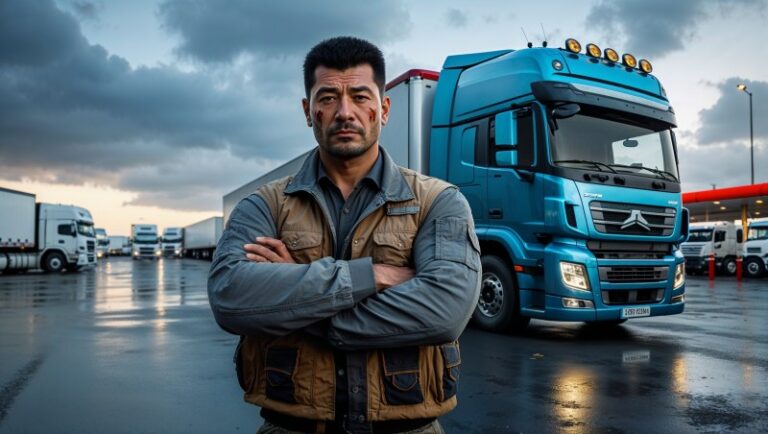
- Between February and March 2026, non-EU drivers employed by Lithuanian companies stopped trucks and cargo in three Dutch locations — Rotterdam Maasvlakte, Deurningen and Venlo — invoking the right of retention under Dutch law to claim unpaid wages ranging from three to seven months.
- The phenomenon has structural dimensions. According to the union Fnv, numerous non-EU drivers are involved in the Netherlands alone, while across Europe the figure reaches into the thousands. The most common nationalities are Uzbek, Tajik, Belarusian, Filipino and Zimbabwean.
- Dutch Minister of Social Affairs Eddy van Hijum has described the system as a “violation of human rights” and is leading a group of seven EU countries that has asked the European Commission for an urgent revision of the rules governing the posting of workers.
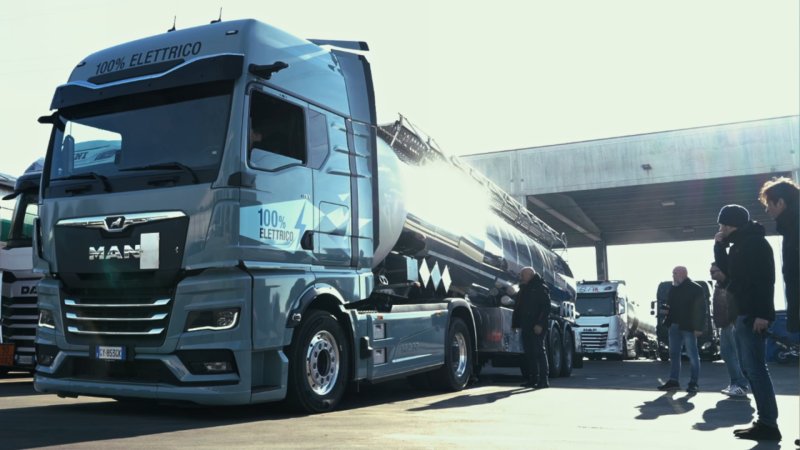
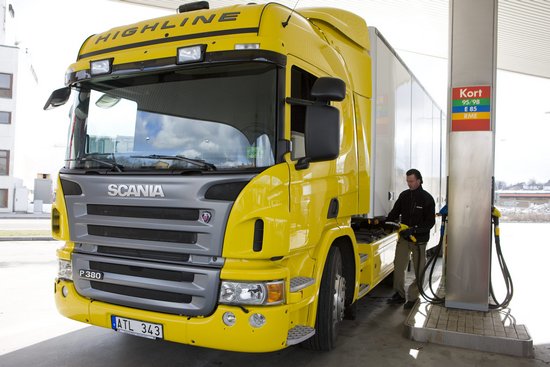
Since 13 February 2026, Abdusattor, a Tajik truck driver, has not left the cab of the truck parked in the port of Rotterdam. Not by choice: he has not received his salary for months, has no money for food or washing, and his employer — a Lithuanian company — has ignored every request. The only tool at his disposal is the “retentierecht”, the right of retention under Dutch law that allows him to block the truck and its cargo until the arrears are paid. The same legal instrument is being used by Parviz, another Tajik driver who has been stationary for more than a week at Maasvlakte Plaza: seven months without pay and two years without returning home to his family.
These are not isolated stories. Between February and March 2026, protests have multiplied in three Dutch locations — Rotterdam, Deurningen along the A1 motorway and Venlo — involving workers from Tajikistan, Uzbekistan, Belarus, the Philippines and Zimbabwe. The method is always the same: stopping the vehicle, formally invoking the retentierecht and remaining in the cab until payment is made. Dutch police recognise the legitimacy of the right and protect drivers from attempts to forcibly remove the vehicles.
Behind the protests lies a well-established system of exploitation documented by Dutch journalistic, trade union and government sources. The main companies involved are Lithuanian firms that formally employ non-EU drivers with work permits issued in Lithuania, only to post them to the Netherlands and other Western European countries, where they remain for months without ever setting foot in the country that issued the permit. The system is based on a loophole in the EU Posted Workers Directive and allows companies to pay them less than the Dutch collective labour agreement, to avoid paying overnight allowances required by law and to evade inspections.
Working conditions documented in Rotterdam, Deurningen and Venlo are severe and systematic. Drivers live in their cabs for long periods without the possibility of alternative accommodation. Working days exceed eleven hours, in breach of European driving time rules. In some cases, according to the Dutch union Fnv (Federatie Nederlandse Vakbeweging), workers have been forced to manipulate the tachograph and provide false statements to police during roadside inspections. Salaries, when paid at all, are far below Dutch contractual minimums. In cases documented in Venlo, an Uzbek driver has been recognised as a victim of human trafficking by the Arbeidsinspectie (Dutch Labour Inspectorate).
The response of Lithuanian companies to the protests has been aggressive. According to reports from Fnv and the Itf (International Transport Workers’ Federation), companies have attempted to have trucks removed by reporting them as “stolen”, remotely disabled electrical systems leaving drivers without heating, terminated contracts and threatened prison sentences in Lithuania. In Venlo, a “team” arriving from Lithuania allegedly intimidated both workers and union officials during a visit to the parking area.
The retentierecht has proved more effective than traditional legal routes precisely because it operates in real time: stopping the cargo creates immediate economic pressure on companies and final clients, forces national and international media coverage and does not require the financial resources that a legal case would entail. Under basic Dutch law, the carrier may retain the cargo only for payment relating to the ongoing transport operation; through contract — for example under the Avc general conditions — it is possible to extend the retentierecht to previous claims, substantially increasing the worker’s negotiating power.
The Fnv union has intervened on several fronts. It collects funds to provide drivers with basic necessities such as food, personal hygiene items and cash for showers and parking, offers free legal assistance, documents violations and puts pressure on the Dutch government, the European Commission and private clients. Edwin Atema, an official of Fnv Transport en Logistiek, has described the companies involved as “rogue companies” and speaks openly of “modern slavery”. Menno Janssen, a member of the Fnv leadership, describes the phenomenon as a “large-scale violation of human rights”.
Lithuania has become the reference country for this model not because of geography or service quality but because it issues work permits to non-EU citizens with considerable ease. According to Fnv, “work permits are handed out like hot cakes”. Sector research indicates that Lithuanian companies have registered thousands of heavy vehicles in other EU countries in order to circumvent the rules of the EU Mobility Package that entered into force in 2022, with Poland and Germany as the main destinations. In 2022, more than 800 Lithuanian transport and logistics companies are believed to have established entities abroad.
The Minister of Social Affairs and Employment, Eddy van Hijum, has publicly acknowledged that the self-regulation of companies and temporary employment agencies “has failed” and has pledged to “dismantle this business model”. Van Hijum describes the practices of Lithuanian, Polish and other companies as “dubious constructions” that exploit free-movement rules to create unfair competition. The Dutch government has proposed a package of measures: mandatory registration for employers hiring non-EU workers, a minimum period of three months of actual work in the country that issued the permit before workers can be posted elsewhere, alignment between the type of permit and the activity performed, and the gradual reduction of wage deductions for accommodation — currently up to 25% of the minimum wage — with elimination planned by 2030.
At the European level, in February 2025 Van Hijum submitted, on behalf of seven EU countries — the Netherlands, Germany, Belgium, Denmark, Austria, France and Sweden — a formal request to the European Commission to strengthen posting rules. The Commission has opened discussions on the matter, but the pace of European legislation makes a rapid response difficult. Resistance from Eastern European countries — which benefit economically from the system by collecting social security contributions from workers who may never realistically claim their rights — further complicates the situation.
Fnv and Itf also point the finger at final clients: supermarkets, car manufacturers and multinational logistics companies that outsource transport to low-cost Lithuanian operators without verifying working conditions within the supply chain. European rules on corporate responsibility for human rights (due diligence) require large companies to intervene when violations emerge. Drivers on strike in Venlo have written directly to the clients of transport companies to inform them of the exploitation and request action. Atema noted that the Arbeidsinspectie has already confirmed human rights violations in several cases and that clients are legally required to assume their share of responsibility.
The phenomenon, however, is not new. As early as 2018, Fnv warned that the road transport sector was “rotten to the core”, documenting systematic violations of driving hours and exploitation in car transport on behalf of major automotive manufacturers. In 2011, Dutch truck drivers protested against unfair competition from colleagues in Eastern Europe, mainly Polish and Romanian. Over time the target has shifted: no longer EU workers with recognised rights, but non-EU workers employed through the “Lithuanian channel” with permits that do not provide effective protection. In 2024 the Arbeidsinspectie discovered cases of exploitation “by chance” during non-targeted inspections, confirming that the phenomenon is far more widespread than documented.
In March 2026, protests continue to multiply in new Dutch locations and are spreading to Germany, France and Belgium. Some drivers are developing informal networks to share strategies and mutual support. Media pressure is growing: broadcasters Rtl Nieuws, EenVandaag and Nos are devoting increasing coverage to the issue, while social media campaigns using the hashtags #ModernSlavery and #TruckersRights are amplifying international visibility. Organisations such as Human Rights Watch and Amnesty International have begun monitoring the situation. The short- and medium-term outlook remains uncertain: political and media pressure may translate into concrete measures, but European timelines are long and structural resistance remains strong.
Michele Latorre