





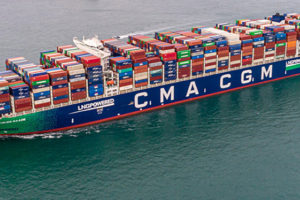

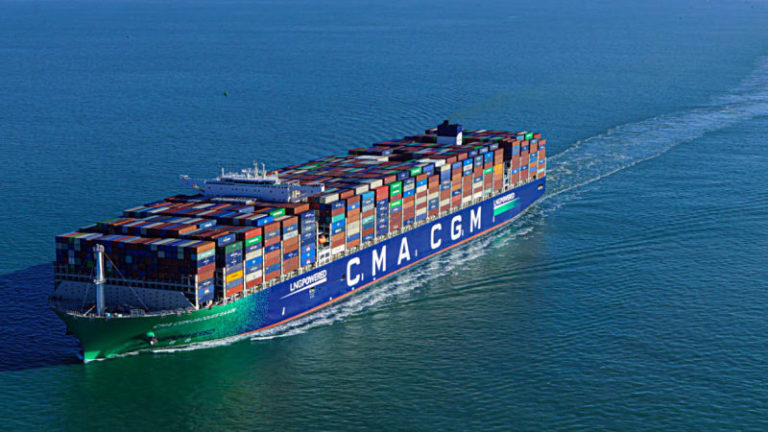
At the beginning of April 2026, the container ship Cma Cgm Kribi, operated by the French group Cma Cgm, transited the Strait of Hormuz en route to western Europe, becoming the first known case of a crossing linked to European trade since the outbreak of the conflict between Iran and the United States-Israel axis. The passage took place between 2 and 3 April along a coastal corridor authorised by Tehran, in a context where the strait is effectively almost closed. According to Bloomberg, the vessel left waters off Dubai on Thursday afternoon, keeping its AIS signal active and indicating French ownership, before being recorded off Muscat the following morning.
The transit comes against a backdrop of sharply reduced traffic. Since hostilities began on 28 February, the number of vessels making the crossing has collapsed, with only a handful of passages involving countries considered non-hostile by Tehran. A system of prior authorisations issued by Iran for coastal corridors is taking shape, while some Asian countries have already negotiated transit quotas. The Kribi’s passage fits within this selective framework, appearing more like an operational test than a structured reopening.
The Cma Cgm Kribi, a vessel of around 5,000 TEU, appeared laden according to draught data, indicating a fully operational commercial voyage. The ship, sailing under the Maltese flag but declared as French-owned, followed a route between the islands of Qeshm and Larak, maintaining full visibility of its track. Bloomberg notes that two sources with direct knowledge of the situation confirmed the transit, while AIS tracking in the area remains complex due to signal interference and manipulation. Cma Cgm is among the operators most exposed on the Asia-Europe route. The group, the world’s third-largest container carrier, suspended transits in the area at the end of February and repositioned vessels pending acceptable safety conditions. At least 14 of its ships are reportedly stranded in the Persian Gulf, unable to cross Hormuz in the weeks following the outbreak of the conflict.
The Kribi’s passage does not, however, alter the overall strategy of operators, and intermodal corridors have been activated via ports in the United Arab Emirates and Oman, linked to overland networks towards the Mediterranean and Europe. Nevertheless, this transit carries significance beyond logistics. Iran maintains tight control over the strait and is using the selective granting of passage as a negotiating lever. Clearance for a vessel clearly identified as French-owned is being interpreted as a signal towards certain European countries, in a context where relations with the United States and Israel remain confrontational. Bloomberg reports that Paris, along with other European governments, has initiated diplomatic contacts aimed at de-escalation, although no concrete results have yet emerged.
French President Emmanuel Macron stated that France will work to stabilise the situation in the strait “once the bombing has ceased”, indicating a timeline still tied to the military evolution of the conflict. Meanwhile, Iranian authorities are considering the introduction of a toll system for transit, a measure that would strengthen economic control over a key infrastructure for global oil and gas flows and could have direct repercussions on logistics costs.
Several uncertainties remain. Details of the security conditions applied to the Kribi’s passage are not known, nor are any specific protocols between the vessel and Iranian authorities. Likewise, there is no information on dedicated insurance cover or the presence of military escorts. The decision to keep the AIS signal active and transparent along the entire route is seen as a measure to reduce the risk of misidentification in a highly tense environment.
Mara Gambetta