







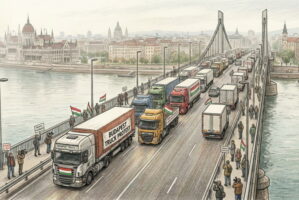
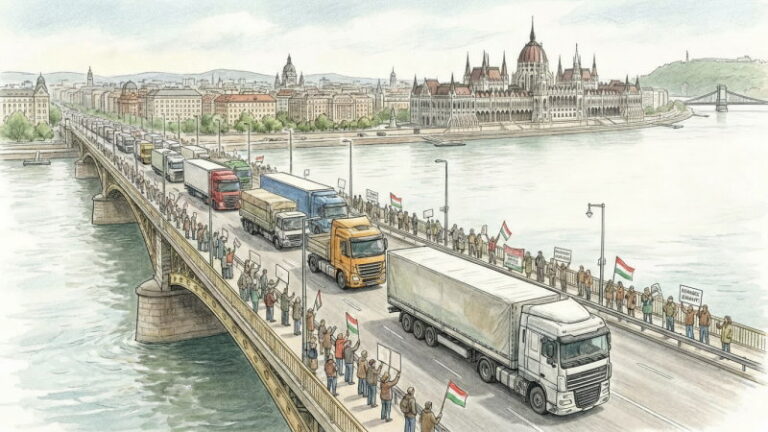
On 22 December 2025, thousands of Hungarian hauliers brought Budapest to a standstill with a demonstration unprecedented in recent years in terms of scale and impact on traffic. At the heart of the protest is the increase in road tolls decided by the government for 2026, with particularly sharp rises on main roads, which small and medium-sized transport and logistics companies consider unsustainable.
The mobilisation is the direct consequence of a decree published on 1 December 2025 in the Magyar Közlöny, the official gazette, by the Ministry of Construction and Transport, led by János Lázár. The measure provides for a 4.3% adjustment of motorway tolls, in line with inflation, but introduces increases of more than 50% on sections of the ordinary road network used by heavy traffic. According to the government, the aim is to shift lorry flows towards dual carriageways, reducing noise, accidents and environmental impact in built-up areas crossed by main roads. Trade associations, however, have denounced the lack of prior consultation and the risk of a significant competitive imbalance to the detriment of smaller operators.
On 19 December, the ministry announced an agreement with seven representative organisations in the sector, reducing the overall increase on main roads to 35%, to be implemented in two phases between January and March 2026. The agreement also includes toll calculation tools and periodic reviews of regional restrictions on heavy traffic. Despite this, a significant proportion of hauliers rejected the deal, judging it unbalanced and not representative of the needs of small and medium-sized enterprises.
The protests have focused in particular on the role of the Magyar Közúti Fuvarozók Egyesülete, the road haulage association that was among the signatories to the agreement. The association is chaired by Zsolt Barna, chief executive of Waberer’s International, one of Central Europe’s largest logistics operators. The company is 52% owned by István Tiborcz, son-in-law of Prime Minister Orbán, who acquired the majority stake in 2023. According to protest organisers, this overlap between association representation and large industrial groups influenced the outcome of the negotiations, favouring companies with extensive fleets that are better able to absorb the increases or benefit from more favourable conditions.
The protest also involved sectors linked to logistics, particularly agriculture. Mosz, the organisation representing agricultural cooperatives, which was excluded from the negotiations, has estimated an additional cost burden of more than 5 billion forints, around €12.5 million, for the agricultural supply chain. According to the association, the toll increases would be passed along the supply chain, affecting final food prices.
The demonstration on 22 December took the form of a long convoy of lorries crossing Budapest’s main arteries, from the entrance of the M3 motorway to Heroes’ Square. Organisers estimated the participation of around 2,000 heavy vehicles. Authorities allowed only some of the lorries to reach the city centre, while others followed a ring route around the capital. Queues of up to three kilometres were reported at access points, but the protest passed without incidents.
During the mobilisation, an extensive document was circulated addressing, in addition to tolls, structural issues affecting the sector, including union representation, the penalty system, payment times for transport services, competition between operators and professional recognition for drivers. The content of the demands highlights widespread discontent linked to rising operating costs, regulatory pressure and the perception of an increasingly concentrated market.
The government responded by reiterating the validity of the 19 December agreement and stressing the need to direct international traffic onto the motorway network. János Lázár ruled out any intention to increase tax revenues, arguing that in the past heavy vehicles had excessively used secondary roads to reduce transit costs. Opposition parties, by contrast, expressed support for the protesters, linking the toll increases to the broader issue of the 35-year motorway concession awarded in 2022 to the Mkif consortium, which is connected to business groups close to the government.
The concession, estimated to be worth between 15 and 17 trillion forints, or €38–43 billion, is the subject of an infringement procedure by the European Commission over alleged transparency shortcomings and a duration deemed excessive. According to independent analyses, in the early years of operation the fee paid by the state would have exceeded actual maintenance investments, generating immediate margins for the concessionaire.
From an economic perspective, hauliers warn that 35% increases could place Hungary among the countries with the highest tolls in Europe, after Switzerland. Some Hungarian newspapers are already reporting staff reductions and possible market exits by numerous small and medium-sized companies. From 1 January 2026, further changes to the toll management system and a general increase in road penalties will also come into force, adding to operational uncertainty for logistics companies.
Pietro Rossoni