





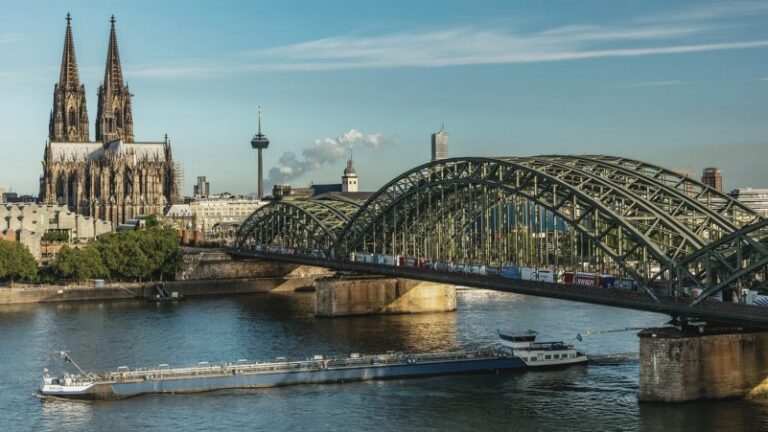
Two models are often cited as benchmarks in the railway industry when discussing high-speed rail: the French and German approaches. The model adopted by France began with the opening of its first Ligne à Grande Vitesse (LGV), the Sud-Est line between Paris and Lyon, which entered service in 1981. The defining feature of this line, shared by all those built in subsequent years, is that it is dedicated entirely to passenger transport, with only high-speed trains, the now-famous TGVs, operating on it. This decision led to a specific approach to line design, with lower axle-load capacity unsuitable for heavy freight trains and, above all, gradients that can be relatively steep without posing a problem for powerful high-speed trains. The latter characteristic has made it possible to avoid building more expensive tunnels.
The other model, the German approach, is based on mixed-traffic high-speed lines carrying passenger trains at speeds exceeding 250 km/h while remaining fully suitable for freight traffic thanks to their higher axle-load capacity and gentler gradients. Since the construction of the first line, Hanover–Würzburg, in 1991, these characteristics have long been emphasised by German railways operator DB.
But after all these years, what has been the outcome of Germany’s decision to develop a mixed passenger and freight railway system? German specialist publication Deutsche Verkehrs-Zeitung (DVZ) has revealed a government document showing that the results achieved so far have fallen far short of expectations, to say the least. The report was prepared in response to a parliamentary inquiry examining five corridors: Cologne–Rhine/Main, Nuremberg–Ingolstadt, Erfurt–Leipzig/Halle, Ebensfeld–Erfurt and Wendlingen–Ulm.
The figures are nothing short of astonishing. The Nuremberg–Ingolstadt line, for example, was completed in 2006 with freight traffic projected at 100 trains a day. The reality has been very different: in 2025, the line was used only occasionally, effectively serving as an alternative route for diverted freight services. This was partly due to safety restrictions on trains passing through its tunnels. The picture is no different on the Erfurt–Leipzig/Halle and Ebensfeld–Erfurt routes, which were originally designed to accommodate 131 and 168 freight trains a day respectively. Yet over the whole of 2025, just 449 freight trains used the former and 651 the latter. The Wendlingen–Ulm line recorded only 160 freight train movements during the entire year.
And what about Italy? Some background is needed. Many forget that Italy built Europe's first high-speed railway line, the Rome–Florence Direttissima, whose first section opened in 1977 and was designed for speeds of 250 km/h. It incorporated the same track layout and infrastructure solutions that would later become standard across European high-speed rail networks. From the outset, the line carried both passenger and freight trains, not least because Frecciarossa services were still a long way off. Subsequently, however, the rapid expansion of high-speed passenger services effectively turned the Rome–Florence Direttissima into an almost exclusively high-speed passenger line, excluding many train categories, particularly freight services.
What most people know as Italy's high-speed rail network, or TAV, began in 2005 with the Rome–Naples line, before being extended to form a continuous route from Turin to Salerno and subsequently towards Brescia and beyond. But which model was adopted? The answer is paradoxical: Italy's high-speed network was designed and built according to the German model, yet in practice it has always operated exclusively according to the French one. Furthermore, under RFI regulations, trains are not permitted to operate on these lines at speeds below 250 km/h. The paradox is that this decision required substantial investment in infrastructure and track design to accommodate freight traffic, when a lighter network intended solely for high-speed passenger trains could have been built at significantly lower cost.
The reasons are not technical but essentially political. To secure the support of local authorities and political groups less favourable to a dedicated high-speed rail network, this approach was adopted. Whether it was a genuine attempt to preserve the possibility of future changes to rail services or merely a way of silencing opposition is difficult to establish. In practice, the only freight service to use Italy's high-speed network was the short-lived ETR 500 Mercitalia Fast operation, which ran between 2018 and 2022, providing a high-speed connection between Maddaloni Marcianise and Bologna Interporto for the transport of lightweight parcels.
Piermario Curti Sacchi