







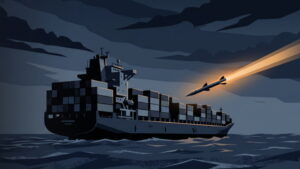
Tensions remain high in the Strait of Hormuz, where on Tuesday 11 August the US Navy struck with a missile launched from a helicopter the Vela Nova, a 30-year-old container ship flying the Panamanian flag, as it crossed the Gulf of Oman about 71 nautical miles off the Pakistani coast. According to the Wall Street Journal, the vessel was attempting to force the naval blockade imposed by Washington on Iranian ports. Seventeen crew members were operating on board the Vela Nova, all of whom were rescued after abandoning ship, while the fire that broke out following the strike was later extinguished. The registered owner of the merchant vessel is Liberia-based Golden Valley Marine Investment, while operational management is handled by Turkey’s Doris Shipping & Trading. The ultimate beneficial owner is unknown. Charlie Brown, senior adviser at United Against a Nuclear Iran, told Seatrade Maritime News that he had already reported on 4 August the presence of the Vela Nova in port in Mumbai together with two other ships, the Zyra and the Enzo 2, which were believed to be linked to Iran-related traffic and suspected of circumventing international sanctions.
A few hours earlier, in the southern Red Sea, a separate incident involved the cargo ship Tihamah, a small Tanzanian-flagged vessel that had departed on Saturday from al-Mokha, in Yemen. According to Reuters, citing two sources from the Yemen Coast Guard and two military officials from the Sana'a government, the vessel was hit by the Houthis while at anchor 3.3 nautical miles north-east of Perim Island, causing the deaths of three crew members: two Pakistani nationals and one Indonesian. British maritime security company Ambrey said the Tihamah was neither owned nor operated by Saudi entities at the time of the attack, a detail that weakens any direct link with the embargo declared by the Houthis against Riyadh.
If confirmed, the attack on the Tihamah would be the first fatal Houthi strike on a vessel since the attacks by the United States and Israel against Iran in late February triggered the wider regional conflict, although it should be noted that the Houthis have not yet claimed responsibility. The group declared a maritime embargo against Saudi Arabia in the Bab el-Mandeb on 20 July, in response to what it describes as a Saudi siege of Yemen and a raid on Sana'a airport. Since then, it has claimed eight attacks on Saudi tankers. The latest, on 5 August, prompted Riyadh to shift part of its oil exports towards the Red Sea, a route the Houthis have targeted precisely to strike this alternative logistics option.
Traffic in the Bab el-Mandeb has been affected: according to Kpler data, the average over the past week fell to 32 vessels a day, compared with 50 before the blockade began. On 30 July, 14 countries in the region - Saudi Arabia, Turkey, Pakistan, Egypt, Bahrain, Qatar, Jordan, Kuwait, Bangladesh, Djibouti, Somalia, Yemen, Sudan and Comoros - formed the Multinational Maritime Defence Alliance to protect navigation in the strait. Just a week before the attack on the Tihamah, on 4 August, the Indian merchant vessel Msv Faize Noore Oliya sank off Yemen after an attack, with all 14 crew members rescued.