








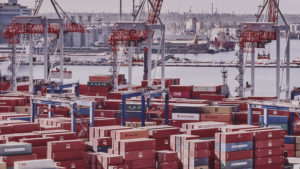
Between 1 and 10 August 2026, the Ukrainian port of Odessa, on the Black Sea, once again became a focal point of the Russian campaign against Kyiv’s maritime logistics, with an escalation culminating during the night of 9-10 August, when a fresh missile attack damaged residential buildings and injured at least fourteen people, eleven of whom were admitted to hospital. The sequence follows weeks of closely spaced strikes on fuel depots, energy facilities and civilian shipping, with Moscow’s stated aim of hitting Ukrainian military logistics and, according to Kyiv, cutting the country off from maritime trade.
On 1 August, the Russian Ministry of Defence said it had carried out strikes on fuel depots in the port of Odessa and on a tug in the port of Mykolaiv. On the other side, Ukrainian naval drones sank the sanctioned Russian container ship Yanina in the same period, as part of Kyiv’s campaign against Moscow’s so-called shadow fleet. On 3 August, Russia said it had hit three cargo vessels carrying military supplies in the Black Sea and a cargo ship in the port of Mykolaiv. Between 5 and 6 August, Russian forces claimed attacks on two merchant ships with German links off Odessa: the Liberian-flagged Emil was hit by drones 21 miles from the port, causing a fire on board but no injuries, while another vessel, flying the Guinea-Bissau flag and loaded with Ukrainian grain, was struck, causing one death and three injuries, according to regional governor Oleh Kiper.
On 7 August, a missile attack hit the city’s Chornomorets stadium, injuring several people. The following day, Moscow claimed a drone attack on a Ukrainian cargo ship off Odessa, saying it was carrying weapons for Kyiv’s forces, while Ukraine’s Unmanned Systems Forces said they had hit another twelve vessels from Russia’s shadow fleet in the first week of the month. According to their version, which has not been independently verified, this brought the total since the start of the MoLoChka campaign on 6 July to 218 vessels.
The largest attack of the period came during the night of 8-9 August: Iskander-M and S-400 ballistic missiles, Oniks anti-ship missiles and Kh-31P anti-radar missiles, together with around one hundred drones including Banderol loitering munitions, struck Odessa and the wider region. Ukrainian air defence intercepted 72% of the drones but only one of 11 missiles. Russia’s Tass news agency reported that Moscow’s forces had hit fuel, lubricant and military equipment depots in the port. Ukrainian President Volodymyr Zelensky accused Russia of waging war on global food security by targeting the port, a key artery for the country’s agricultural exports: 6-8 people were injured in the attack and around 90,000 customers were temporarily left without power.
The following night, between 9 and 10 August, a fresh attack again hit energy infrastructure and residential buildings. Zelensky said 300,000 households had been left without electricity in the city and region, with water supply also disrupted because of damage to the power grid reported by operator Dtek. By Sunday evening, a third of customers had already been reconnected, while repair work continued. The port remains the recurring target of Russia’s campaign to isolate Ukraine from the Black Sea. Regional governor Kiper recalled that attacks on the port in the first three weeks of July alone had caused 28 deaths. Ukraine’s Ministry of Energy also reported a sharp increase, in the days before 9 August, in parallel attacks on facilities operated by Naftogaz in the region.
The maritime crisis has prompted Turkey to make a diplomatic intervention. Turkish Foreign Minister Hakan Fidan said on 8 August that Ankara had proposed to Kyiv and Moscow the creation of a moratorium mechanism on attacks against commercial shipping in the Black Sea, after two Turkish civilian vessels were damaged by drones and crew members were injured. The request, initiated by Kyiv and passed on by Ankara to Moscow, has not yet received a Russian response. In the following days, Turkey temporarily restricted the transit of some commercial vessels bound for the Black Sea through the Dardanelles, citing safety concerns linked to the escalation in attacks. Transit returned to normal on Sunday 9 August, with passages towards the Black Sea through the Turkish strait resuming.
The pressure from attacks on Odessa is compounded by the Danube water crisis, after the river fell to record lows following weeks of drought. Barges used for exports are now loading between 30% and 60% less cargo than usual, with longer fleet rotation times and queues at river terminals. The Danube ports of Izmail and Reni have handled around 3.8 million tonnes since the start of 2026, compared with more than 42 million tonnes passing through Odessa’s ports over the same period, a gap that shows how marginal the river route remains compared with maritime transport despite capacity-building efforts coordinated by Kyiv with the European Union, Romania and Moldova. Fuel logistics are also affected: small vessels that normally carry up to 4,000 tonnes of petroleum products on the river are now limited to 1,000 or 2,000 tonnes. Kyiv acknowledges that, even in the most favourable scenario, Danube, rail and road routes together can cover no more than 45-50% of annual agricultural exports, while estimates by analysis centre Gmk Center suggest the 2026 crisis for Ukraine’s steel industry risks proving more severe than that of 2022.
M.L.