






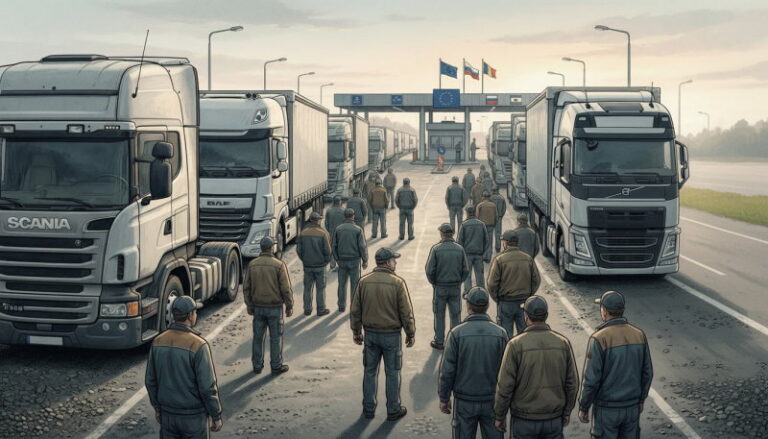
On the afternoon of 26 January 2026, hauliers from Serbia, Bosnia and Herzegovina, Montenegro and North Macedonia launched a coordinated blockade at more than twenty freight border crossings into the Schengen area, with simultaneous blocks starting at 12.00 and actions already under way from midnight on some inbound routes to the Balkan countries. The protest was organised by the main national road haulage associations and disrupted traffic continuity along the axis linking the European Union with Turkey and the Middle East, with immediate repercussions for transit times, vehicle availability and delivery reliability along regional corridors.
The protest stems from the strict application of the Schengen 90-days-in-180 rule to non-EU professional drivers and from the entry into operation of the digital Entry/Exit System (EES), which makes the verification of days of stay more stringent. The associations argue that a rule designed for short stays becomes, with automated enforcement, an operational constraint that drastically reduces workable days in the Schengen area and increases the risk of stops, refusals of entry and penalties. According to the Bosnia and Herzegovina hauliers’ association, in 2025 more than one hundred drivers were reportedly expelled for exceeding the limit, with further measures announced in the days preceding the blockade.
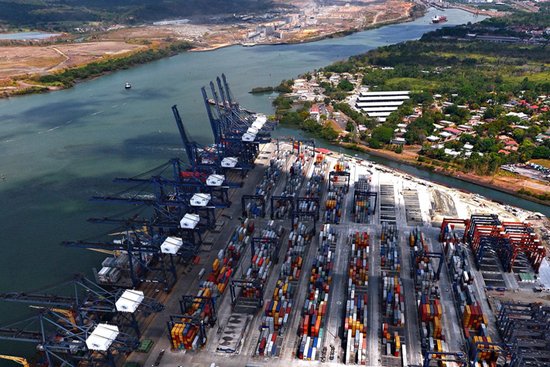
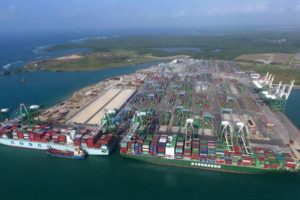
The blocks on 26 January affected the main freight terminals and road crossings along the Serbia–Hungary, Serbia–Croatia, Bosnia and Herzegovina–Croatia, North Macedonia–Greece and Montenegro–Croatia routes, with the addition of the port of Bar, where hauliers restricted access and operations at the terminal and in the free zone area. Organisers said they had introduced exemptions for certain humanitarian and security-related cargo categories, while passenger traffic was excluded from the action. The organisation was based on shifts, continuous blockss and logistical support for drivers waiting, with the aim of maintaining pressure for at least a week.
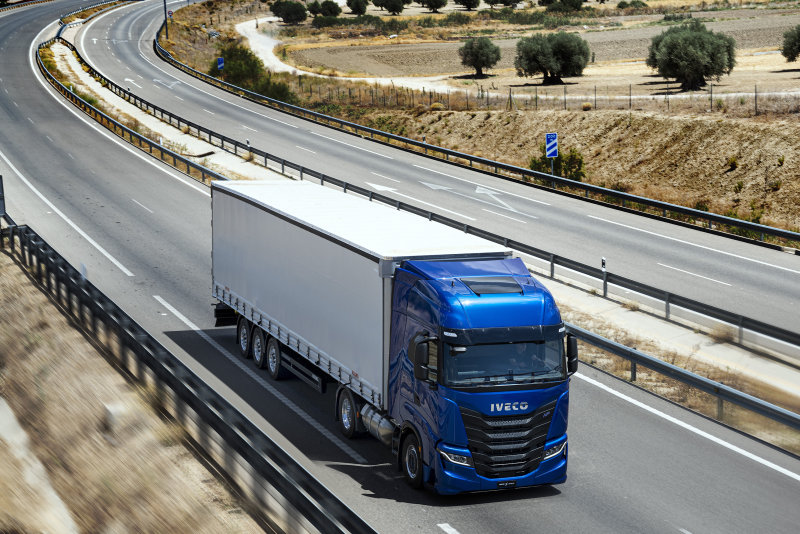
The scale of involvement has been described with high estimates, reaching into the thousands of trucks, although an exact figure has yet to be recorded. The visible effect at border crossings was an almost total reduction in crossing capacity for industrial vehicles, with queues, journey rescheduling and diversions onto alternative routes where available. In Hungary, diversions and exit restrictions towards the Serbian border were suggested, with real-time updates from the authorities.
The economic impact also appears significant. The president of the Serbian Chamber of Commerce, Marko Čadež, quoted by Agenzia Nova, estimated direct losses from blocked exports at €100 million per day and contractual penalties for delays of between €10,000 and €50,000 per day per company, with around 10,000 exporting firms involved on the Serbia–EU channel alone. In parallel, the Kosovo Chamber of Commerce warned of a potential impact on the regional value chain of almost €1 billion per day, a figure that includes delays, additional costs and supply disruptions.
The most exposed supply chains are those involving components and time-critical deliveries, as well as fresh produce. The Western Balkans are fully integrated into EU manufacturing supply chains, including the automotive sector, where delays quickly translate into production costs and missed deliveries. In this context, the border blockades affect not only Balkan exports but also return flows of semi-finished goods and components, as well as e-commerce logistics along south-east European and eastern Mediterranean routes. The network effect has also affected countries not taking part in the protest. Kosovo depends on transit via Serbia and North Macedonia, with impacts on imports and exports, and has issued an appeal for EU institutional intervention to restore circulation until a permanent solution is found.
One feature of the mobilisation on 26 January is institutional support, in some cases explicit. In North Macedonia, local sources reported the presence at the Blace crossing of Deputy Prime Minister and Minister of Transport Aleksandar Nikoloski, who described the protest as “a warning” ahead of the full operational launch of the EES scheduled for 10 April 2026 and indicated February and March as a useful window for a shared solution. In Serbia, Agenzia Nova reported Čadež’s visit to the Batrovci crossing, aimed at strengthening damage assessments and turning the issue into an economic priority, while in Bosnia and Herzegovina, European Western Balkans reported statements by the Minister of Communications and Transport, Edin Forto, expressing understanding of the hauliers’ reasons and the need for dialogue at EU level.
European Commission spokesperson Markus Lammert said that the EES does not change short-stay rules but allows for better enforcement, while acknowledging that there may be a need for flexibility for highly mobile professions such as hauliers and athletes. The response, however, contains no immediate operational proposal, and this point has been cited by organisers as a reason to maintain the blockade. The Secretariat of the Transport Community has reconstructed previous exchanges and the organisation’s limited room for manoeuvre, reiterating that the matter falls under the competence of the European Commission and the Member States.
The technical issue remains how stays are calculated and enforced. Hauliers’ associations particularly contest the fact that both the day of entry and the day of exit are counted as full days, further reducing effective availability for repeated missions. Hence the demand for a special status for professional drivers, or for an alternative counting mechanism that distinguishes cross-border work from personal stays. Among the options discussed is the creation of a separate category within the EES and tools comparable to dedicated work visas, seen as practical solutions to prevent border management from becoming a structural constraint on the continuity of international road haulage.
The protest continued on 27 January 2026, with the prospect of extending it throughout the week in the absence of negotiating openings. The timeline leading up to the actions of 26 January links them to previous protests in 2025 and to intensified institutional dialogue in the preceding weeks, culminating in warnings issued by some diplomatic representations and foreign ministries of neighbouring countries.
M.L.