



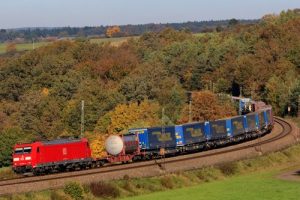
The year 2026 is shaping up to be marked by disruption and challenges in Bavaria. The German rail infrastructure manager DB InfraGo has planned an extensive renewal programme affecting several Bavarian lines, which serve as transit corridors for the Brenner route. Thanks to additional funds allocated to the infrastructure budget, a strengthening and modernisation plan will begin, covering 500 kilometres of track and the replacement of more than 200 sets of points. A further four billion euros will be invested, on top of works already planned and under way.
Some of these interventions concern Munich’s S-Bahn network, the suburban passenger service, but several main railway routes will also be involved. Excluding the more peripheral line starting from Lindau on Lake Constance, the works will affect the routes between Augsburg, Nuremberg, Ulm and Munich, essentially the network that branches out from the Bavarian capital towards northern Germany.
Bavarian authorities view these investments positively, as they represent a shift from a past in which Bavaria, despite its size, was often treated by the federal railways as a somewhat peripheral area. This trend emerged especially after German reunification in 1990, which shifted attention towards integrating the central networks. Evidence of this is the decline in investment interest along the Brenner axis, particularly in the access lines from Germany to Austria and therefore to the base tunnel towards Italy.
While the scope and positive impact of the interventions on Bavaria’s rail network—focused on high-capacity corridors—are clear, there is once again the risk of significant knock-on effects, involving prolonged closures, route changes and inevitably train cancellations, particularly for freight services. This is also because the 2026 projects come on top of ongoing works in the Werdenfelser Land (Upper Bavaria) and in the Upper Palatinate, which connects through Regensburg to Nuremberg.
The memory is still fresh of the disruption caused by one of the German network’s major upgrade projects, the complete five-month closure for works on the Frankfurt–Mannheim line, also known as the Riedbahn, one of the country’s busiest rail arteries and a central axis of the Rhine–Alpine corridor. DB InfraGo’s decision to concentrate all upgrade works during scheduled closures avoids the slow drip of long-lasting construction sites, but at the same time makes it difficult to manage alternative routes, particularly for freight trains, given the saturation of available lines.
Piermario Curti Sacchi