






14 October marks a turning point in the commercial conflict between the United States and China. From that date, Washington introduces access tariffs at US ports for ships built in China – a measure that adds to existing import duties and will further raise the cost of imported goods. The fragile truce of recent months had already started to unravel with the announcement of a 100% tariff on Chinese goods from November, followed by Beijing’s countermeasures. This escalation adds fresh uncertainty to global trade and to maritime and air cargo operations.
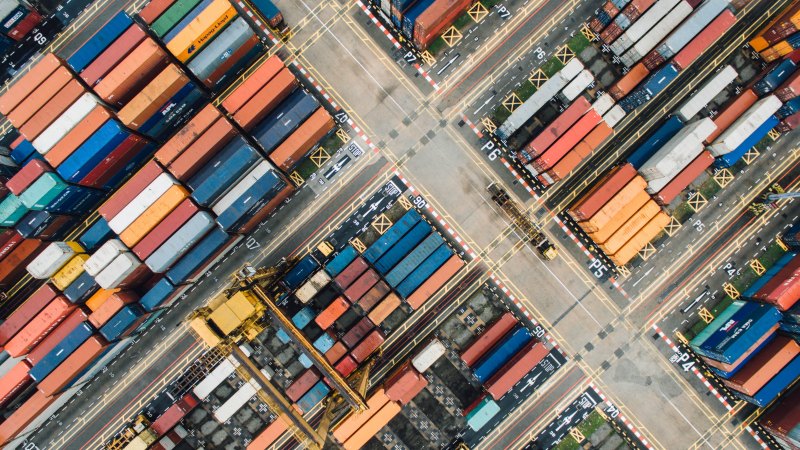
The United States has imposed port access fees on all Chinese-built vessels, regardless of flag or ownership, aiming to curb the dominance of Chinese shipbuilding, as revealed by an investigation from the US Trade Representative’s Office (USTR). The tariff system is complex: vessels owned or operated by Chinese entities are subject to a charge of USD 50 per net ton per voyage, rising annually to reach USD 140 per net ton by April 2028. For vessels built in China but operated by non-Chinese companies, the tariff is based on the higher of USD 18 per net ton or USD 120 per TEU, with annual increases of USD 5 per net ton over the next three years.
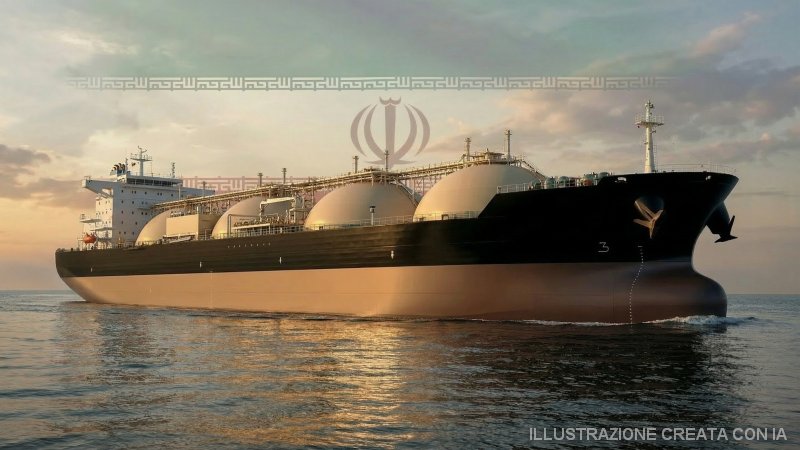
Two exceptions are included in the measure. Car carriers face a fixed rate of USD 46 per net ton, while LNG tankers are exempt, although subject to specific requirements when flying the US flag. Given that the United States is one of the world’s main exporters of natural gas, the exemption aims to preserve the competitiveness of its exports.
The USTR’s action does not stop there. It has also proposed an additional 100% tariff on Chinese-made port cranes, to take effect on 9 November 2025, and is considering tariffs ranging from 20% to 100% on containers, semi-trailers and other port components of Chinese origin.
China has responded with “special port tariffs”, applied from 14 October to all vessels linked to the United States calling at its ports. These start at 400 yuan (about USD 56) per net ton, increasing progressively to 640 yuan (April 2026), 880 yuan (April 2027) and 1,120 yuan per net ton by April 2028. The tariffs cover a wide range of ships: those owned, operated or built in the US, vessels flying the US flag, and those owned or operated by entities with at least 25% American ownership.
This last clause could have far-reaching implications, given the significant US investment presence in many global shipping companies. China has also imposed sanctions on five US subsidiaries of South Korean shipbuilder Hanwha Ocean, accusing them of assisting the American Section 301 investigation. The sanctions completely prohibit any transaction or cooperation with the affected entities, showing how the trade conflict is spilling beyond bilateral boundaries.
Industry analyses estimate that global shipping will face an additional USD 3.2 billion in costs in 2026 due to the US tariffs alone. Cosco, China’s largest shipping line, is expected to be hardest hit, with annual costs of USD 1.5 billion. Its subsidiary OOCL will face an additional USD 654 million, equivalent to 7.1% of projected revenue. Other carriers affected include CMA CGM (USD 400 million), Evergreen (USD 350 million) and Hapag-Lloyd (USD 200 million).
To mitigate rising costs, several shipping lines are developing strategies to limit the impact of the new tariffs. Cosco and OOCL are exploring the use of non-Chinese vessels through collaboration within the Ocean Alliance with CMA CGM and Evergreen. Many lines are also considering rerouting cargo through Mexican, Canadian or Caribbean ports to bypass US port tariffs – a feasible option given the participation of US companies in domestic coastal trade.
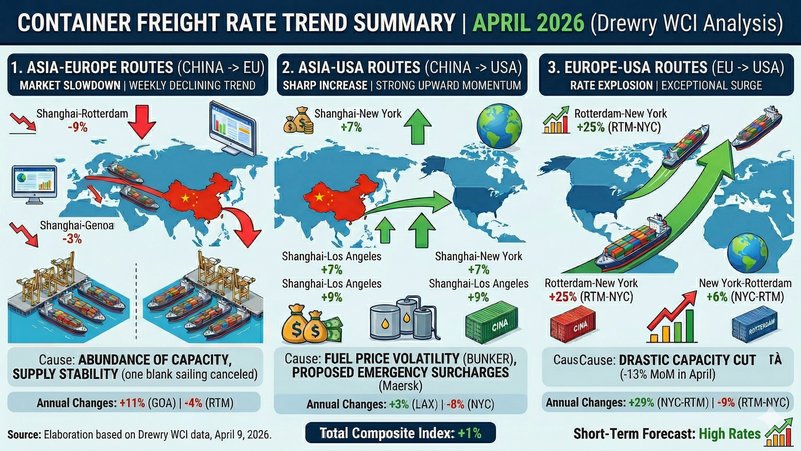
Analysts also expect repercussions for US ports, particularly on the West Coast. Los Angeles and Long Beach, which together handle about 40% of the nation’s containerised imports, are already seeing declining activity, with bookings on China-US routes down by 60% in recent weeks. Meanwhile, European and South American ports may benefit from redirected global trade flows, with container traffic expected to rise by 2–5%. Freight rates are projected to increase across the board.
The maritime dimension is only one aspect of the broader US-China trade confrontation. Another key front is the system of goods tariffs, regardless of transport mode. Following a bilateral truce in May, which capped Chinese imports at 30% and US imports at 10% until 10 November, President Trump abruptly reversed course on 10 October, announcing a further 100% tariff on Chinese goods from 1 November, on top of existing duties. From that same date, all exports of so-called “critical” software will also be subject to control. For now, the 1 November meeting between Trump and Xi Jinping at the APEC summit in South Korea remains confirmed.
This sudden policy shift must be viewed in a broader context involving US exports of electronics and Chinese exports of rare earths. Tensions rose further in October: on the 7th, the House Select Committee on Strategic Competition issued a report calling for tighter export controls on semiconductor equipment destined for China. Two days later, China’s Ministry of Commerce published Announcement No. 61 (2025), introducing stricter controls on rare earth elements and related technologies.
The new regulation adds five heavy rare earths – holmium, erbium, thulium, europium and ytterbium – to the existing control list, bringing the total to 12 of the 17 rare earth elements over which China holds full control, from extraction to component manufacturing. In effect, Beijing has implemented a “Foreign Direct Product Rule” modelled on the US semiconductor export strategy. Under this rule, foreign companies must obtain Chinese export licences for any product containing 0.1% or more of Chinese-origin rare earths, or produced using Chinese technologies, even when no Chinese firm is directly involved in the transaction.
The consequences were immediate. ASML, the Dutch company and the world’s sole producer of EUV lithography machines for advanced chips, warned of shipment delays lasting several weeks due to the new restrictions. ASML depends on Chinese-origin rare earths for critical components in its high-precision laser systems, magnets and other key parts. The European automotive sector is also under strain, though no significant delays have yet been reported.
The Chinese restrictions are also expected to hit US defence production. The Center for Strategic and International Studies has noted that rare earths are essential for technologies such as F-35 fighter jets, Virginia- and Columbia-class submarines, Tomahawk missiles, radar systems and Predator drones. China has announced that from 1 December 2025, it will deny most export licences to companies with any military affiliation, including those linked to the US armed forces.
This crisis highlights the systemic vulnerabilities of global technology supply chains. With China controlling over 90% of rare earth refining and about 60% of extraction, Beijing’s ability to “exclude any country on Earth from participating in the modern economy” introduces a new dimension of geopolitical risk. Western firms are working to diversify and reduce their reliance on Chinese rare earths, but many of these elements possess unique properties that make them irreplaceable in high-performance applications in the short term.