





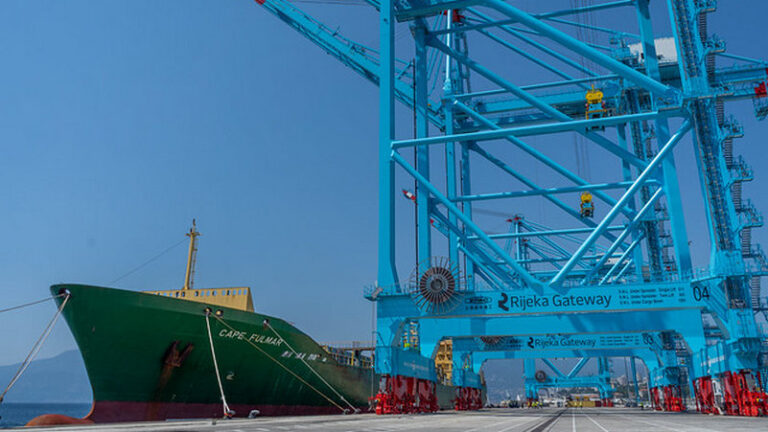
From that date, ports across the northern Adriatic have been facing a new competitor: Rijeka Gateway, the container terminal in the Croatian port that entered service with the arrival of Hapag-Lloyd’s Al Jasrah. It represents the largest private investment in Croatian logistics, worth a total of 380 million euros, and is set to transform Rijeka into a strategic hub for trade flows towards Central Europe.
The project stems from a joint venture between Apm Terminals, part of the Maersk group with a 51% stake, and the Enna group with 49%. The concession, signed in 2021, grants a 50-year management contract and a development plan divided into two stages. The first stage, already completed at a cost of 200 million euros, delivered the operational quay, four state-of-the-art quay cranes and the set-up of logistics areas. The second stage, to be rolled out over the next decade, will require a further 180 million euros to extend the terminal and boost handling capacity.
At present, the quay measures 400 metres with a depth of 20 metres, allowing access for large oceangoing containerships. Annual capacity stands at 650,000 teu, a figure that will rise above one million once expansion works are finalised, providing 680 metres of quay and dedicated space for vessels of up to 24,000 teu. The terminal covers a total of 20 hectares.
Rijeka Gateway is the first fully automated terminal in the Adriatic. The remotely operated ship-to-shore cranes, each standing 138 metres high and weighing 1,700 tonnes, are supported by fifteen rubber tyred gantry cranes for the yard, two rail mounted gantry cranes for rail operations and twenty-eight terminal tractors. Ninety-five percent of the equipment is electric, powered exclusively by certified renewable energy sources, minimising both emissions and noise pollution.
The opening of the terminal has been immediately accompanied by its inclusion in the Gemini Cooperation services of Maersk and Hapag-Lloyd. The EA12 loop to East Asia initially includes one weekly call, which will gradually increase. In the first commercial operation, more than 1,700 containers, both full and empty, were handled.
The launch of the terminal has also generated significant employment. More than 250 direct jobs have already been created, set to rise to 300 once the terminal reaches full capacity. In 2025 alone, over 50,000 hours were devoted to staff training, including advanced simulations and study visits to international ports.
A decisive element for full development will be rail connectivity with the hinterland. At present the terminal is equipped with four intermodal tracks between 475 and 485 metres in length, but the Croatian government has prioritised construction of a new flat line between Oštarije and Rijeka. This connection is considered essential to shift up to 60% of flows onto rail and to ensure competitiveness with the ports of Trieste and Koper.
The project has also involved complementary infrastructure investments worth around 600 million euros, including the construction of the new D403 highway providing direct access to the terminal, internal works within the port and a new intermodal facility. In addition, the historic Warehouse 22 has been refurbished and converted into the administrative headquarters, reflecting a commitment to combining innovation with the existing heritage.