






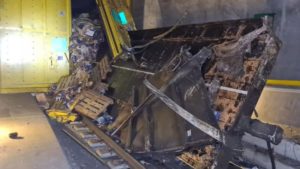
On 10 August 2023, a derailment occurred inside the Gotthard Base Tunnel, causing severe damage to infrastructure but no fatalities. Freight train 45016, which had departed from Chiasso and was heading to Basel with thirty wagons and two BR 185 locomotives, suffered the fracture of a wheel on wagon number 11, triggering a series of events that culminated in the derailment of sixteen wagons and the destruction of over seven kilometres of track and two high-speed points.
The final report, published by the Swiss Safety Investigation Service (Sisi), reconstructs the dynamics of the incident with clarity and precision. At around 12:15, the train entered the tunnel’s southern portal. At kilometre 47, an initial fragment detached from the right wheel of the first axle on wagon 11. Another seven fragments broke off over a stretch of 300 metres, ending at kilometre 46.7, where the axle finally dislodged from the rail and remained tilted beneath the wagon. The train continued running for approximately seven kilometres until it reached the multifunctional station at Faido, where the misaligned wheel struck the Hydrostar W 387 and W 386 points with great force. The impact with these high-speed switches, whose locking mechanisms were mounted on top of the sleepers and thus particularly exposed, caused a cascading series of derailments.
The Sisi investigation, conducted in collaboration with Swiss and Swedish authorities, identified the primary cause as the brittle fracture of the BA 390 wheel, resulting from thermal overload. Metallographic analysis revealed vertical fatigue cracks originating on the running surface and propagating into the wheel disc. The break was triggered by extreme overheating, most likely caused by a brake that remained engaged or was not fully released during the journey. The discovery of similar cracks on the other three wheels of the same wagon suggests repeated, undetected exposure to overheating episodes.
One of the most significant aspects of the report concerns the limitations of current trackside monitoring systems. Sensors installed at Mendrisio and Claro, intended to detect temperature anomalies in brakes and axleboxes, registered no alarms on the day of the incident. According to Sisi, this confirms that existing technology is unable to detect fatigue cracks or critical thermal conditions in time to prevent such events. Operational procedures carried out by staff, both in Chiasso and in Bellinzona—where during a stop a driver had reported smoke and the brakes on wagon 14 were deactivated—were found to be in line with the Safety Management System. However, the paper documentation and manual transcriptions reviewed during the investigation highlighted a degree of redundancy and potential vulnerability to error, prompting Sisi to issue a specific advisory in favour of digitalising operational procedures in the future.
Material damage was extensive. In addition to the destruction of two points, tracks, sleepers, door components and safety structures were torn up over a stretch of around seven kilometres. The derailed wagons, many of which were overturned or severely deformed, required a complex recovery operation that prolonged the tunnel’s closure. Both tubes were temporarily closed; partial reopening of the east tube, at reduced speed, only took place on 23 August 2023, following the installation of a temporary bulkhead. Full regular service through the tunnel resumed only more than a year later, on 2 September 2024, with severe repercussions for freight and passenger logistics along the north-south axis.
Sisi issued four main recommendations. The first calls for a reduction in the minimum operating diameter of BA 390 wheels or their early withdrawal from service, while the second proposes the systematic use of ultrasonic inspections for this type of wheel. The third recommendation suggests that the European Union Agency for Railways (ERA) conduct a detailed study into the thermal influence of L-type brake shoes on various wheel models. Finally, the fourth recommendation aims at a structural review of Hydrostar points, whose design proved too vulnerable to impact from dislodged components. Complementing the package of measures, safety notice number 54 stresses the urgency of digitalising train preparation procedures to avoid transcription errors or duplicate manual records.