







It may be too soon to call it a real turning point, but there is certainly something new in Rfi’s strategy for upgrading railway infrastructure serving Alpine crossings, particularly the Gotthard route between Italy and Switzerland. Until now, Rfi has consistently argued in institutional settings that the technological upgrades already implemented or under way — or at most minor improvements — would suffice, as the capacity of historical lines such as the Monza–Chiasso would remain adequate even beyond 2030.
However, this stance now appears far less firm. The change comes directly from the network operator itself. Speaking at a conference held on 28 October 2025 at Milan’s Centro Svizzero, organised by the Italian association for the Gotthard High-Capacity Railway Line, Michele Rabino, Rfi’s head of infrastructure development for the North-West area, revealed two key developments — one partly anticipated, the other disclosed for the first time.
Starting with the latter, Rabino announced the launch of the Docfap (Document of Feasibility of Project Alternatives), as required by Italy’s public procurement code, to define an alternative freight route bypassing the Milan hub — the so-called eastern freight bypass — in view of the long-term saturation expected on the Seregno–Monza and Milano Greco–Turro–Lambrate sections.
The options under study within the Docfap include two main interventions: doubling the Seregno–Carnate line and creating a new variant line from Carnate to Melzo/Treviglio. The second proposal is the real innovation, as earlier plans envisaged a link towards Bergamo, mainly serving the Brescia corridor. In the new formulation, however, the project would serve the entire eastern Milan area, directly connecting it to the Gotthard corridor.
The second project, already at a more advanced stage with its feasibility study completed, concerns upgrading the Milano–Chiasso line by 2035. After assessing two alternative layouts, Rfi has opted for one that involves building a third track alongside the existing line between Camnago–Lentate and Cantù–Cermenate, creating a new movement post at Seregno with an additional pair of freight passing loops, and reconfiguring the Rosales junction, currently at grade. The final outcome will not be the full quadrupling of the section between Seregno and Rosales, as many rail operators had hoped, but rather a balanced compromise that increases capacity while keeping both territorial impact and costs within reasonable limits.
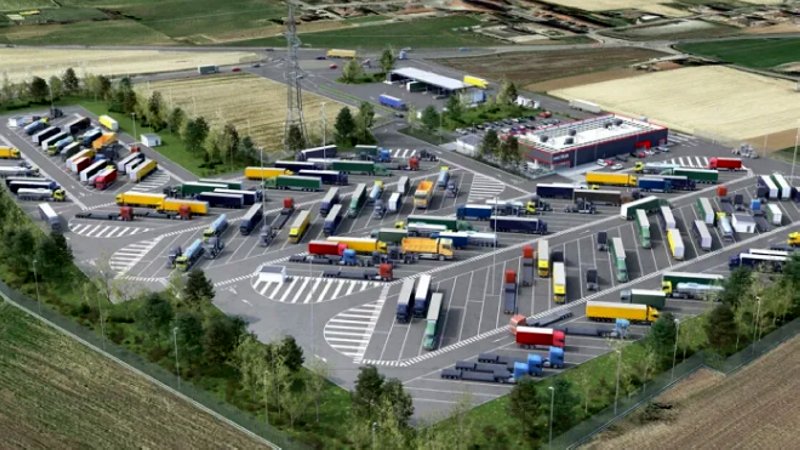
Meanwhile, Rfi continues to strengthen all Alpine crossing routes — Simplon, Luino and Chiasso — along two main lines of intervention: adapting the loading gauge to P/C80, suitable for unrestricted intermodal transport, and building 750-metre passing loops.
As for gauge enlargement, work has been completed across the Chiasso and Luino routes except for the Seveso–Milano Greco triple junction, scheduled for activation in 2027. A couple of remaining works on the Domodossola–Arona–Sesto Calende and Arona–Oleggio lines are still pending under the 2012 Italy–Switzerland agreement.
Progress is slower on the 750-metre module, especially within the Milan hub, where Smistamento yard will be upgraded in 2026 and Certosa not before 2028. Works on the Chiasso and Luino lines are complete, but much remains to be done on the Simplon axis, where eight facilities have been upgraded but nine more still await intervention. The medium-term scenario foresees daily freight traffic reaching 170 trains via Chiasso, 90 via Luino (a remarkable figure for a single-track line), and 130 via the Simplon crossing.
Piermario Curti Sacchi