










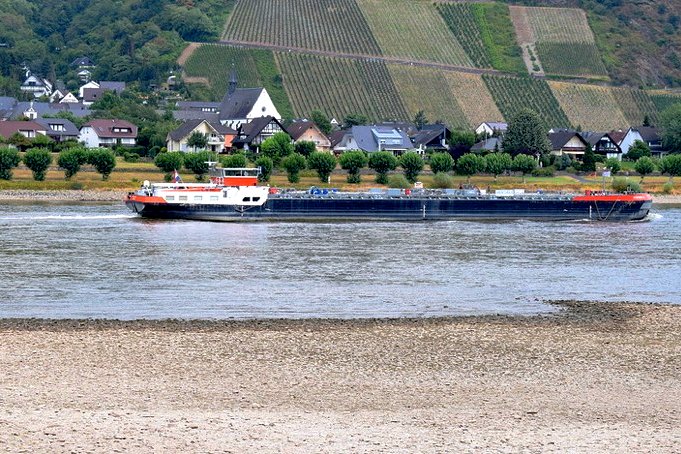
At 4.45 pm on 20 November 2026, the gauge at Kaub, in the rocky stretch of the Middle Rhine that affects freight navigation along the entire river corridor, stood at 143 centimetres, up from 21 centimetres on 2 November. The reading exceeds the equivalent low-water level by 66 centimetres: the GlW is 77 centimetres, corresponding to a reference fairway depth of 190 centimetres. It is also approaching the roughly 150 centimetres that, according to the Bundesverband der Deutschen Binnenschifffahrt (BDB, German Inland Navigation Association), most vessels need to operate fully laden. In its bulletin "Low water levels receding", published on 19 November, the Bundesanstalt für Gewässerkunde (BfG, German Federal Institute of Hydrology) reported that rainfall had eased low-water conditions mainly on the Rhine and, to some extent, on the Danube and Weser. It expects further rises across Germany in the coming days and weeks.
Conditions have improved along the entire German stretch of the river. At the same time, Maxau, on the Upper Rhine, recorded 496 centimetres, exactly matching the average daily level for 2010–2020. Duisburg-Ruhrort, on the Lower Rhine, stood at 378 centimetres, slightly below the average of 394 centimetres but more than 150 centimetres above its own GlW. The recovery began on the evening of 15 November, when a series of weather fronts from the west brought repeated rainfall to central Europe, particularly heavy in western Germany and the country's low mountain ranges. However, the BfG distinguishes between the rapid response of river levels and the much slower replenishment of soil moisture and groundwater reserves, which sustain river flows during dry periods. The accumulated rainfall deficit has therefore not been eliminated, and conditions over the coming weeks will depend on further precipitation. On 12 November, the agency had already warned that flows on the Elbe and Oder would initially remain low.
The low-water period had lasted since mid-July 2026. In August, according to the Rhine Waterways and Shipping Office, Kaub fell below the 25-centimeter mark of October 22, 2018, which had been the record low until then. On November 5, the BfG was still speaking of a return to extreme low water, with very low levels at many locations along the free-flowing section of the Rhine. For the end of November, the agency now forecasts levels in the mean-water range and, through the end of the year, values around the multi-year averages. In the 14-day probabilistic forecast issued on November 19 for Kaub, the indicated probability of falling below the GLW remains at zero through December 2 and, from November 21 to 27, also for falling below a daily average of 157 centimeters. From November 28, the probability of dropping below that level rises again, reaching 13% on December 2.
A.M.B.