





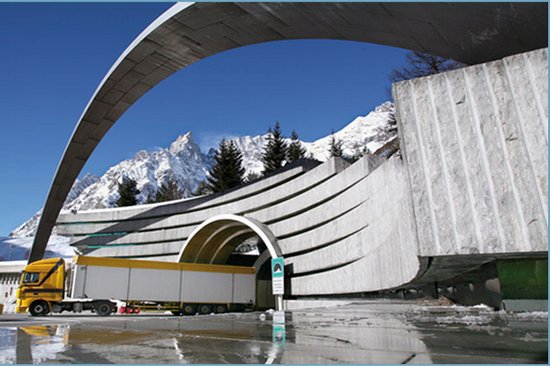
Traffic through the Mont Blanc Tunnel resumed at 5.00 pm on 12 December 2025, following a continuous fifteen-week closure that began on 1 September. Confirmation came from Geie Tmb, which operates the Italian-French infrastructure. The reopening is conditional on the completion of more than 800 functional checks on safety systems, currently in their final phase after starting at the end of November, covering the tunnel and all operational areas in Aosta and Passy. On the morning of 12 December, a final safety exercise was held involving the tunnel’s internal teams, the Valle d’Aosta fire brigade, French sapeurs-pompiers, the binational police force and emergency medical services. According to Geie Tmb, this will be the 105th drill carried out in the tunnel since 2002.
The reopening follows the completion of the second test construction phase focused on rehabilitating the tunnel vault, covering a total length of 254 metres. This represents one of the most significant interventions ever undertaken on an infrastructure inaugurated in the 1960s and now subject to an extensive refurbishment programme. The works are valued at €21 million and have been funded by Sitmb and Atmb. Activities continued for 102 consecutive days thanks to the involvement of more than 150 workers operating without interruption, 24 hours a day, for a total of over 150,000 working hours.
The works included demolitions, waterproofing, installation of prefabricated segments and concrete reconstruction. In sector G26, a historic water ingress was addressed, channeling around 300 litres per second. During operations, previously unmapped drainage systems were discovered, requiring changes to the project design. All systems temporarily dismantled, including cameras, ventilation boosters, sensors, lighting and the thermometric cable, were reinstalled and connected to the Logos supervision system, which manages 36,000 data points from 12,000 devices.
The closure period also allowed for additional works, such as the removal of 8,000 square metres of cladding for structural inspections, installation of new LED lighting along the tunnel’s entire 11.6-kilometre length, replacement of 2,600 light points in evacuation corridors, updates to the ventilation algorithms of the Logos system and external maintenance operations including resurfacing. In parallel, the 300 Geie Tmb operators took part in training programmes, including a course dedicated to thermal stress in hostile environments at the Cfetit centre of the Fréjus Tunnel.
According to information provided by the Franco-Italian intergovernmental commission, the 2024 and 2025 test construction phases will be used to define the rehabilitation strategy for around six kilometres of the vault. The options under consideration include a single, continuous closure lasting 3 to 3.5 years starting in 2030, or a series of annual closures from September to December over a period of 15 to 18 years. The year 2026 will be dedicated to analysis, with the definition of the first contract expected in 2027 and the final decision scheduled by the end of 2025.