





After several days of repeated airspace violations by hot air balloons, Lithuania announced on 27 October that it would close its borders with Belarus indefinitely. Prime Minister Inga Ruginiene stated that no hybrid attack would be tolerated and did not rule out invoking Article 4 of the NATO Treaty, which allows a member state to request consultations with allies whenever its territorial integrity is threatened. However, local media reported that the balloons were not linked to strategic espionage but were instead being used by criminal organisations to smuggle cigarettes. Belarusian authorities have called the closure a “provocation”, and Foreign Minister Maksym Ryzhankov has urged the Lithuanian government to reverse its decision.
For now, borders remain closed, with only the Šalčininkai crossing—around 50 kilometres south of Vilnius—open to diplomats, Lithuanian or EU citizens, Lithuanian residents, and travellers in transit to Kaliningrad. Unless extended, the restrictions will stay in place until 30 November. However, transport associations, led by Linava, have warned the government about the potential impact of the measure on the national haulage industry.
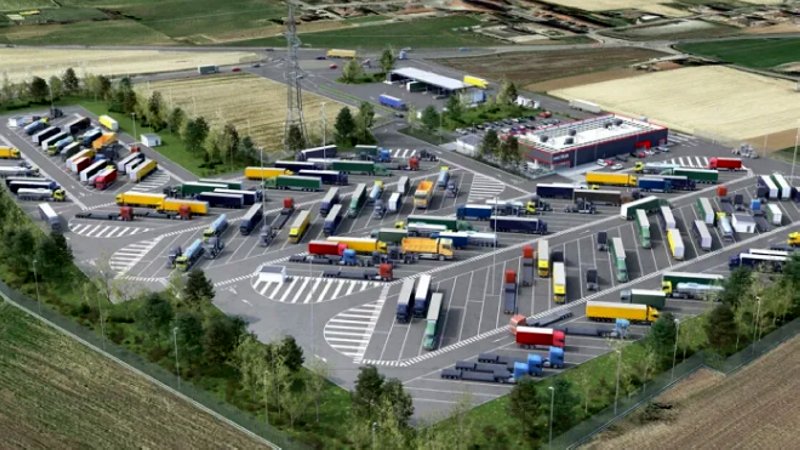
The border closure not only disrupts supply chains, delaying goods flows and causing multimillion-euro losses, but also risks creating a humanitarian emergency. Hundreds of lorries have already been stranded on the Belarusian side and forced to reroute through Poland, generating high costs for companies and significant delivery delays.
Linava also reported that dozens of vehicles that had already cleared Belarusian customs cannot alter their route and are now trapped in bureaucratic limbo—unable to enter Lithuania and not authorised to divert through Poland. The association stressed that the complex situation poses not only logistical but also humanitarian risks, as drivers may face weeks of uncertainty without clear information, food or decent accommodation. Linava has therefore called on the Lithuanian government to convene an emergency meeting with transport sector representatives to restore stable freight movements.
The situation mirrors the one that unfolded in Poland only a few weeks ago, when Prime Minister Donald Tusk’s government closed road and rail crossings with Belarus following joint military exercises between Minsk and Moscow. At that time, hundreds of trucks were also left stranded, and a humanitarian crisis was averted only after Poland reversed its decision and reopened the border.
Just weeks later, Warsaw has not only reopened its borders but also announced plans to resume traffic through two crossings that had been closed for several years. Tusk confirmed his intention to reopen the Bobrowniki corridor—closed since 2023 after a Polish activist was convicted in Belarus—and the Kuznica crossing, inactive since 2021 due to high migration pressure. He described the reopening as a “trial operation”, warning that the borders could be closed again if needed, although Polish authorities expect the move to ease congestion and restore regular goods flows.