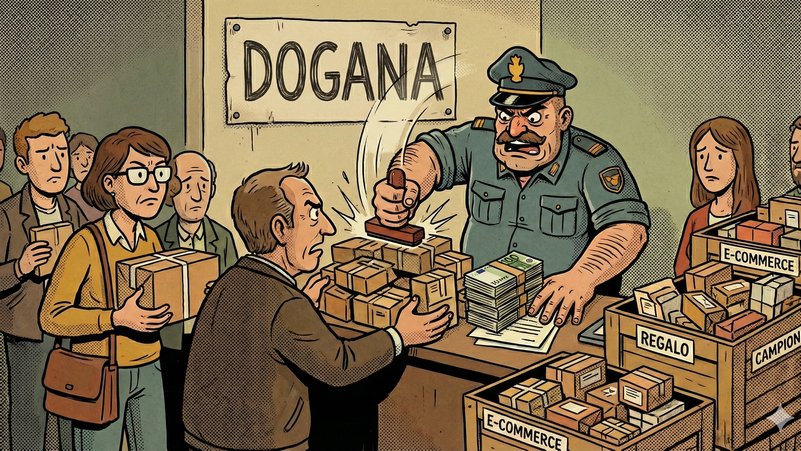








The Milan Prosecutor’s Office, led by public prosecutor Elio Ramondini, has opened an investigation into smuggling and violations of the Union Customs Code, which on 24 November 2025 resulted in searches at Amazon’s Milan headquarters and at the logistics platform in Cividate al Piano. According to investigators, these facilities may be linked to a system for importing Chinese-made products without paying VAT or customs duties. The inquiry connects this alleged scheme to a network of Italian shell companies used to simulate commercial transactions and fictitious movements of goods within the Union. Prosecutors believe the flow of goods was organised to bypass tax obligations estimated at €1.2 billion.
During the searches, officers seized around five thousand products at the Cividate al Piano hub in the province of Bergamo, while in Milan they seized IT equipment, administrative documents and materials considered useful for reconstructing the supply chain. Investigators also identified the manager responsible for domestic goods transport, who is now subject to further checks.
The current investigation stems from a wider case already coordinated by the Milan Prosecutor’s Office concerning online sales between 2019 and 2021, a period in which the alleged violations are thought to have taken shape. That inquiry had already led to the seizure of hundreds of thousands of items and the acquisition of documents aimed at reconstructing seller management models, marketplace operations and the traceability of goods flows. Authorities suspect that Chinese-made products entered the Union through unidentified channels before being placed on the Italian market via a chain of transit or cover companies acting as shells.
According to sources cited by Reuters, investigators believe Amazon may have played a “Trojan horse” role by enabling the circulation of non-EU products without the application of the required taxes. The case file examines in particular the relationship between marketplace functions, the algorithm that determines offer priority and the framework of responsibilities set out in the rules governing intermediaries. The investigative theory suggests the platform facilitated the sale of goods that were not properly identified for tax purposes, with shared responsibility linked to its obligation to monitor operators introducing products into the national market.
The technical complexity of the probe centres on the management of flows in logistics hubs, where goods from non-EU third-party sellers converge. Investigators argue that the combination of automated processes, high volumes and the use of external companies created conditions in which irregularities could be concealed. Document reconstruction is ongoing with the company’s cooperation, as Amazon has granted access to its IT systems and requested logistics records.
Reuters reports that the cross-border nature of the case prompted the Milan Prosecutor’s Office to present it to Eurojust in July 2025 during a meeting with magistrates from Germany, France, the Netherlands, Poland, Spain, Belgium, Sweden and Ireland. The European Public Prosecutor’s Office has also launched checks on the group’s accounts for the 2021–2024 period to assess potential tax and customs implications in other member states. At the same time, the Italian Revenue Agency has submitted a proposed settlement that Amazon must assess by December.
Checks will continue in the coming months, focusing on import flows, the role of the third-party companies involved and the responsibilities of intermediaries in selling non-EU goods through e-commerce. The proceedings remain under the coordination of the Milan Prosecutor’s Office and the regional Revenue Agency.