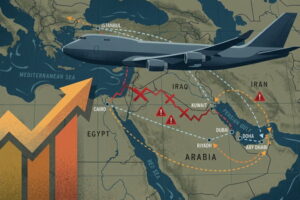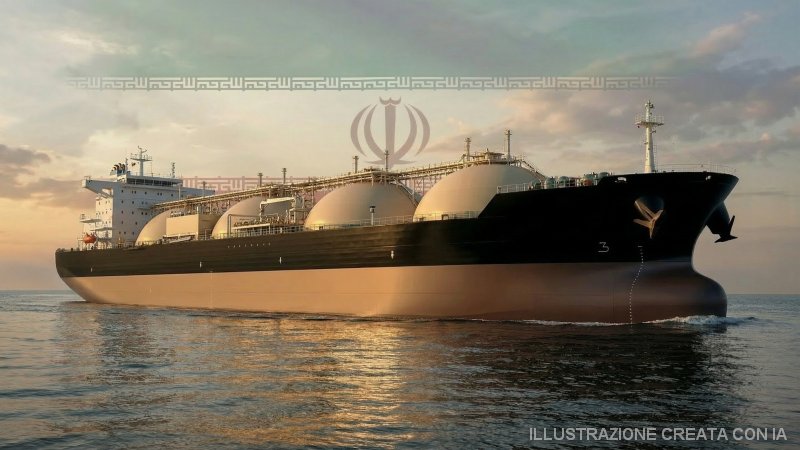




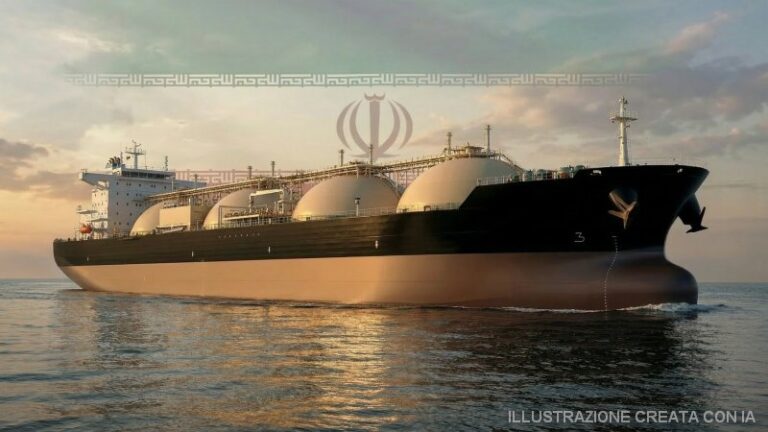
- Iran has established a semi-formal control system over the Strait of Hormuz: ships seeking to transit must provide the Islamic Revolutionary Guard Corps (IRGC) with crew lists, cargo details and voyage documentation. For oil tankers and LNG carriers transporting high-value cargoes, payments have also been requested, channelled through intermediaries. Passage is guaranteed only to vessels from “friendly” countries, in coordination with the relevant Iranian authorities.
- The Ras Laffan LNG plant in Qatar has sustained extensive damage following Iranian drone attacks and subsequent retaliatory strikes. Two production trains have been taken out of service, with a combined annual capacity of 12.8 million tonnes, equivalent to 17% of Qatar’s LNG exports. QatarEnergy has indicated it may invoke force majeure on some contracts for up to five years.
- The energy crisis is hitting emerging Asia particularly hard. Pakistan, which relies on Qatar for 99% of its LNG imports, risks running short of gas for power generation as early as mid-April. India, Vietnam and the Philippines are facing shortages of cooking fuels and industrial energy, while the cost of a single LNG shipment to Asia has exceeded $80 million (around €73 million), more than double pre-conflict levels.
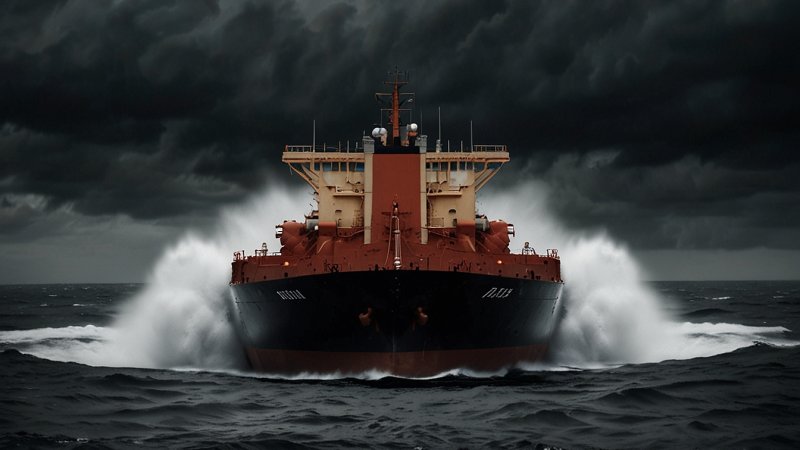
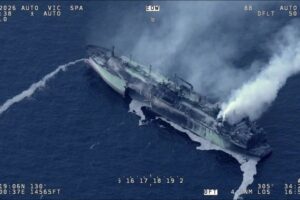
For nearly a month, the Strait of Hormuz has effectively been closed to international commercial traffic. Since late February 2026, when the United States and Israel launched military operations against Iran, the maritime corridor linking the Persian Gulf to the rest of the world has ceased to function as a global trade artery. Only a limited number of vessels have completed the passage, almost all Iranian or linked to China, and largely involved in crude oil transport.
The bottleneck is not solely the result of the ongoing conflict. In recent weeks, Iran has built a semi-formal system to control transit through the strait, entrusted to the IRGC. According to sources cited by Bloomberg on 25 March 2026, vessels intending to pass must submit detailed crew and cargo lists, along with voyage data and bills of lading. Clearance is not automatic: it is granted case by case, with a process that remains idiosyncratic and varies from ship to ship. For certain types of cargo, the IRGC has also requested cash payments. According to the same sources, these demands mainly affect oil tankers, LNG carriers and ships carrying high-value goods, and are channelled through intermediaries. Not all vessels have been subject to this condition, but the mechanism appears to be established and expanding.
Tehran said in a statement that navigation continues for “friendly” countries and “in coordination with the relevant Iranian authorities”, and that traffic “has not been suspended”. However, the same statement links the full restoration of security in the strait to the cessation of military threats in the region. The IRGC also reported turning away a container ship for failing to comply with protocols and lacking transit authorisation. On the diplomatic front, the US government has been pushing to open negotiations with Tehran. President Donald Trump set and then postponed a 48-hour deadline for reopening the strait. A 15-point plan to end the conflict helped ease oil prices on 26 March, but there have been no tangible changes in traffic flows around Hormuz.
The effective closure of the strait has triggered a global energy crisis, with the most acute consequences in the LNG sector. In early March, an Iranian drone attack struck the Ras Laffan plant in Qatar, the world’s largest natural gas liquefaction facility and a cornerstone of the global LNG market for three decades. Subsequent retaliatory strikes, following an Israeli operation on the South Pars fields, caused extensive damage. Two production trains were taken offline, removing 12.8 million tonnes of annual capacity, equivalent to 17% of Qatari exports.
Saad Al-Kaabi, chief executive of QatarEnergy, said force majeure could be required for some contracts for up to five years. Repairs are expected to take between two and five years, in addition to the time needed to restart exports and restore navigation through Hormuz. Analyst Saul Kavonic of MST Marquee described the situation as moving towards a “scenario of a gas crisis of catastrophic proportions”, noting that even after the conflict ends, disruptions to LNG supplies could persist for months or years depending on the extent of the damage.
The impact on the global LNG market compounds an already fragile situation. Before the outbreak of the conflict, 2026 had been expected to mark a turning point, with a significant increase in global production capacity — particularly driven by US expansion — set to create an oversupply. According to Morgan Stanley, a disruption lasting more than a month would quickly turn that surplus into a deficit. A three-month disruption would be the most severe in the sector’s 50-year history.
The most immediate energy consequences are being felt in Asia, which absorbs four-fifths of Qatar’s LNG exports and the majority of shipments from the United Arab Emirates. Pakistan depends on Qatar for 99% of its LNG imports, and authorities in Islamabad have warned that supplies could be insufficient to meet electricity generation needs from mid-April. The textile sector, Pakistan’s main export industry, faces a dual risk: a shortage of gas for domestic power generation and for thermal processing of materials. Similar conditions are emerging in India, where shortages of liquefied petroleum gas have caused tensions in distribution networks, and in Vietnam and the Philippines, where additional LNG purchases on the spot market have effectively been suspended pending a drop in prices. A single shipment to Asia currently costs around $80 million (approximately €73 million), more than double pre-conflict levels. Indian companies have been forced into some of their most expensive purchases in recent years.
With LNG volumes reduced, many Asian economies are increasing their reliance on coal. The Philippines is in talks with Indonesia for additional coal supplies, while India plans to burn record volumes to meet summer electricity demand. What might in theory appear to be an opportunity to accelerate the transition to renewables is, in practice, resulting in greater dependence on the most polluting fossil fuel.
The problem is not limited to emerging economies. According to research firm Rystad Energy, a six-month disruption would also force developed countries in Europe and Asia to cut consumption if gas prices were to return to 2022 peaks. Francisco Blanch, head of commodities research at Bank of America, noted that European inventories are emerging from a harsh winter at very low levels, and that the process of rebuilding storage over the next two to three months will take place under significant pressure.
Europe’s vulnerability is structural. Since 2022, following the energy crisis triggered by Russia’s invasion of Ukraine, the EU has pursued diversification by building new regasification terminals and expanding storage capacity. However, as highlighted in a report by consultancy Roland Berger for industry group Cefic (European Chemical Industry Council), plant closures in gas-dependent sectors have increased sixfold since the start of the 2022 crisis, while investment in the sector has fallen by more than 80%. The new disruption is hitting an already weakened industrial base.
Taiwan, which relies heavily on LNG for its semiconductor manufacturing industry, has secured supplies for April and mid-May. South Korea has lifted operational limits on its coal-fired power plants to cope with gas shortages. Japan, through its energy minister, has asked Australia to release additional LNG volumes, but industry experts believe the country has already reached full production capacity.
In this context, attention is also turning to alternative supplies. US officials report that several Asian countries have already begun talks to increase purchases of American LNG. Bangladesh is exploring a potential agreement for additional supplies, while Taiwan aims to boost imports from the United States starting in June. Interest is also shifting towards projects previously considered marginal, such as the Alaska LNG terminal backed by the Trump administration: its eight-day shipping distance to Japan, compared with 24–28 days from the Middle East, represents a significant logistical advantage at a time when global supply routes are being reshaped.
M.G.