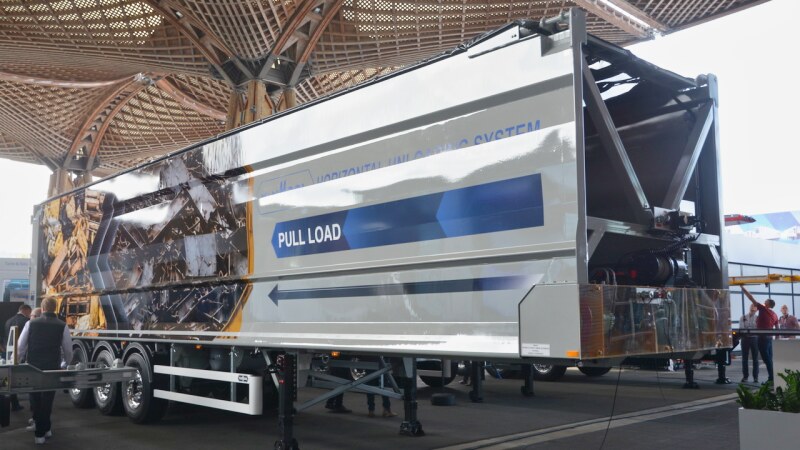
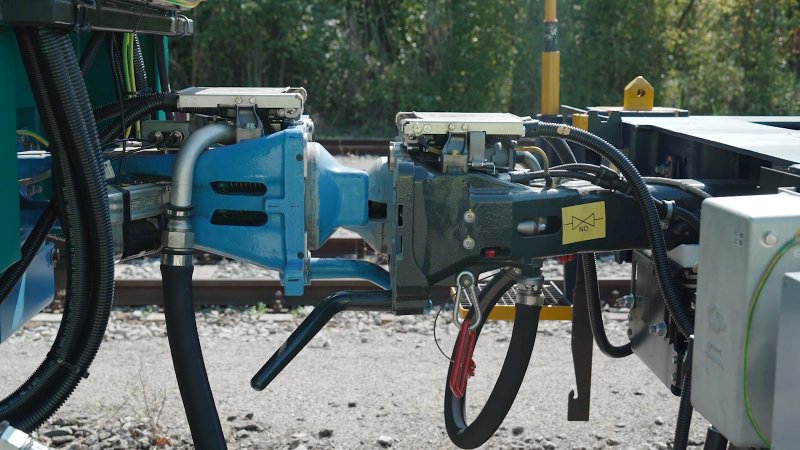




The growth of unaccompanied combined road-rail transport is being supported by public subsidies and the upgrading of certain railway routes that now allow the transit of semi-trailers up to four metres in height. Technology is also playing a role, offering systems that can load trailers onto trains without the need for lifting equipment. However, there are still hurdles to overcome, primarily related to the level of organisation that this form of transport demands. Transport companies must have road tractors and drivers stationed at the various railway terminals to cover the road segment of the journey. In the absence of their own vehicles, they need to rely on local hauliers at each destination, a situation that remains challenging for small and medium-sized enterprises and has so far prevented many of them from accessing this mode of transport.
Nevertheless, if combined road-rail transport is to expand, this barrier must be overcome, and there are those working to do just that, offering their expertise in the sector. Among them is Alexander Gieren, an Italian-German professional with a long career in Italy and extensive experience in intermodal transport developed at companies such as Ambrogio Intermodal, Arcese, Fercam, P\&O Ferrymasters and Nothegger. In early 2021, Gieren launched his own venture, founding Agieren in Germany with the main aim of helping small and medium-sized enterprises enter the world of intermodality.
“Our mission is to bridge the knowledge and mindset gap that often holds small and medium-sized businesses back,” he explains to TrasportoEuropa. “These companies, used to straightforward road transport from point A to point B, are faced with the complexity of intermodality, which involves at least three different operators: for the first mile, the rail leg, and the final mile. Agieren acts as a facilitator, connecting these companies with reliable rail and last-mile operators. We provide consultancy lasting from six to twelve months, with weekly video calls guiding businesses step by step towards independence in the intermodal sector. We also put them in touch with foreign partners for logistics needs such as parking and repairs.”
His main clients are transport operators. “Take, for example, a German haulier looking to enter the Italian market, perhaps focusing on the Veneto region, but without a local customer base. In this case, we provide an analysis of potential clients by goods sector and handle cold calling on their behalf, reaching out to decision-makers in the transport departments. Once we have reached the right contact, we put them in touch with our client’s sales team. We also offer an active sales service for foreign clients wishing to expand into Italy, calling Italian customers in their name and on their behalf.” The reverse is also true, as Gieren’s knowledge of both the language and the transport sectors in Italy and Germany allows Agieren to operate effectively in both countries.
The Agieren team consists of four people covering Romania, Bulgaria, Greece, Turkey, Italy, Germany and the Benelux region. Beyond the purely operational issues, what are the main difficulties small and medium-sized enterprises face when approaching intermodal transport? “The biggest challenge is the lack of clarity and their lower bargaining power compared to large companies when dealing with the railways. Smaller firms are often penalised in terms of priority and thus view road transport as a more reliable alternative. Paradoxically, small business owners see intermodality as a way to double the number of trailers on the move with the same number of drivers, but the drawback remains the service level, which is not yet fully comparable to road-only transport.”
Agieren also addresses the main operational hurdle: securing haulage services at departure and arrival terminals. “That’s right. There’s a real fear of entrusting one’s trailer to unknown hauliers abroad. At Agieren, we introduce our clients to at least two or three hauliers for each rail terminal, selected based on our past experience and with a low rate of damage and incidents. We reassure clients about the professionalism of these hauliers, though it undoubtedly remains one of their main concerns.”
Another area where the company offers support is in finding return loads. “This is an issue both in intermodal and traditional road transport, especially for an exporting country like Italy. The imbalance between imports and exports is a constant factor. That’s why we also provide targeted commercial support to help secure return loads, particularly for flows from Germany, Belgium and the Netherlands back to Italy.”
Looking to the future of intermodality, Gieren sees particular promise in the unaccompanied rail transport of semi-trailers, for which non-crane loading solutions are now also available. “In such cases, I advise clients to initially rent craneable trailers during the first few months of consultancy, to avoid upfront investments.” Swap bodies, on the other hand, require a more complex logistics setup, including on the part of the recipient.
Finally, there is the important issue of costs, as intermodal transport has traditionally been perceived as more expensive than road-only alternatives. For Gieren, this is a misconception. “Intermodality can be economically advantageous for certain types of goods, although it’s true that not all freight is suited to rail transport due to time constraints. However, the main advantage for road hauliers lies in the ability to at least double the amount of freight in circulation, increasing turnover even with the same cost per journey. Although rail is still seen as complicated to manage and companies tend to favour road for its immediacy, in the long run, intermodality pays off. Moreover, the growing shortage of drivers makes intermodality an increasingly attractive solution, offering drivers more local work and a better quality of life.”
Michele Latorre