




- Commercial transits through the Strait of Hormuz have collapsed by 81% compared with January averages, with daily tonnage volume plunging from 10.3 million to just over one million dwt. Between 150 and 200 large-tonnage vessels are anchored in the Gulf of Oman, while almost 10% of the global fleet of VLCC supertankers is trapped inside the Persian Gulf.
- The withdrawal of the main P&I clubs of the International Group — which collectively insure around 90% of the world’s ocean-going tonnage — has made transit economically impossible even before the missiles. War risk premiums have reached 5% of a vessel’s value for a single voyage, with a cost of 3 million dollars for a VLCC supertanker worth 100 million on the commercial market.
- The Trump administration has mobilised the Dfc — whose portfolio has been expanded to 205 billion dollars by the Build Act — to provide state-backed insurance guarantees for maritime trade in the Gulf, also announcing possible naval escorts by the US Navy. Markets have remained unconvinced: Brent has held above 82.53 dollars per barrel, while Maersk, Hapag-Lloyd and CMA CGM have rerouted fleets via the Cape of Good Hope, applying surcharges of up to 4,000 dollars per container.
On 4 March 2026, five days after the launch of the joint US-Israeli military operation against Iran known as “Epic Fury”, the Strait of Hormuz is effectively closed to commercial traffic. Statements from the Islamic Revolutionary Guard Corps (IRGC), which claims full control of the waterway and has threatened to strike with missiles and drones any vessel in unauthorised transit, have transformed what has historically been the most heavily monitored energy chokepoint on the planet into an active war zone. The result is an unprecedented collapse in maritime flows that threatens global supplies of oil and liquefied natural gas.
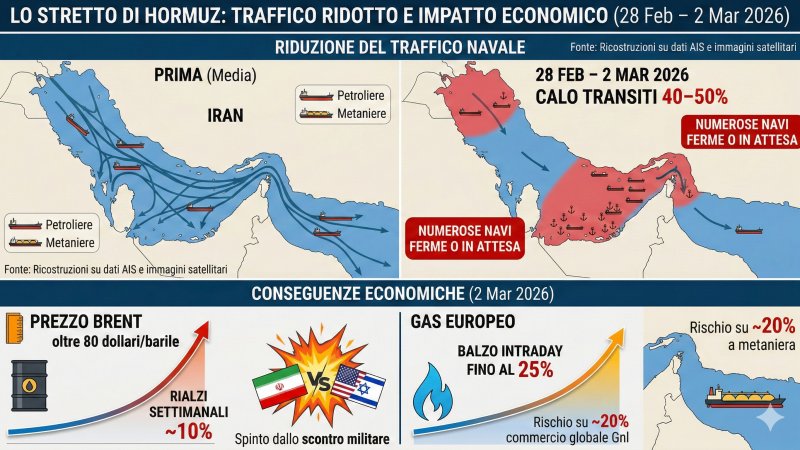
Tracking data compiled by Lloyd’s List Intelligence, MarineTraffic and Windward illustrates the scale of the paralysis. Transits through the strait fell by more than 81% on 1 March compared with consolidated averages at the end of February. Daily tonnage volume dropped from an average of 10.3 million deadweight tonnes (dwt) recorded in January to just over one million dwt. On the morning of 4 March, transit activity for large tankers was effectively zero, with the sole exception of occasional movements by smaller vessels and local coastal traffic.
The congestion is physically visible at both ends of the strait. Between 150 and 200 large commercial vessels — Very Large Crude Carriers (VLCC), LNG carriers and transoceanic container ships — have dropped anchor in the open waters of the Gulf of Oman and the Arabian Sea while awaiting diplomatic or military developments. Within the enclosed basin, according to Lloyd’s List data, almost 10% of the entire global fleet of VLCC supertankers is trapped in the Persian Gulf, unable to reach Asian and European markets due to the absence of valid insurance coverage or because of stop orders issued by shipowners. Among the trapped vessels are at least seventeen large container ships with capacities exceeding 4,000 TEU, whose cargoes are effectively being held hostage by geopolitics.
The paralysis is not simply the result of speculative caution. The operational environment has been deliberately degraded by direct attacks on merchant shipping designed to demonstrate Iran’s interdiction capabilities despite the bombardments it has suffered. The tanker Skylight, flying the flag of Palau, was struck by a missile in waters near the port of Khasab in Omani territory, causing a major fire on board. In a more serious incident, the tanker Mkd Vyom, flagged in the Marshall Islands and managed by V.Ships, was hit by a projectile that triggered an explosion and a fire, killing one crew member. Intelligence analysts note that the IRGC’s command infrastructure is designed in a highly decentralised way, allowing individual coastal batteries to operate even in conditions of total isolation from Tehran’s military leadership.
Yet the effective economic and legal closure of the strait has not been caused by missiles but by the withdrawal of the private insurance market. Over the weekend between 28 February and 1 March, the main P&I clubs belonging to the International Group — a consortium that collectively insures around 90% of global ocean-going tonnage — invoked cancellation clauses for war risk cover in the waters of the Persian Gulf, the Strait of Hormuz and adjacent areas. Entities such as Gard, Skuld, NorthStandard, London P&I Club, American Club and Steamship Mutual issued unequivocal notices: cancellation will take effect at midnight on 5 March 2026. On 3 March, London’s Joint War Committee (JWC) formalised the extension of high-risk regions through official circular Jwla-033, including the waters of Bahrain, Djibouti, Kuwait, Oman and Qatar, as well as portions of the Red Sea.
The consequences for premiums have been immediate and severe. In the months before the conflict, war risk cover in Middle Eastern waters ranged between 0.2% and 0.5% of a vessel’s insured value. As of 4 March, brokers Marsh and Aon report baseline increases between 25% and 50% for the Marine Hull market in the Gulf. For active transits through Hormuz, rates requested by underwriters approach 3%, with peaks of up to 5% for high-risk vessels. For a VLCC supertanker or a large container ship with a commercial value of 100 million dollars (around 92 million euros), a 3% premium translates into a cost of 3 million dollars (around 2.76 million euros) for a single voyage. For cargo valued at 20 million dollars (around 18.4 million euros), the specific premium on the goods reaches 600,000 dollars (around 552,000 euros). Costs of this magnitude make transit economically unsustainable for the vast majority of shipowners.
The administration led by President Donald Trump has responded with an unprecedented move in recent economic history. Through an executive order issued between 3 and 4 March, Trump instructed the United States International Development Finance Corporation (DFC) to provide comprehensive political risk insurance and financial guarantees for all maritime trade operating in the Gulf, with particular focus on energy cargoes. Congress had recently reauthorised the DFC through the Build Act, raising its portfolio limit from the previous 60 billion dollars to the current 205 billion dollars (around 189 billion euros). Trump specified on his Truth Social platform that the coverage will be offered at “a very reasonable price” and made available to all shipping companies worldwide, regardless of the flag they fly. Implementation of the programme has been entrusted to Energy Secretary Chris Wright and Treasury Secretary Scott Bessent.
The DFC’s original mandate was to mobilise private capital towards developing countries as a counterweight to China’s economic influence. Its use as an insurer of last resort for maritime trade in the Persian Gulf represents a radical repositioning of the institution, effectively shifting a large share of geopolitical risk from the private reinsurance market to US public finances. Historically, the move recalls measures adopted after the attacks of 11 September 2001 and, even more closely, the dynamics of the tanker war of the 1980s, when Washington formally reflagged Kuwaiti tankers under the US flag to justify their insurance and military escort under Operation Earnest Will.
President Trump has stated that the US Navy will begin physically escorting commercial tankers through the strait “as soon as possible”, reiterating that the United States will guarantee the free flow of energy for the world. Secretary of State Marco Rubio said that ongoing military operations aim to eliminate the naval and missile capabilities through which Iran believes it can control 20% of global energy. Independent military analysts and sources in the maritime sector, however, view this prospect with considerable scepticism. By definition, the Strait of Hormuz is an extremely high-density fire zone: in these narrow waters, US surface warships would be exposed at close range to concentrated fire from anti-ship ballistic missiles and coastal batteries, losing the crucial tactical advantage of stand-off distance.
In terms of available resources, as of 4 March the US Navy has roughly twelve warships across the entire Middle East region, most of which are already engaged in high-intensity offensive and defensive operations within Epic Fury, particularly the interception of Iranian ballistic missiles directed towards Israel and allied military infrastructure. Deploying Arleigh Burke-class destroyers as escorts for slow merchant convoys would divert key assets from the regional integrated air defence network while simultaneously exposing those same units to the risk of saturation attacks by swarms of Iranian drones.
Energy market reactions to Trump’s statements have been telling. After an initial and brief cooling of prices, Brent crude futures stabilised around 82.53 dollars per barrel, up 1.4% on Wednesday alone, reflecting traders’ scepticism regarding the timing and logistical effectiveness of US naval escorts.
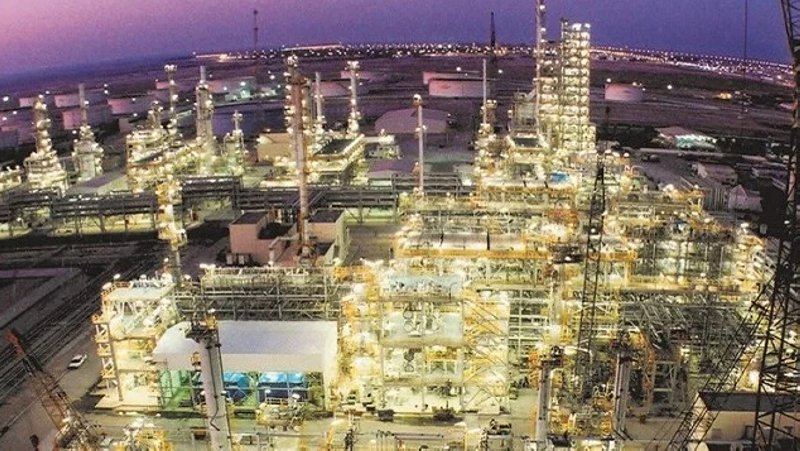
The consequences of the crisis are hitting the liquefied natural gas supply chain in an asymmetric way. Unlike crude oil, which has some alternative outlets — such as Saudi Arabia’s large East-West pipeline and the Emirati pipeline ending at the ocean port of Fujairah — gas extracted in Qatar depends entirely on maritime transport through the strait. The Ras Laffan industrial complex in Qatar exports around 20% of all LNG consumed globally, necessarily through Hormuz. Facing attacks on its infrastructure, Qatar has announced a temporary suspension of production. The naval blockade quickly fills coastal storage capacity, forcing local authorities to halt extraction and liquefaction processes to avoid overpressure risks.
The major container shipping alliances have reacted to the crisis with speed and decisiveness. Maersk, Hapag-Lloyd, CMA CGM and MSC have announced that all their intercontinental fleets will be routed via the Cape of Good Hope, circumnavigating the African continent. Maersk has confirmed the suspension of the passage of all its vessels through the strait “until further notice”, warning that services to Persian Gulf ports will face severe delays or complete suspension.
Several leading carriers — including MSC, CMA CGM, COSCO, HMM, Ocean Network Express (ONE) and OOCL — have suspended indefinitely the acceptance of new bookings for cargo to and from the Middle East. The measure directly affects Upper Gulf ports such as Bahrain, Kuwait and Umm Qasr in Iraq, as well as almost all Saudi and United Arab Emirates port hubs, with the exceptions of Fujairah and Khor Fakkan, which are located on the ocean side before the strait. Lars Jensen, president of Vespucci Maritime, notes that more than 135,000 TEU, with an aggregate value close to 4 billion dollars (around 3.7 billion euros), are currently in uncertain transit between the oceans, caught in maritime diversions of unpredictable duration.
To pass the additional costs along the supply chain, the main ocean carriers have introduced emergency surcharges from the first days of March. Maersk has implemented an Emergency Freight Increase (EFI) of 1,800 dollars (around 1,656 euros) per 20-foot container and 3,000 dollars (around 2,760 euros) for 40- and 45-foot units, with an additional 3,800 dollars (around 3,496 euros) for refrigerated containers on all routes to and from the United Arab Emirates, Qatar, Saudi Arabia, Bahrain, Kuwait, Iraq and Oman. Hapag-Lloyd has introduced a War Risk Surcharge (WRS) of 1,500 dollars (around 1,380 euros) per standard TEU and 3,500 dollars (around 3,220 euros) for refrigerated or special equipment, alongside an additional Contingency Surcharge (CSU) of the same amount for routes affected by the Red Sea crisis. CMA CGM has implemented an Emergency Conflict Surcharge of 2,000 dollars (around 1,840 euros) per standard TEU, 3,000 dollars (around 2,760 euros) for 40-foot FEU units and 4,000 dollars (around 3,680 euros) for refrigerated containers, applicable across the entire Persian Gulf and Red Sea ports. Chinese carriers such as CU Lines and Zhonggu, initially inclined to maintain riskier routes, have also aligned themselves by applying increases ranging from 2,100 to 3,200 dollars.
The situation highlights a significant political paradox. Just days before the outbreak of the conflict, the Trump administration presented the “Maritime Action Plan” (MAP), a presidential directive proposing, among its main measures, the introduction of a universal port tax on all foreign-built commercial vessels calling at US ports. The calculation parameters are based on the weight of imported goods and could range from 1 to 25 cents per kilogram, with the objective of raising 1.5 trillion dollars over the next decade. The International Chamber of Shipping (ICS), the leading global organisation representing shipowners, responded on 4 March with strong opposition, warning that such measures risk distorting international trade, increasing costs for US consumers and encouraging retaliatory measures by third countries. Major shipping companies thus find themselves squeezed between exposure to Iranian fire in the strait and the threat of tariff barriers in the principal Western import market.
M.L.