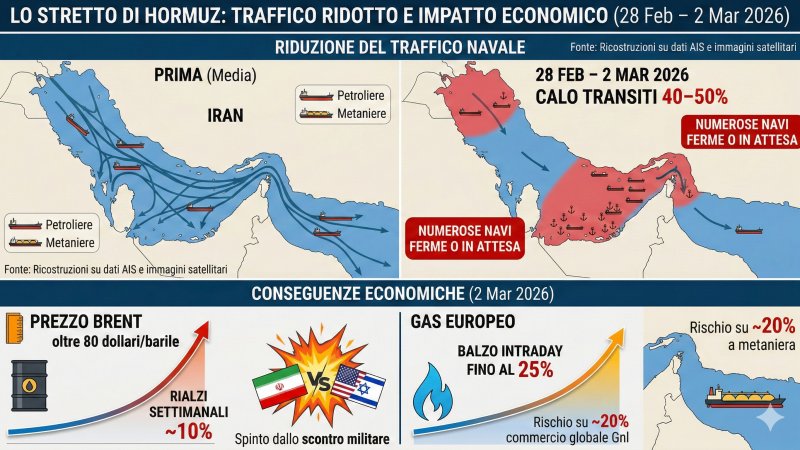






The de facto closure of the Strait of Hormuz, announced on 28 February 2026 by the Islamic Revolutionary Guard Corps (IRGC) following military attacks against Iran, has triggered a rapid reduction in maritime traffic to Gulf ports and an immediate impact on the global ro-ro transport of new vehicles. Several shipowners have suspended or limited car carrier transits through the strait, sharply reducing transport capacity to one of the most important areas for seaborne automotive distribution, due to security concerns and rising insurance costs linked to war risk.
Seaborne vehicle transport depends on a limited number of routes and logistics hubs. Among these, the port of Jebel Ali in Dubai, operated by Dp World, plays a central role. It is one of the main distribution nodes for vehicles destined for the Middle East, East Africa and parts of southern Europe. The port serves as a regional hub for vehicle flows, particularly those originating from Asia. The facility has infrastructure dedicated to ro-ro traffic and extensive storage areas, with a capacity of around 75,000 CEU and berths capable of accommodating several specialised vessels simultaneously.
In the early days of the crisis, the port also experienced a temporary interruption of operations. Activities at Jebel Ali were suspended as a precaution after a fire caused by debris from a missile interception. Dp World later reactivated the terminals, but by that time several shipping companies had already suspended bookings or reduced services to the Gulf. This dual factor – geopolitical risk in the strait and operational uncertainty at regional ports – has reduced the availability of ro-ro vessels on routes linking Asia with Middle Eastern markets. The reduction in transport capacity has led to an immediate increase in logistics costs per vehicle and longer delivery times.
Ships avoiding the Gulf have partly been redeployed on alternative routes or diverted to other markets. In some cases operators have chosen to bypass the area by rerouting services via the Cape of Good Hope, a solution that can add between 10 and 14 days of sailing time on routes between Asia and Europe. This diversion increases fuel consumption and operating costs, with direct repercussions on freight rates.
The effects are also being felt across the distribution chains of the automotive industry. Many Middle Eastern markets depend almost entirely on vehicle imports by sea. Exports from Asian manufacturers, particularly Chinese brands such as Chery, Saic Motor and Great Wall, often use Jebel Ali as an entry and regional redistribution point. The slowdown in Gulf traffic is already causing delivery delays to dealers and distributors across the region.
The consequences are not limited to flows of finished vehicles, but also affect supply chains serving automotive plants in the region. One example concerns Hyundai’s industrial project in Saudi Arabia, where planned production using kit components could face delays if maritime flows to the Gulf remain restricted. For the global ro-ro sector, the Hormuz crisis once again highlights the industry’s dependence on a small number of strategic maritime corridors.