




At 13:00 on 1 March 2026, container terminals across the Middle East were operating in a climate of acute instability following the US and Israeli attack on Iran and the subsequent response. The strikes on 28 February prompted major shipping lines to suspend sailings in the area, while several Gulf port authorities closed or restricted operations. The picture is of a region split between suspended gateways and ports that remain open but under mounting pressure.
According to Reuters, as of 1 March hundreds of commercial vessels, including container ships, were anchored on both sides of the Strait of Hormuz awaiting developments. No formal international closure of the passage has been declared, but Iranian radio warnings, military risk and internal carrier directives have led to a collapse in effective transits. Many container lines have withdrawn from the strait, revising decisions already taken in recent weeks regarding the Red Sea corridor.
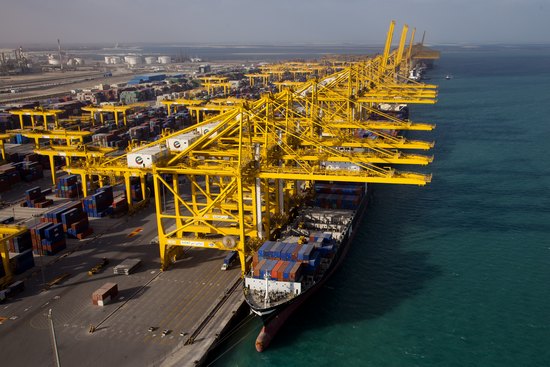
In the Gulf, the most significant impact concerns Jebel Ali, the United Arab Emirates’ main container hub. Operations have been suspended, and the closure of a gateway of this scale sharply reduces transhipment and regional distribution capacity, with immediate effects on feeder services to other Gulf ports.
Elsewhere in the United Arab Emirates, Sharjah remains open and operational, while Fujairah and Khor Fakkan are working at full capacity with no navigation notices issued. These ports, located outside the inner Gulf, offer short-term alternatives for diverted volumes. However, their transhipment capacity is lower than Jebel Ali’s, and rising arrivals risk triggering selective congestion, with waiting times increasing.
In Oman, the port of Duqm, including Asyad Dry Dock, has suspended operations, while Sohar and Salalah remain operational. Salalah in particular continues to act as a hub on Arabia–Asia routes, at a time when carriers are redesigning rotations to avoid the most exposed areas. The operational resilience of these ports is central to maintaining continuity on services linking the Middle East with Asian and African markets.
In Kuwait, all ports are formally open, but the Kuwait Ports Authority has ordered container vessels bound for Shuaiba to divert to Shuwaikh, which operates with a 9.6-metre draught limit and at ISPS level 2. Manifests are transferred automatically. This decision concentrates flows on a single terminal, raising the risk of saturation and delays in truck movements and gate operations.
In Qatar, the ports of Hamad, Doha, Ras Laffan, Mesaieed and Al Ruwais are open, but GPS signal degradation has been reported and maximum caution is advised for navigation. Airspace restrictions, with limits on crew changes in several Gulf countries, are further complicating port call planning and vessel rotations, with indirect effects on terminal productivity.
Maritime sources cited by Lloyd’s List report operational suspensions in some ports in Dubai, Oman and Bahrain amid fears of further attacks, while major Saudi Arabian ports, including Jeddah and Yanbu, remain operational without official suspension notices. In Jordan, the port of Aqaba is fully operational, with terminals and services running regularly according to Iss Shipping, making it one of the few Levant gateways not directly affected by restrictions.
Maersk, CMA CGM and Hapag-Lloyd have announced the suspension of transits through the Strait of Hormuz. According to Maersk, port omissions in the Gulf are possible, with containers to be discharged at alternative ports and forwarded by road or feeder services. CMA CGM has introduced an “Emergency Conflict Surcharge” for the Middle East area.
The current crisis comes on top of an already fragile situation along the Red Sea–Suez corridor. After a partial return to Suez transits in February, the new escalation has halted the reabsorption of flows previously diverted via the Cape of Good Hope. The combined effect is a structural increase in sailing distances, transit times and fuel consumption, with repercussions for logistics costs and the balance between capacity and demand.