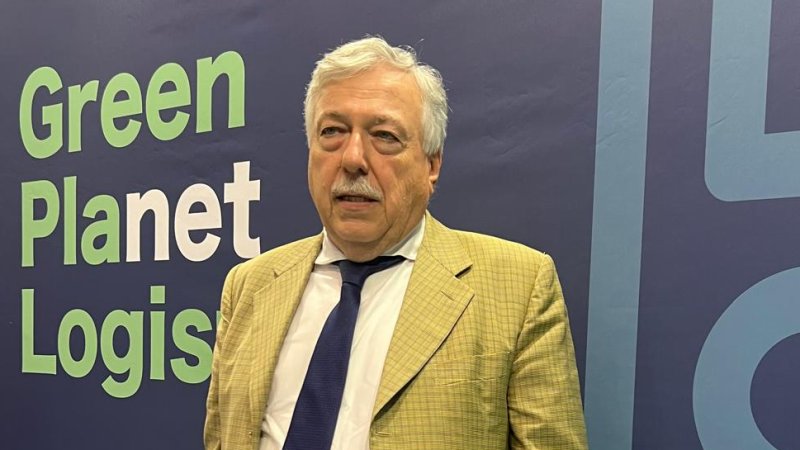




As widely reported by the German press in recent days, Deutsche Bahn has formalised the restructuring of its freight subsidiary’s management. The supervisory board appointed 57-year-old Bernhard Osburg as the new chief executive of DB Cargo during an extraordinary meeting on 30 October 2025. The German engineer will officially take office on 15 November, succeeding Sigrid Nikutta, who has been blamed by unions for the company’s ongoing crisis.
The appointment is part of the broader restructuring plan launched by Evelyn Palla, CEO of Deutsche Bahn Group since 1 October 2025, who has initiated a sweeping renewal of the management board. Alongside Osburg, the board will welcome Karin Dohm, joining from Continental and Hornbach, who will become chief financial officer on 1 December 2025, and Harmen van Zijderveld, who will take charge of regional traffic from 1 November 2025. According to Werner Gatzer, chairman of the supervisory board, the goal is “to accelerate and bring in the necessary expertise for the planned relaunch.”
The Evg union, Nikutta’s main critic, has welcomed the new structure, describing it as a balance between continuity and innovation. The German rail group faces one of the most challenging phases in its history: strained infrastructure, rising debt, and the need for a deep administrative overhaul. Palla has already announced a comprehensive review programme for 2026, dubbed “the year of major reorganisation”, aimed at strengthening regional responsibilities and reducing the size of central operations.
Bernhard Osburg, originally from Duisburg, has extensive industrial experience. A mechanical engineering graduate from Duisburg and Düsseldorf, he began his career in 1996 at Johnson Controls Interior before moving into management consulting with Roi Management Consulting. He joined the Thyssenkrupp Group in 2000, where he held several senior positions, eventually becoming chairman of the executive board of Thyssenkrupp Steel Europe in 2020, a role he maintained until August 2024.
His departure from Thyssenkrupp came amid internal tensions surrounding the restructuring of the steel division and the proposed joint venture with entrepreneur Daniel Kretinsky. Osburg and part of the management team resigned after disagreements with the group’s top leadership, receiving backing from several union representatives within the steel sector.
His new position at DB Cargo presents a challenge of similar scale: restoring profitability to a company that has recorded losses for fifteen consecutive years and posted an operating deficit of €350 million in 2024. In the first half of 2025, losses fell to €96 million, largely thanks to extraordinary measures such as the sale of locomotives and terminals.
According to the European Commission, which has already approved €1.9 billion in state aid, DB Cargo must return to profitability by the end of 2026 to avoid closure or the forced divestment of business units. One of the key issues is single-wagon traffic, which accounts for over two-thirds of losses but remains vital to German industry. Cutting this service, as proposed in Nikutta’s previous plan, could lead to as many as 8,000 job losses and serious repercussions for supply chains in core sectors such as steel, chemicals and automotive.
Osburg’s challenge is therefore twofold: to ensure economic sustainability without undermining the industrial function of rail freight transport. He must also contend with private competitors, who now hold about 60% of the market, and with a decline in demand, down 10% in the first half of 2025. His knowledge of the steel sector—one of the main users of rail freight—is seen as an advantage in engaging with industrial clients and in defining a new operating model.
In a LinkedIn post on 31 October, Sigrid Nikutta reflected on DB Cargo’s resilience during the pandemic and the war in Ukraine before addressing the core issue: transforming DB Cargo. She acknowledged that achieving profitability by 2026 is “a truly arduous path”, but added that by the end of 2025 almost all divisions will be profitable, except for single-wagon transport.