





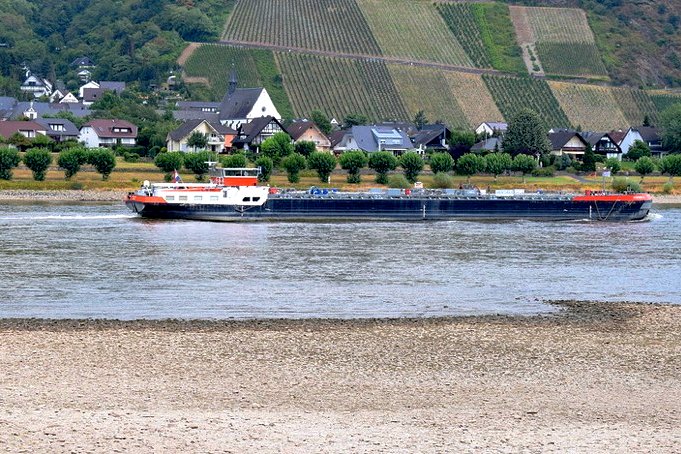
- On 31 July, the navigable depth of the Rhine at Kaub, on the Middle Rhine, fell to about 25 centimetres, matching the low recorded on 22 October 2018. Germany’s Wasserstraßen- und Schifffahrtsverwaltung des Bundes (Federal Waterways and Shipping Administration) expects a new record low of 24 centimetres, with barges often limited to 20% of their payload.
- In the Netherlands, Rijkswaterstaat (Directorate-General for Public Works and Water Management) halted navigation at the Eefde locks from midday on Saturday 25 July, with an immediate ban on water abstraction from the Twentekanaal for irrigation. TLN estimates that the canal closure has generated additional transport demand of about 1,500 lorries a day.
- The cost of tanker barge transport from Rotterdam to Karlsruhe has risen to 150-155 euros per tonne, compared with 45 euros at the end of June. Hapag-Lloyd has warned customers that below 30 centimetres at Kaub the Upper Rhine would effectively be closed to commercial traffic, with longer transit times.
The point where Rhine navigation has been measured in Germany for more than a century is a stretch of river only a few dozen metres wide below the Kaub crag in the Mittelrheintal. On Friday 31 July 2026, the navigable depth at that point fell to about 25 centimetres, the same level reached on 22 October 2018 at the end of a summer of severe drought. This time, however, that threshold was reached in July. The Wasserstraßen- und Schifffahrtsverwaltung des Bundes expects a further fall to 24 centimetres, which would mark the lowest level since measurements began. It should be noted that the gauge reading does not correspond to the river’s actual depth, which at Kaub remains about one metre higher, but is the conventional parameter used to determine permitted draught and carrying capacity. At current levels, vessels operating on the Rhine are often travelling at around 20% of capacity and can still load about 250 tonnes through Kaub. There is no precise threshold at which navigation stops, but there comes a point when loads are too small to be economical or shipowners fear damaging their vessels.
Further downstream, the situation is more uneven. In Cologne the level has fallen to 79 centimetres, while at Duisburg-Ruhrort the WSV forecast for 31 July indicated 152 centimetres, compared with a historic low of 153 centimetres, also recorded in October 2018. At other measuring points, the margin from the record remains significant: about 30 centimetres at Speyer, 19 at Mainz, 15 at Koblenz and 9 at Worms. Upstream, on the Swiss section, Basel’s gauges at the end of June showed levels below seasonal averages but still compatible with normal port operations. The factor German hydrologists consider unusual, however, is the timing: Wasserstraßen- und Schifffahrtsamt Rhein (Rhine Waterways and Shipping Office) and the Bundesanstalt für Gewässerkunde (Federal Institute of Hydrology) describe a low-water event of this intensity as unusually early, as seasonal lows normally occur in late summer or autumn. At the end of June, the Rhineland-Palatinate hydrological service recorded levels at Kaub of between 104 and 107 centimetres, compared with a 2000-2010 historical average of about 224 centimetres. Sporadic rainfall in southern Germany in mid-July brought only temporary relief: on 27 July the gauge stood at 31 centimetres, the following day at between 27 and 30 centimetres, and on 29 July at 29 centimetres.
The economic consequences are already measurable in river freight rates. Tanker barge transport from Rotterdam to Karlsruhe has risen from 45 euros per tonne at the end of June to 150-155 euros on 31 July, with repercussions for grain, minerals and petroleum products. Since the same volume requires more voyages and more partly loaded units, costs multiply just as industrial shippers are seeking alternatives by road and rail, which are also expensive. Hapag-Lloyd has told customers that below 30 centimetres at Kaub the Upper Rhine would effectively be closed to commercial navigation, warning of longer transit times and reduced availability of empty containers. Infrastructure works on the Fulda rail corridor have further restricted the capacity to shift traffic to rail towards southern Germany, Austria and Switzerland.
In the Netherlands, the drought has led to the first real crisis measure. Rijkswaterstaat has closed the Eefde locks, which provide access to the Twente canals, to navigation from midday on Saturday 25 July, while also banning water abstraction from the Twentekanaal for crop irrigation. The reason is structural before it is logistical: on the Almelo-De Haandrik section, the level must remain at least 9.10 metres above NAP, the Amsterdam height datum, because below that point the quays that also serve as embankments risk collapsing. In the preceding days, pumping and restricted use of the locks had not been enough to maintain the required level. From 28 July, the Vechtstromen water authority extended the abstraction ban to much of its area.
The priority order being applied dates back to the protocol defined after the 2003 water crisis, which places the stability of flood defence works, the prevention of soil subsidence and nature protection ahead of other interests, including navigation. No deadline has yet been given for lifting the measures: they will remain in force until the level at Eefde has returned to the required height. For shippers and carriers in the area, the ports of Meppel, Kampen and Zwolle remain available and are accessible without draught restrictions even at current levels.
The road haulage impact has been calculated by TLN, Transport en Logistiek Nederland (Transport and Logistics Netherlands), which estimates that the closure of the Twentekanaal alone is generating additional demand of about 1,500 lorries a day. TLN places the figure in a wider context: lower permitted loads on the Rhine, Meuse and Waal are shifting growing shares of traffic to road and rail, increasing pressure on already critical corridors such as the A15 motorway. The association’s president, Elisabeth Post, has proposed making rail transport temporarily more cost-effective during periods of drought, in order to absorb part of the volumes with available capacity. She has also warned that without better coordination between modes, flows diverted to road are unlikely to return to water or rail once the emergency has passed.
On the Swiss side, Schweizerische Rheinhäfen (Swiss Rhine Ports), the company that manages the Rhine ports, says water scarcity means more hold capacity must be used to move the same volumes, directly increasing logistics costs. Risks of fuel shortages, as fuels are also transported by inland waterways, have been ruled out by Avenergy Suisse, which points to mandatory reserves covering four and a half months and diversified supply channels: 22% arrives via the Rhine, 31% by rail and 41% through the pipeline from southern France.
German authorities cite the prolonged absence of significant rainfall, combined with heatwaves that have reduced inflows into the Rhine basin, as the main causes of the situation. The Bundesanstalt für Gewässerkunde does not expect a lasting improvement in the coming weeks, as forecasts remain largely dry and isolated rainfall is not enough to restore levels on a stable basis. The impact on logistics is accompanied by environmental consequences: rising water temperatures, lower dissolved oxygen, stress on fish fauna and, in some places, the emergence of wartime ordnance previously submerged.
Antonio Illariuzzi