




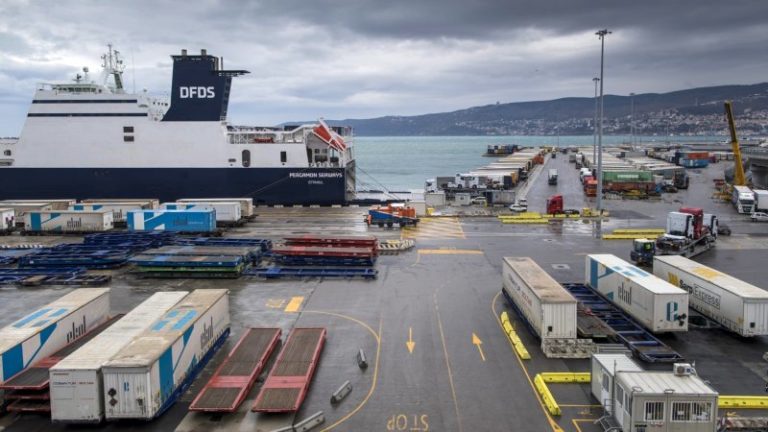
The port of Trieste has become the focal point of the battle for trailer shipping between Turkey and Europe since September 2024, when Grimaldi launched a direct ro-ro link between Trieste and Ambarli in Istanbul. The service was later expanded with a call at Patras and, in March 2025, reinforced with the deployment of a third Eco-class vessel. The Italian group’s entry, followed by Msc’s announcement of a new service on the same corridor, has further crowded and intensified competition on the Turkish–Italian axis, which had long been dominated by Dfds.
For Dfds, which relies on Trieste as its main gateway for Turkish traffic, profitability in the second quarter of 2025 took a clear hit. Volumes held up reasonably well, but pricing fell short of expectations, eroding margins. The company responded by diverting part of its capacity to alternative routes, including the newly launched service between Trieste and Damietta in Egypt, as well as stronger links to France and Tunisia. It also announced the introduction of a new tariff model in September, though without entering into a destructive fare war.
Competitive tensions in the Mediterranean were the main factor behind the sharp decline in group earnings during the quarter. The Ferry division posted revenues of 4.313 billion Danish kroner (around 578 million euros), down 6.9 per cent on 2024, with Ebit slumping to 186 million kroner (25 million euros), a year-on-year drop of 63.4 per cent. More than 90 per cent of the fall in the division’s adjusted Ebitda was attributed to the Mediterranean, further weighed down by higher net fuel costs and the expense of launching passenger services to Jersey.
In terms of volumes, the Mediterranean ended the quarter with a 2.4 per cent increase, supported by flows between Turkey or Tunisia and France and by the new Egypt connection. The Turkey–Italy route via Trieste, however, was under greater strain as competitive pressure drove down freight rates. Elsewhere, performance was mixed: down 1.8 per cent in the North Sea, hit by strikes at Swedish ports, up 0.5 per cent in the English Channel thanks to the new Jersey services, down 4.5 per cent in the Baltic and up 6.3 per cent in the Strait of Gibraltar, where Dfds nonetheless had to close the Tarifa–Tangier Ville route in May, transferring its two vessels to Jersey operations.
The Logistics division presented a more resilient but uneven picture. Quarterly revenues rose to 3.897 billion kroner (522 million euros), though profitability remained under pressure, with Ebit falling to 33 million kroner (4.4 million euros). Northern Europe and the Continent continued to face overcapacity and aggressive tendering, while in the United Kingdom and Ireland Dfds managed to sustain positive organic growth. Conditions were more challenging in Turkey and Southern Europe, where weak demand, pricing uncertainty and rail bottlenecks into Germany added to difficulties.
To tackle these dynamics, the company accelerated its Logistics Boost restructuring programme, which currently covers eight projects. More than 400 full-time positions have been cut, five activities discontinued and eight sites closed or consolidated. In parallel, in the new Türkiye & Europe South division, over a thousand equipment units have been sold and around a thousand full-time positions reduced, with greater reliance on subcontracting.
At group level, Dfds closed the quarter with consolidated revenues of 7.810 billion kroner (1.045 billion euros), up 3 per cent year on year, but Ebit fell to 163 million kroner (22 million euros), a 69 per cent drop. The company has lowered its forecasts for 2025, now expecting Ebit between 0.8 and 1.0 billion kroner (107–134 million euros), revenue growth of around 5 per cent and stable adjusted free cash flow of 1 billion kroner (134 million euros). On the balance sheet, financial leverage stands at 4.2x, with the aim of bringing it down by year end through cash flow and a cut in capex, which are projected at 1.4 billion kroner.