



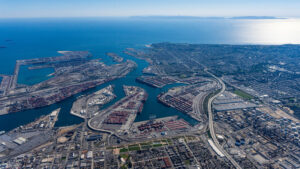
At 9 a.m. on 9 September 2025, during unloading operations at Pier G, 67 containers toppled from the Portuguese-flagged Mississippi, which had been chartered by Israeli carrier Zim. The vessel, owned by Norway’s Mpc Container Ships and with a capacity of 5,504 teu, had sailed into the US port after departing Yantian in China on 26 August. The incident led to a temporary suspension of activities at Pier G, although other terminals at Long Beach continued operating normally.
Eyewitnesses described a domino-like collapse of the containers. Some units fell into the water while others crashed onto the quay. Among the collateral damage was the Stax-2 barge, an emissions-capture system serving the vessel, which was struck by several falling containers. Fortunately, no injuries were reported among crew or dockworkers.
The containers carried mainly consumer goods destined for the US market, including clothing, footwear, electronics and furniture bound for retailers such as Costco, Target and Walmart, alongside independent distributors. Aerial images showed garments and shoes floating in the harbour waters. The economic fallout was immediate: the shutdown of the terminal triggered daily costs estimated at one million dollars for berthing the vessel, while retailers are facing losses from destroyed or damaged cargo.
Authorities set up a unified command involving the Coast Guard, Fire Department, Long Beach Police, the US Army Corps of Engineers and the Port Authority, with input from commercial operators. The Coast Guard established a 500-yard (460-metre) safety zone around the ship, issued hourly navigation advisories and deployed vessels and aircraft to monitor the situation. Containment measures included laying floating barriers to corral containers in the water and using high-pressure jets to keep them within port limits. Some units sank and will require underwater recovery operations. Unified command meetings outlined a salvage plan, although the timeframe remains uncertain.
On the question of causes, the Coast Guard has launched a preliminary inquiry. Port operators have suggested possible ballast imbalance, mistakes during unloading or instability linked to the removal of lashings. Workers with long experience stressed the exceptional nature of such an accident occurring at the quay.
The incident also affected the Stax-2 system, developed by Stax Engineering, designed to connect to ship exhausts and capture up to 99% of particulate matter and 95% of nitrogen oxides. Damage to the unit represents a temporary setback for the port’s environmental agenda, which has been guided for years by the Clean Air Action Plan aimed at limiting the impact of port activities on surrounding urban areas.
Long Beach port handles more than 9 million teu annually and cargo worth 300 billion dollars. Together with Los Angeles, it manages around 40% of the country’s inbound containers. Pier G terminal, founded in 1971 and operated by International Transportation Service, is one of the six main facilities in the port complex, offering direct rail links as well as stevedoring services for major international carriers.