




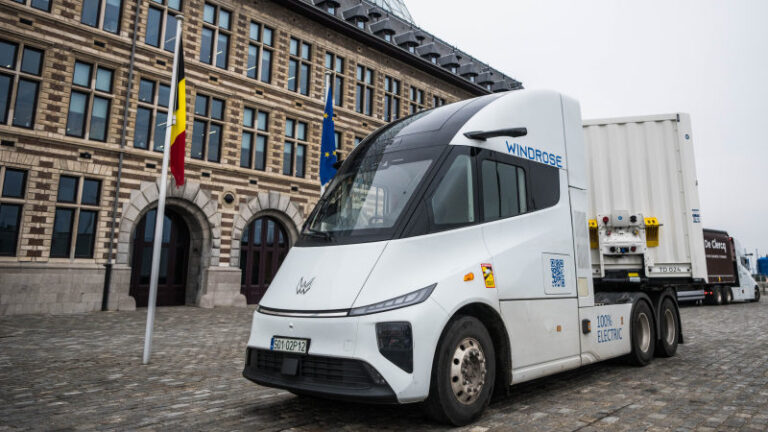
In 2026 the European heavy commercial vehicle market is facing an unprecedented wave of competitive pressure. Chinese truck manufacturers are entering the continent with battery-electric models whose list prices may be up to 30% lower than those offered by traditional operators. This advance comes at a time when Europe’s fleets have aged significantly: according to data compiled by Ing Think, the average age of trucks in the EU has exceeded 14 years, with around six million commercial vehicles on the road, including 2.2 million long-haul tractor units.
The need to renew these fleets is generating replacement demand estimated at around 385,000 units in 2026, slightly above the ten-year average. However, long-established European manufacturers are struggling to offer economically sustainable alternatives: an electric truck produced in Europe costs on average about €320,000, roughly three times the price of a comparable diesel vehicle. It is in this market opening that the Chinese industry is positioning itself, backed by a domestic market in which zero-emission heavy vehicles already account for 29% of total sales. This share has enabled Beijing’s manufacturers to amortise research and development costs over enormous volumes and develop a mastery of lithium iron phosphate (LFP) battery chemistry that Western competitors have yet to replicate.
On the regulatory front, January 2026 marked a significant turning point in EU-China trade relations. The European Commission introduced the so-called Price Undertaking framework, a mechanism allowing Chinese manufacturers — including Byd, Geely and Saic — to avoid anti-subsidy duties, which had reached 35.3% for companies deemed non-cooperative and 17% for groups such as Byd, provided they respect a minimum sales price in the European market. The first concrete case occurred in February 2026 with the exemption from duties for the electric SUV Cupra Tavascan from the Volkswagen Group, assembled in China. An unexpected effect of this agreement is that Chinese companies now retain the extra margin that previously flowed into EU customs revenues, giving them additional resources to reinvest in local factories and subsidised service contracts.
Further complicating the picture, 1 January 2026 marked the entry into force of the final phase of the EU’s Carbon Border Adjustment Mechanism (CBAM). Importers of heavy industrial goods are beginning to accumulate real financial liabilities, with the first certificates to be purchased by February 2027. Chinese manufacturers, which use significant quantities of steel and aluminium in their truck chassis, face gradually rising costs linked to the carbon price differential between Europe and China. However, industry analysts estimate that their competitive advantage in battery manufacturing and power electronics will more than offset the penalties introduced by CBAM.
On the production side, several Chinese manufacturers have already launched or announced European plants. Byd has invested in building a factory in Szeged, Hungary, and is planning a plant in Turkey by 2026. The Turkish location is strategically significant because, thanks to the customs union with the EU, it allows exports to Western Europe without the duties applied to imports from mainland China. Windrose, a start-up founded in 2022, has chosen the Port of Antwerp-Bruges in Belgium as the site of its first European plant, with a €100 million investment on an 8.5-hectare former industrial site and an initial capacity of 2,000 trucks per year. A second facility is being planned in Onnaing, France. Sinotruk and SuperPanther instead assemble vehicles at Steyr Automotive in Austria, respectively using SKD (Semi-Knocked Down) assembly and contract manufacturing.
The models proposed by Chinese manufacturers feature specifications that directly challenge European platforms. The Sany e263 4x2 electric tractor unit, with the first European deliveries expected in the first quarter of 2026, is equipped with a 636 kWh LFP battery on an 800-volt architecture, with a declared range of more than 500 km at full load and a kerb weight of just 10.9 tonnes, maximising payload capacity. Windrose positions its tractor at around €250,000, with a 670 km range designed to cover the entire maximum driving shift permitted under European regulations without intermediate charging.
A decisive factor for commercial penetration is the aftersales service network, historically the weak point for new entrants in the commercial vehicle market. Chinese manufacturers have adopted different approaches to address this gap. Sany has signed a partnership with Alltrucks, the European multi-brand network of more than 700 workshops founded by Bosch, Knorr-Bremse and Zf, offering maintenance contracts of six to ten years and 24-hour roadside assistance in 13 countries. In the UK market, Farizon has reached an agreement with The Aa (Automobile Association), with more than 100 mobile technicians, 200 workshops and warranties of four years or 120,000 miles. SuperPanther has also joined the Alltrucks network, replicating Sany’s model.
In long-term technological innovation, Asian manufacturers are also closing the gap in hydrogen fuel-cell powertrains (FCEV), considered essential for ultra-long-distance heavy transport. Foton Motor has tested a commercial fleet of more than 3,600 hydrogen vehicles and unveiled the Beacon platform for heavy trucks, designed to accommodate high-pressure gaseous hydrogen modules or cryogenic liquid hydrogen, with declared ranges exceeding 1,000 kilometres and refuelling times of around 15 minutes. Sinotruk has developed a technology partnership with Toyota Motor and Weichai Power on fuel cells, securing orders exceeding 1,100 units in China. In Europe, the H2Accelerate Trucks consortium, funded with nearly €30 million by the Clean Hydrogen Partnership, aims to register 125 fuel-cell trucks across six member states by 2028 — volumes that pale in comparison with operations already under way in Asia.
Projections by S&P Global Mobility indicate that the share of Chinese brands in the European car and transport vehicle market will rise from around 6% in 2025 to nearly 15.5% by 2035, with more than 2.1 million Chinese vehicles registered annually in Europe. In the heavy commercial vehicle sector, this dynamic is expected to appear with a delay of 24–36 months, the time needed to complete a widespread aftersales service network.
In terms of commercial models, the same analytical agencies foresee a gradual transition towards Vehicle-as-a-Service platforms and subscription-based contracts, a format in which Chinese manufacturers hold a structural advantage thanks to their native expertise in cloud-connected electronic architectures and onboard artificial intelligence systems. According to MarketsandMarkets data, the global market for vehicle subscription services is expected to grow at a compound annual growth rate of 13.6% between 2024 and 2035, expanding from $4.8 billion to $22 billion (around €20.3 billion at the current exchange rate).
Michele Latorre