




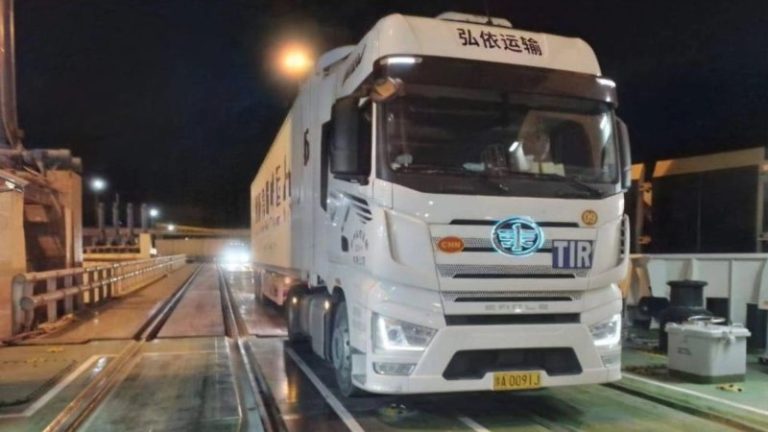
Russia’s road haulage industry is facing one of the deepest crises in its recent history. At the centre of the tensions is the unprecedented expansion of Chinese carriers, accused by Russian trade associations of engaging in price and social dumping, systematically breaching regulations and increasingly operating in domestic cabotage. According to many operators, this is no longer an episodic phenomenon but a structural shift that risks undermining the very survival of the national haulage sector.
Following the attack on Ukraine and the introduction of European Union sanctions, journeys handled by Chinese hauliers have risen exponentially, from 100,000-150,000 per year to more than 300,000 in 2023, 400,000 in 2025, and potentially close to half a million in 2026. According to industry associations, this trend has led to the bankruptcy of more than 7,000 Russian companies and the return of around 20,000 trucks to leasing firms. The news has been widely reported in Russian media, which have gathered testimonies from road transport entrepreneurs describing how their businesses are struggling amid the advance of Chinese carriers.
At the root of this new reality lies not only an aggressive commercial strategy, but also a fundamentally different cost and financing structure. In China, for example, a truck from state-owned manufacturer Faw costs around 3.5 million roubles (about €38,000 at current exchange rates), while in Russia it is sold for 7 million. The gap widens further on financing, with Russian leasing rates standing at around 21-30%, compared with 3-5% in China thanks to state subsidies. These differences directly affect per-kilometre costs: according to operators, leasing costs amount to 20 roubles per kilometre (about €0.22) for a Russian carrier, compared with just 5 roubles for Chinese operators. Maintenance follows a similar pattern, with monthly costs of 936,000 roubles for a Russian vehicle versus 624,000 for a Chinese one, based on comparable average monthly mileage of 13,000 kilometres.
Significant differences also emerge in regulatory compliance. Chinese carriers are accused of ignoring the requirement to pay the Platon toll for vehicles over 12 tonnes, benefiting from ineffective enforcement by the authorities. Until a few months ago, Russian cameras were unable to recognise Chinese licence plates, and roadside checks remain difficult. A Chinese driver in Russia can be fined only in the presence of a certified interpreter, a figure rarely available at checkpoints, meaning many penalties are effectively disregarded by the police. The situation is further complicated by the lack of information exchange between Russian and Chinese customs systems, and by the fact that fines issued in Russia do not follow drivers across the border, while Russian trucks entering China are stopped by authorities and released only after penalties are paid.
Four years after the outbreak of the war in Ukraine and the gradual establishment of Chinese vehicles, the areas covered by these carriers have also changed. Initially concentrated in border regions, they have progressively expanded into the Russian interior, carrying out continuous cabotage operations to the detriment of local firms. Over time, Chinese operators have also developed their own freight forwarding networks and logistics bases, opening offices across Russia and even dedicated hotels where drivers can rest while waiting for new loads.
According to media reports and industry sources, Chinese companies also operate without effective controls on driving hours or vehicle weight, covering up to 1,500 kilometres per day or carrying loads of 30 tonnes over long distances, at times damaging roads and infrastructure. Accusations of social dumping are also frequent, particularly linked to excessive driving hours and the exploitation of drivers. Another factor disadvantaging domestic operators, and cited by media as a source of unfair competition, is the recycling tax tied to the cost of dismantling obsolete vehicles, which applies only to Russian operators and not to foreign trucks.
To address the crisis, at least partially, and support domestic firms, the Ministry of Transport has recently proposed a series of countermeasures, including subsidised leasing rates for trucks, a reduction in the recycling tax and insurance incentives. However, operators have stressed that these measures are both late and only partial.
The Russian case, which may seem distant today, particularly given the geopolitical context, could serve as a warning for the entire European Union. Until a few years ago, the idea of a large-scale presence of Chinese trucks on European roads seemed far-fetched, but new Eurasian routes and persistent cost pressures make this scenario increasingly plausible. Without symmetrical rules, effective enforcement and tools to protect the internal market, Chinese competition could quickly overwhelm European haulage companies as well. Brussels has the advantage of observing what is happening in Russia and introducing the necessary countermeasures to avoid facing similar challenges.
Marco Martinelli