






China represents a world of its own in the railway sector too, accustomed to overwhelmingly outperforming comparisons with networks in other countries or even entire continents. Further confirmation comes from the five-year plan defined in early 2026 by China Railway, the fully state-owned company run by the State. By 2030, the railways expect network expansion through the opening of a further 15,000 kilometres of lines, reaching a record length of more than 180,000 kilometres.
The flagship once again is the high-speed passenger network, which will total 60,000 kilometres, effectively three times all existing high-speed lines currently in operation across the five continents. Over the past five years, China’s railway network has grown by 13%, with high-speed lines expanding by one third. Freight traffic is also robust, reaching 19.6 billion tonnes, up 24.1%. In 2025, Chinese railways moved 4.1 billion tonnes of freight, an increase of 2.1%.
Alongside the network itself, there is no shortage of other primacies, true world records that dwarf any comparison with what other railways can offer. These concern both passenger and freight transport. In the former case, the standout project is the CR450 high-speed train, where the designation refers to a maximum speed set at 450 km/h, translating into an unprecedented commercial speed of 400 km/h. This will also require the modernisation and upgrading of existing high-speed lines to operate at these speeds.
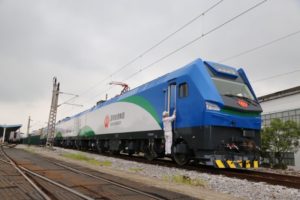
As for freight services, the crown jewel of Chinese railways is the Shen-24, a true giant of cargo transport. Although it is reductive to define it simply as a locomotive, as it resembles an entire locomotive train, it delivers almost 29 MW of power and a tractive effort of over 2,000 kilonewtons. By comparison, a Siemens Vectron has an hourly power output of 6.4 MW with 300 kN, while a Bombardier Traxx family locomotive ranges from 4.2 to 6.4 MW.
Its visual impact is also imposing, as the Shen-24 consists of six sections with an overall length exceeding 100 metres. But it is in terms of performance that it has no equal: a single unit can haul a 10,000-tonne freight train on a 12 per mille gradient at a maximum speed of 120 km/h. This makes it ideally suited to operations where it can fully exploit its capabilities, namely the long and heavy freight trains typical of mineral transport.
However, Chinese railways are not focused solely on record-breaking passenger high-speed services or freight gigantism on dedicated lines, but are also investing in the conventional network. Construction is nearing completion on the 238-kilometre double-track mixed-traffic line from Liuzhou-Guangzhou to Wuzhou, in Guangxi province. Track laying is also under way to complete the Ruijin-Guangzhou conventional line in Jiangxi province, another mixed-traffic route stretching 240 kilometres.
Piermario Curti Sacchi