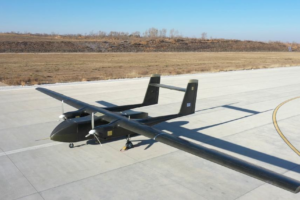





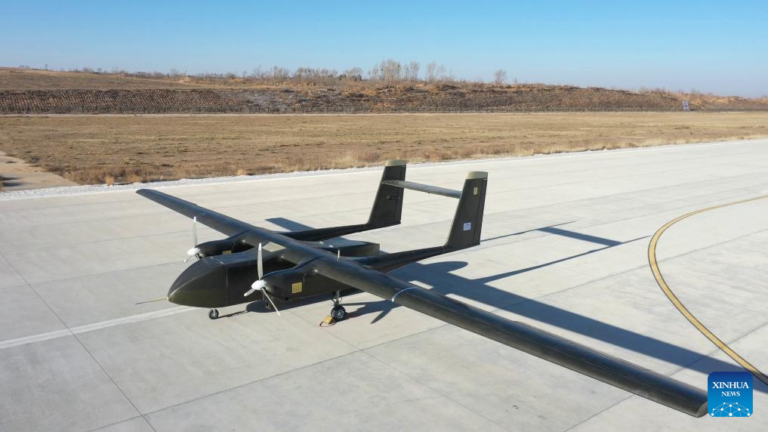
On 11 January 2026, the Tianma 1000 cargo drone successfully completed its first flight in China. The unmanned aircraft is developed by Xi’an Asn Technology Group, a subsidiary of China North Industries Group Corporation, a defence industrial group supervised by Sasac (State-owned Assets Supervision and Administration Commission of the State Council). The Tianma 1000 is a tonne-class unmanned transport aircraft designed to operate at medium altitude with relatively low operating costs. The drone can carry up to one tonne of payload, with a maximum range of 1,800 kilometres and an operational ceiling of up to 8,000 metres.
One of the system’s core features is its ability to take off and land in confined spaces. The take-off run is less than 200 metres and the aircraft can operate on unpaved surfaces, such as grass fields or compacted dirt roads, significantly expanding the range of usable airstrips. This configuration allows the drone to be deployed in high plateaus, mountainous regions, coastal areas and rural locations with limited airport infrastructure.
The Tianma 1000 integrates an automatic loading and unloading system capable of handling one tonne of materials in around five minutes, from cargo arrangement in the hold to ground operations. The entire operational cycle – mission planning, load management and flight execution – is based on full automation. The architecture includes intelligent route planning, autonomous obstacle avoidance and flight management in adverse weather conditions.
The aircraft’s avionics include systems for recognising mountainous terrain, buildings and obstacles in unfamiliar airspace. It also features an optical assisted landing system enabling precise autonomous manoeuvres even in rain, snow, fog or haze. A flight attitude tolerance system is also cited, designed to maintain stability and controllability in crosswinds and turbulence.
The modular cargo bay allows rapid reconfiguration between different missions, including freight transport, aerial delivery, communications platform and other applications. The aircraft can switch quickly from cargo mode to airdrop configuration, broadening its operational spectrum in both civil and emergency scenarios. Declared applications include high-frequency express air routes, resupply of remote and border areas, emergency management support and deliveries to regions that are difficult to reach by land.
Official sources refer to its use in the event of earthquakes and natural disasters, when road infrastructure is damaged and conventional links are disrupted. The combination of a one-tonne payload, 1,800-kilometre range and short-runway capability allows several days’ worth of supplies to be delivered in a single flight. While official sources do not explicitly mention military applications, the programme is developed by Norinco, a major defence group, making potential civil-military dual use a plausible scenario.
The Tianma 1000 is presented as a response to structural bottlenecks in areas with weak logistics infrastructure. The ability to create temporary nodes in villages, emergency base camps or border areas, connected to larger hubs via express air routes, introduces a network model positioned between ground transport and traditional aviation. Reduced staffing requirements, enabled by automated loading and mission planning, could reshape cost structures in environments where deploying large teams is complex. The stated objective is to develop an “intelligent logistics ecosystem” capable of operating in all weather conditions and across multiple application domains.
P.R.