




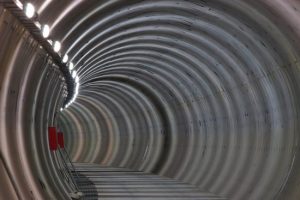
The headline chosen by the Austrian daily Tiroler Tageszeitung raises a question that nonetheless suggests a far from optimistic outlook: “What future for the Brenner Base Tunnel? Its inauguration in 2032 is hanging by a thread”. In its 10 March 2026 edition, the Tyrolean newspaper expresses more than one doubt about the timetable for completing the railway tunnel between Italy and Austria. The question arises from a query put forward by the Transport chief of the Austrian region of Tyrol, René Zumtobel, to the project company Bbt, which oversees construction of the cross-border infrastructure. The Tyrolean State Councillor asked for a realistic assessment of the tunnel’s opening date. Clearly something is not adding up, given the official move by Tyrol’s transport chief.
The answer lies in the construction schedule. On the one hand, around 90% of the tunnels that make up the project have already been excavated, representing a total development of 230 kilometres. On the other hand, procurement procedures are running behind schedule, along with the subsequent works needed for the technological equipment of the line, from track installation to the electric traction system, and from signalling to safety systems. According to Tiroler Tageszeitung, the start of operations for the base tunnel could be pushed back by another two years, effectively moving the date to 2034. The newspaper also reports that the overall cost of the project may have risen to around €10.5 billion, including procurement procedures for the railway equipment, which alone is worth around €1.5 billion.
Several decisive steps for the final phase of the project also remain unresolved. In particular, Rfi (Rete Ferroviaria Italiana – Italian Railway Network) and Austria’s Öbb-Infrastruktur (Austrian Federal Railways Infrastructure) still need to agree on various aspects linked to the management of the future railway, partly due to technical choices that are far from straightforward. One example concerns the power supply. As the electrical systems differ between the two countries, a particularly complex model has been chosen: instead of a simple voltage change at a single agreed point, trains will enter from the Austrian side with 15 kV at railway frequency, switch to 25 kV at industrial frequency along the shared section, and then move to 3 kV direct current once in Italy. Moreover, as is normal for infrastructure of this scale, once construction is completed a testing and pre-operational phase lasting around one year will also be required. Only after this phase is completed will the railway tunnel actually enter service along the Brenner corridor.
Piermario Curti Sacchi