




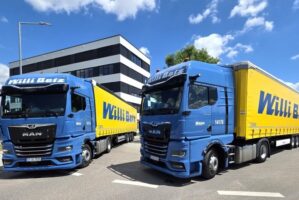
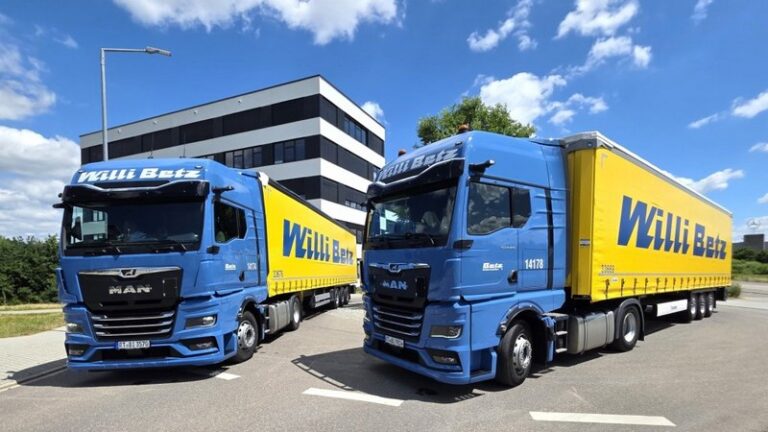
On 2 April 2026, Betz International filed a request to open insolvency proceedings with the Amtsgericht (local court) in Tübingen. The news became public on 8 April, quickly turning into a symbol of a broader crisis affecting German road transport and, more broadly, the industrial model that has supported it for decades. The company is part of one of the most well-known German and European haulage groups, Willi Betz, founded in the post-war period in Reutlingen and expanded into one of the continent’s leading carriers, recognised for its yellow trucks with blue lettering and a strong presence along East-West corridors. At its peak, the group generated close to €1 billion in revenue and employed thousands of people.
Today, Betz International employs around 140 staff, all of whom are affected by the ongoing proceedings. The Tübingen court has ordered a “vorläufiges Insolvenzverfahren” (preliminary insolvency proceeding), under which the court-appointed provisional administrator, lawyer Dirk Poff, is tasked with assessing the company’s assets - including fleet, property, receivables and existing contracts - and liabilities, in order to evaluate possible outcomes: continuation after restructuring, sale of business units to new operators, or liquidation. Day-to-day operations are continuing under the administrator’s supervision. Employees’ wages are guaranteed for three months through Insolvenzgeld, the mechanism designed to protect workers’ income at the start of insolvency proceedings.
Management has cited reasons increasingly common among struggling transport companies: a combination of weak economic conditions and rising costs that has made continuing operations in their current form unsustainable. The group’s leadership stated that internal optimisation measures and cost reductions were insufficient to offset pressure from higher fuel prices, intense competition from foreign carriers with lower labour costs, and declining volumes in traditionally key sectors such as automotive, chemicals, metals and construction, which form the core of Germany’s industrial customer base.
Betz International is headquartered in Sonnenbühl, in the Reutlingen district of Baden-Württemberg, a historic hub for German road transport and the region where the Willi Betz brand built its identity after the Second World War. However, the scale of the crisis extends well beyond the local level. The company operates internationally, with established links to Eastern Europe, South-East Europe, the Balkans, Turkey and other EU markets. The exit of an operator with such geographic reach opens space for competing carriers, including foreign ones, along corridors where Betz has long been active.
The case is part of a longer-term decline rather than a sudden downturn. Industry reports recall a decades-long erosion, from legal scandals in the early 2000s involving corruption and social security irregularities, which damaged the reputation of a growth model partly based on lower labour costs along the Germany-Eastern Europe axis, to the gradual reduction of fleet, workforce and volumes. Today’s operating subsidiary, with 140 employees, is far removed from the structure that once made the brand a continental benchmark.
The macroeconomic backdrop to Betz International’s insolvency is a Germany that recorded a historic peak in large corporate failures in 2025. According to Allianz Trade, there were 94 “Großinsolvenzen” - proceedings involving companies with revenues above €50 million - an 8% increase on 2024. Globally, Allianz Trade reports that a major insolvency occurs every 18 hours. In Germany, total insolvency cases exceeded 23,000-24,000 in 2025, with further increases expected in 2026 and logistics among the sectors under greatest pressure.
Several structural factors underpin this trend. The extreme fragmentation of the market, dominated by small and medium-sized enterprises exposed to cost shocks in fuel, tolls and financing, has combined with the end of emergency measures introduced during the pandemic. The partial suspension of the obligation to file for insolvency and direct financial support kept many structurally fragile firms afloat, only for them to fail once public support was withdrawn. This has been compounded by a broader loss of competitiveness in the German economic system, driven by higher energy costs, increasing bureaucracy, infrastructure delays and weaker global demand, all of which translate into lower volumes for logistics operators facing high fixed costs.
Pietro Rossoni