




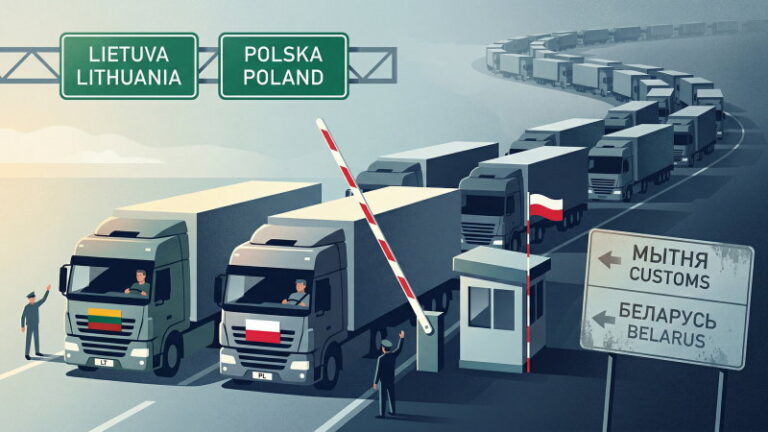
After more than five months of deadlock, Belarus has authorised the return of hundreds of Lithuanian and Polish trucks stranded since the end of October last year. More than 1,900 vehicles, including tractor units, trailers and semi-trailers, had been held at Belarusian customs amid rising tensions linked primarily to security concerns and the broader Europe–Russia divide. Minsk, which had initially demanded exorbitant storage fees, has now lowered its demands, and the trucks are beginning to move again. In recent months, the Lithuania–Belarus route had become a symbol of tensions that rapidly escalated from a local dispute into a wider European crisis.
The dispute began on 27 October 2025, when Lithuania decided to close its border crossings with Belarus following a series of airspace violations caused by balloons apparently used for smuggling, a phenomenon that also disrupted air traffic over Vilnius for several days. Interpreting the move as a provocation, the authorities in Minsk retaliated by blocking hundreds of trucks on the Belarusian side, preventing their return and, in some cases, forcing rerouting via Poland, increasing costs and delaying deliveries. Some trucks had already cleared Belarusian customs and found themselves trapped, unable either to return to Lithuania or divert towards Poland.
In the following days, the situation deteriorated further as Minsk introduced formal restrictions on the movement of Lithuanian trucks, effectively preventing transport companies from recovering vehicles and semi-trailers already inside the country. From 2 November, vehicles registered in the EU were also banned from entering Belarus, deepening a paralysis that had by then reached systemic proportions. For months, thousands of vehicles remained immobilised in customs parking areas and storage facilities, in a situation that risked escalating into a humanitarian as well as a logistical emergency.
Against this backdrop, on 2 March the Lithuanian association Linava submitted a formal complaint to the European Commission, presenting striking figures. The vehicles involved were said to number 1,071, belonging to at least 149 companies, with a total value estimated between €16m and €22m. For their release, Belarusian authorities had initially demanded storage fees of up to €120 per day, explicitly threatening confiscation in the event of non-payment. In its appeal, Linava highlighted a potential breach of the European Union’s economic interests, calling for diplomatic action to secure the return of the unlawfully detained vehicles and for mechanisms to compensate the damage suffered. The European Commission officially described the blockade as unjustified and unacceptable, urging Minsk to facilitate the immediate return of the equipment to its rightful owners.
Despite the urgency, the situation appears to have eased only in recent days, as the first trucks have finally managed to return to Lithuania. Many hauliers, however, must now confront the financial consequences of the blockade, with some fearing they will be unable to repay debts accumulated over months or even recover the stranded vehicles. Belarus has reduced its demands, but daily storage fees remain high. For a trailer–semi-trailer combination, companies must pay €47.6 per day and, for vehicles held since late October, the total bill can easily exceed €7,000. Linava is now coordinating the return operations, issuing instructions to the companies involved and negotiating with the EU over financial support, without which insolvencies and bankruptcies are expected.
What began as a border dispute has evolved into a geopolitical crisis that has tested the resilience of European supply chains, the EU’s ability to respond in a unified manner, and the strength of the road haulage sector, already strained by years of international instability. The coming weeks will show whether the gradual return of vehicles marks the beginning of a resolution or merely a temporary reprieve in a crisis likely to leave lasting scars on the European logistics market.