








Amazon has received authorisation from the UK Civil Aviation Authority to start delivering parcels by drone in the United Kingdom. The approval, granted on Friday 9 January 2026, marks a significant step for the US company, which has been working for years to integrate unmanned aircraft into its logistics network. The decision by the British regulator is particularly notable within the European logistics landscape, coming just days after Amazon announced that it was abandoning its drone delivery projects in Italy, initially planned around the San Salvo facility. The contrast between the two markets highlights how regulatory differences and the broader legal environment can shape the development of innovative transport technologies.
Amazon’s first operational drone delivery service in the UK will be based in the area surrounding the town of Darlington, in County Durham in north-east England. Although the company has been granted permission to begin operations immediately, it has not yet announced a specific start date for actual deliveries. Amazon plans to operate up to ten flights per hour from a local warehouse, with activity spread across twelve hours a day, seven days a week.
The service will allow direct delivery of ordered parcels in under two hours, with drones lowering packages from low altitude directly into customers’ gardens. Amazon originally presented its plans in March 2025, hoping for approval before the Christmas period, but the regulator confirmed its green light only in early January this year.
The authorisation process required Amazon to overcome significant hurdles, particularly concerns raised by some local residents about potential noise generated by the aircraft. The company has provided assurances regarding the minimal acoustic impact of the drones, which are designed to reduce disturbance, and has reiterated that they produce no polluting emissions. According to Amazon, the noise generated by the drones would be lower than that caused by traditional delivery vans, with their slamming doors and reversing manoeuvres.
The Darlington operation marks Amazon’s return to British skies after around a decade. The company carried out early drone trials in the countryside around Cambridge about ten years ago, but later halted those projects due to frustration over the slow progress of drone delivery regulation by the Civil Aviation Authority and other operational challenges.
In the meantime, Amazon has continued to develop its drone delivery service in the United States, where the Prime Air programme is currently active in selected locations, including the Phoenix metropolitan area in Arizona and San Antonio in Texas. The service delivers eligible packages weighing less than 2.3 kilograms – such as personal care items, everyday essentials, medicines and electronics – within one hour of ordering, integrating with same-day delivery stations to provide a faster and more streamlined service during daylight hours and in favourable weather conditions.
The path of the Prime Air service in the United States has not been without setbacks. In October 2025, two Amazon drones crashed in Tolleson, Arizona, after colliding with a construction crane, forcing the company to suspend testing for the second time in 2025. The incident is currently under investigation by the National Transportation Safety Board.
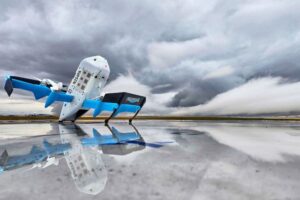
Amazon is expanding its operations beyond its initial test sites in California and Texas, using the new-generation MK30 drones, designed for longer flights, quieter operation and greater resilience to adverse weather conditions. These aircraft can fly in rain and variable temperatures, follow precise routes and release packages into customers’ gardens. The MK30 drones are capable of autonomously detecting and avoiding obstacles such as people, pets and other aircraft to ensure flight safety.
Operations in the United States are conducted in collaboration with the Federal Aviation Administration, as the agency develops its regulatory framework for beyond-visual-line-of-sight flights and the associated certification guidelines for the control and regulation of unmanned aircraft. The drones are deployed from existing Amazon same-day delivery sites, blending with traditional ground-based deliveries by road vehicles to speed up certain eligible shipments.
Amazon’s decision to proceed with its UK launch stands in stark contrast to developments in Italy. At the beginning of January, Amazon told Reuters that it had “decided to halt its commercial drone delivery plans in Italy”, despite the completion of successful tests in San Salvo in 2024. The company had announced the successful conclusion of initial drone delivery trials in the town in the central Abruzzo region in December 2024, an investment that now appears to have been shelved.
The Italian civil aviation authority Enac (Italian Civil Aviation Authority) described the decision as “unexpected” and linked it to “recent financial events involving the Group”. Amazon, however, attributed the failure of the project to the Italian authorities, while avoiding direct accusations against the aviation regulator. In a diplomatically worded statement, the company said that “despite positive engagement and progress with Italian aerospace regulatory authorities, the country’s broader corporate regulatory framework does not, at this time, support our long-term objectives for this programme”.
Antonio Illariuzzi