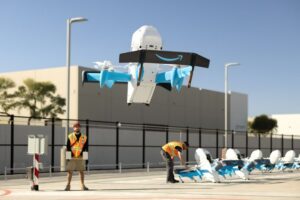







In December 2029 Amazon submitted comments to the Federal Aviation Administration on the new rules the authority intends to introduce for drones flying beyond the operator’s line of sight. According to the e-commerce company, the full integration of drones into last-mile logistics requires an aeronautical environment in which every aircraft is traceable and equipped with advanced detection and collision-avoidance systems.
Commenting on the FAA’s proposal on beyond-visual-line-of-sight operations, Amazon argues that the first safety condition concerns electronic visibility for low-altitude aircraft below 500 feet (152.4 metres). The company believes that requiring all aircraft — including those with a pilot on board — to be “electronically visible” would close a significant gap, ensuring that drones and other operators share mutual awareness of the flight environment.
The second element involves the wider adoption of advanced detection and collision-avoidance systems. Amazon notes that, while recognising the importance of these technologies, the current proposal would limit their mandatory use to certain areas, whereas the safety of shared airspace calls for broader application. The company cites its own computer-vision technology as evidence of its ability to detect a wide range of aircraft, from crewed platforms to hot-air balloons and paragliders, with the aim of preventing interference even when other airspace users are not broadcasting their position.
On this point, Amazon clarifies that it is not proposing the universal adoption of a single camera-based system, but is asking the Federal Aviation Administration to create regulatory pathways for approving different technical solutions that provide detection capabilities beyond human capacity. For the group, technological innovation remains the primary means of ensuring safety in any operating context.
On traffic management, Amazon believes that excessive reliance on drone-dedicated systems, known as uncrewed traffic management, could limit the expansion of delivery services without offering proportionate benefits. The company argues that these systems are valuable in areas with more complex traffic but should not become mandatory in all situations, so as not to hinder scalability.
Another key point concerns the level of oversight required for operators providing home-delivery services. Amazon supports the two-tier regulatory structure envisaged for many beyond-visual-line-of-sight operations, such as agricultural or surveying activities, but maintains that parcel delivery requires a single, more stringent framework. The company says mandatory certification would ensure consistent standards in terms of safety, accountability and supervision, regardless of fleet size or geographical location.