




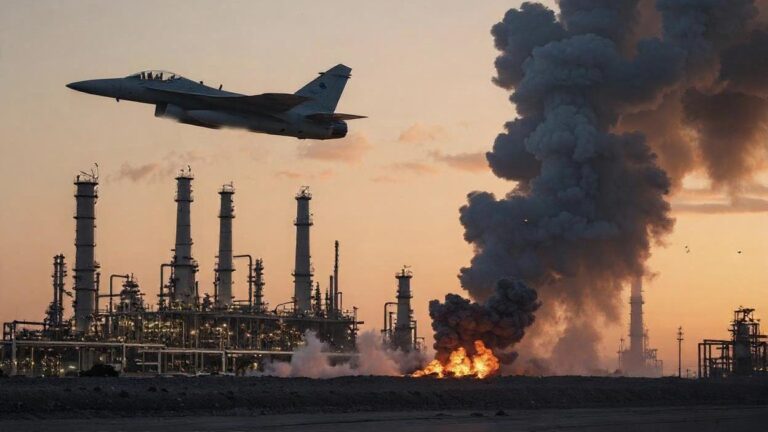
The air traffic crisis in the Middle East, updated at 14:00 on 1 March 2026, is reshaping civil aviation operations within hours and, above all, the availability of air cargo capacity. The trigger lies in the sequence of attacks launched on 28 February 2026 under operation “Epic Fury”, carried out by a coalition led by the United States and Israel against targets in Iran. In the same hours, confirmation of the death of Iran’s Supreme Leader, Ayatollah Ali Khamenei, has accelerated the escalation and hardened air defence postures across the region. Iran’s response, described as operation “True Promise 4”, has involved drone and missile strikes and a rapid extension of civil traffic restrictions by regional aviation authorities.
For civil aviation, the breaking point is not only the direct threat of engagement, but the inability to guarantee separation and reliable target identification in a scenario where multiple countries are operating air defence systems at all altitudes. Easa’s Czib bulletin 2026-03 recommends that operators avoid the airspace of Bahrain, Iran, Iraq, Israel, Jordan, Kuwait, Lebanon, Oman, Qatar, the United Arab Emirates and the northern area of Saudi Arabia, warning of a high risk linked to missiles, drones and anti-aircraft capabilities able to strike even at cruising altitude.
At the same time, national Notams have produced a fragmented and unstable map, with full closures or temporary restrictions subject to rapid renewal. The Tehran FIR is closed, with the extension notified until 08:30 UTC on 3 March 2026, while Israeli airspace is closed to civil flights without priority authorisation until 10:00 UTC on 3 March 2026; Iraq’s closure is described as total. In the United Arab Emirates, restrictions apply, with Escat areas and time windows changing according to risk levels and the capacity to manage diverted traffic, directly affecting Dubai and Abu Dhabi airports.
In this context, electronic warfare has become a multiplier of operational risk. Reports of GNSS interference, including jamming and spoofing, are described as widespread along certain corridors, with potential effects on navigation, flight profile management and crew workload. For airlines, this means abandoning even corridors that are technically open if they do not ensure navigational continuity and an acceptable level of risk under internal safety cases and insurance requirements.
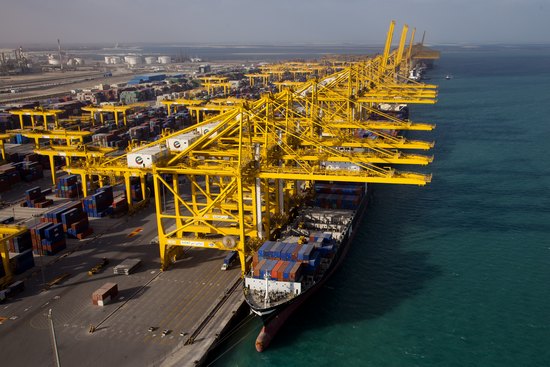
At the heart of the logistical problem is the temporary collapse of the Gulf super-hub model, which over the past two decades has shifted a significant share of east–west flows to the region, including cargo volumes carried in passenger bellyhold and on dedicated freighters. Dubai, Abu Dhabi and Doha are not merely airports: they are consolidation, transit and network feed platforms for intercontinental routes. The suspension of operations or severe limitation of operating windows therefore has an immediate impact on connections between Europe and Asia, Asia and North America and, increasingly, South Asia and Europe. For freight logistics, the most critical variable is the simultaneous loss of widebody capacity and the disruption of routing chains.
Operational decisions by Gulf carriers and global airlines illustrate the scale of the shock. Emirates has suspended operations to and from Dubai, with a restart window linked to safety and airport restoration conditions, while Etihad has announced urgent departure suspensions and Qatar Airways has halted services amid the closure of national airspace, introducing rebooking and refund policies. In Europe, Lufthansa Group, Air France and British Airways have extended suspensions across multiple destinations, and several carriers have ceased overflights of Iran, Iraq and Israel. The network effect is visible in en-route diversions to alternative airports in the eastern Mediterranean and in the need to reposition aircraft and crews out of base, with cascading consequences for rosters and cargo rotations integrated with passenger belly capacity.
For air freight, the first consequence is a sharp reduction in available capacity on corridors crossing the Middle East, with a double impact: less overall space and greater uncertainty over transit times. Capacity has already collapsed in several directly affected countries, with cuts of up to 100% in Iran and Syria, 84% in Iraq and 78% in Israel. Even where operations have not ceased entirely, reductions in Lebanon and Jordan are significant and further constrain alternative routes already under pressure. Globally, freighter capacity is reported to have fallen by 2% in a single week. Taken in isolation, this may appear limited, but it carries far greater weight given that the cut affects some of the densest routes in a system already reconfigured after the closure of Russian and Ukrainian airspace in 2022, which had pushed many airlines to use Middle Eastern and Iranian corridors as alternatives.
The second consequence is rising “forced” demand for air freight as a substitute for part of maritime capacity, just as shipping itself enters a period of stress. The Strait of Hormuz is already facing severe disruption, with insurance and operational impacts making the area difficult for some operators, and a significant number of container ships held up or waiting in the Gulf, around 170 container vessels. At the same time, the structural return to Cape of Good Hope routings continues to lengthen Asia–Europe transits by 15 to 20 days, reinforcing the shift of urgent and higher-value consignments to air. The result is simultaneous pressure on prices, capacity and reliability: air cargo is competing with its own role as the maritime sector’s safety valve.
In this scenario, the most exposed supply chains are those dependent on reliable lead times, cold chain integrity or just-in-time delivery windows. Pharmaceuticals are at the forefront, as they require continuity of the cold chain and often rely on fast routings through Gulf hubs. The absence of capacity and growing congestion could push prices for pharma-grade air capacity 20–30% above late 2024 levels. Electronics, including high-value components such as chips for artificial intelligence applications, are also affected by longer transit times and rising costs, as route deviations mean additional flight hours, higher fuel burn and reduced predictability in connections. In e-commerce, reduced belly capacity and the prioritisation of critical cargo are squeezing space for standard shipments and increasing the likelihood of backlogs at origin and destination airports, with acceptance limited to priority services and higher rates, according to cargo sources.
The crisis is also turning route geography into a balance-sheet issue. By diverting long-haul flights to avoid Middle Eastern corridors, airlines add flight hours and fuel burn, with estimates in the cited material ranging from 6,000 to 10,000 dollars per additional hour, including fuel and crew. At an indicative conversion rate of 0.90 euros to the dollar, this equates to around 5,400 to 9,000 euros per hour, excluding higher overflight charges and indirect costs linked to rebooking and repositioning. For shippers and freight forwarders, these increases feed into rates through surcharges and general price rises, particularly on routes where alternative capacity is limited. Should the situation persist, some estimates in the cited material point to potential impacts of more than one billion dollars for the industry, equivalent to over 0.90 billion euros.
Energy markets amplify the picture. Oil prices are incorporating a geopolitical premium linked to risks in the Gulf and perceptions of vulnerability in the Strait of Hormuz: Brent had already exceeded 71 dollars per barrel on 19 February, with the possibility of surpassing 100 dollars in the event of lasting damage to key infrastructure. In operational terms, this means greater volatility in jet fuel and immediate pressure on airline financial results, in a sector where fuel often accounts for between 25% and 40% of costs. For cargo, higher fuel prices do not simply translate into higher cost per kilo; they also affect effective capacity, as some routes become economically less sustainable or require technical stops and more complex planning.
Alongside direct costs, insurance is another critical factor. War risk cover premiums are rising, moving from 0.125% to between 0.25% and 0.5% of cargo value, with even higher increases on certain routes due to specific surcharges. Notification periods are also reportedly being cut from 48 to 24 hours, signalling an environment in which insurers want to review conditions rapidly, transferring further uncertainty to shippers. For logistics operators, this results in stricter clauses, closer scrutiny of actual routings and, in some cases, the need to redesign business continuity plans, with alternatives via Central Asia or Africa that are not unlimited and risk congestion.
Diversions, moreover, are not a neutral solution. Shifting large volumes of traffic onto a handful of residual corridors creates bottlenecks in airspace and at alternate airports, with potential repercussions for cargo rotation punctuality. The loss of access to Iran and Iraq, which had become crucial after 2022, compresses carriers onto longer and sometimes more congested routes, increasing the likelihood of delays and replanning. For cargo, every break in connectivity carries tangible risks: cold chain disruption, missed warehouse delivery slots, saturation of acceptance areas, the need for temporary storage and greater exposure to damage or theft of high-value goods.
Operationally, the situation is pushing cargo operators towards familiar patterns: a higher share of priority shipments with selective acceptance, the search for uplift at alternative airports outside the region, greater recourse to dedicated charters where possible and the reallocation of freight to transpacific or alternative multimodal routings when transit times allow.
Yet the factor most shaping planning is uncertainty. Notam windows and Escat restrictions are changing rapidly, while electronic interference and insurance requirements render some theoretical solutions impracticable in reality. For freight forwarders, warehouse operators and cargo owners, this means revising delivery commitments in real time and strengthening tracking and verification processes, opting where possible for routings with greater time buffers and pre-agreed fallback options.
The picture that emerges is of a crisis that, although triggered as an airspace security event, has quickly become an accelerator of costs and a physical capacity constraint for global freight transport. The Gulf node, which for years functioned as an operational and commercial shortcut between production regions and consumer markets, is now acting as a friction point: when it stops, the network does not automatically scale onto equivalent alternatives, but instead becomes more rigid, more expensive and less predictable, with immediate effects on belly capacity, rates, transit times and service quality.
M.L.