






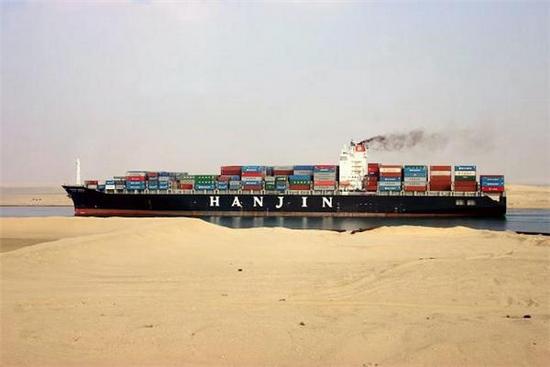
Container shipping through the Red Sea and the Suez Canal could resume on a broad scale during 2026, after more than two years of forced diversions around the Cape of Good Hope due to attacks by Yemen’s Houthi militants. This scenario emerges from an analysis published on 23 December 2025 by Xeneta, which identifies five factors that logistics operators and cargo owners will need to consider when planning future shipments. Any recovery will depend primarily on improved security conditions in the area and on a gradual reduction in the level of risk perceived by shipowners.
Diversions via the Cape have extended transit times between Asia and Europe by 10 to 15 days and absorbed significant capacity, contributing to higher spot freight rates and marked instability in supply chains. According to Xeneta, even if the geopolitical situation improves during 2025, a widespread return to traditional routes is unlikely to take place before 2026.
The first key issue is security. Shipowners, Xeneta notes, will tend to return to the Red Sea only when the risk of attacks is considered structurally reduced, rather than merely under temporary control. Decisions will not be driven by isolated events, but by an ongoing assessment of regional stability, with particular weight given to insurance costs and the conditions imposed by vessel charterers.
A second aspect concerns the impact on capacity. A return to the shorter routes via Suez would free up a significant share of cargo space currently tied up on longer voyages. Xeneta highlights that this effect could quickly translate into excess capacity on the main east–west trades, especially if it coincides with the delivery of new container ships ordered in recent years. In such a scenario, downward pressure on freight rates would be substantial, with particularly visible effects on the Asia–Europe lanes.
The third factor is freight rate volatility. The analysis points out that the shift from a situation of capacity scarcity to one of abundance could occur in a very short time. For shippers, this creates the risk of locking in contracts at freight levels that could become misaligned with the market within a few months. Xeneta therefore urges careful consideration of contract duration and adjustment clauses, especially during the transition towards 2026.
Contract management represents the fourth critical point. After a prolonged period marked by forced diversions and irregular services, the reopening of the Red Sea will once again alter the balance between spot and contract rates. According to Xeneta, shippers will need to strike a balance between cost stability and the flexibility required to adapt to a rapidly changing market. In this context, a larger share of indexed volumes could help reduce the risk of significant deviations from market levels.
Finally, service reliability remains a central issue. A return to Suez routes would improve transit times and schedule integrity, but the initial phase is likely to be characterised by operational reorganisations, changes in rotations and adjustments to alliances between carriers. Xeneta underlines that the benefits in terms of reliability will not be immediate and that, at least in the early stages, shippers will need to continue planning with safety margins.
Overall, Xeneta’s analysis portrays 2026 as a year of transition for global container shipping. A large-scale return to the Red Sea appears likely, but not without operational and market uncertainties. For logistics operators and international traders, the ability to adapt contractual strategies and flow planning will be decisive in a context set to change rapidly.
Pietro Rossoni