







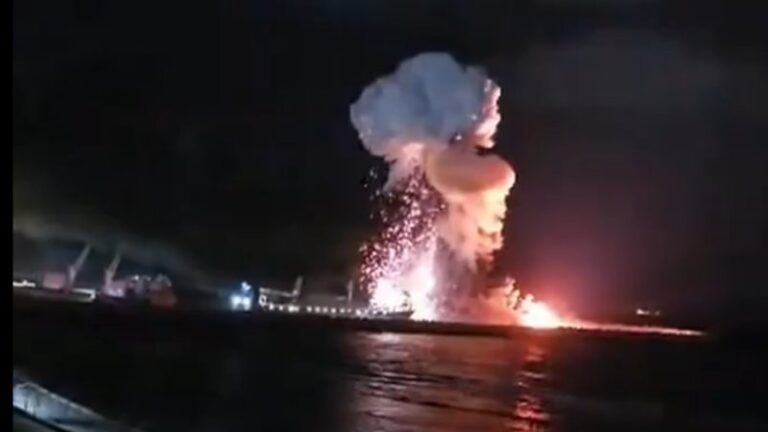
At dawn on 22 November 2026, a series of explosions hit the Benghazi naval base in eastern Libya, an area controlled by Khalifa Haftar’s administration, where the Russian corvette Merkury was moored. That evening, a naval drone struck a ro-ro ship used by Moscow for military transport off the same port. The following day, Ukrainian President Volodymyr Zelensky claimed responsibility, calling it ‘an exemplary Ukrainian operation’. According to Zelensky, seven domestically produced naval drones deployed by the Security Service of Ukraine (SBU) sank the corvette, destroyed the Ka-27 helicopter on board and struck the cargo ship Angara, ‘which the enemy used to transport weapons’. It was the first attack on a Russian warship in the Mediterranean, where only merchant vessels and shadow fleet tankers had previously been targeted. It took place around 2,400 kilometres from the front line, close to Italy.
The Merkury is a Project 20380 (Steregushchiy-class) corvette that entered service in 2023. According to the SBU, it was part of the Black Sea Fleet and regularly escorted Russian convoys, including voyages by the Angara. Libya’s eastern government says the corvette had stopped in Benghazi for fuel and supplies on its way back to Russia under a cooperation agreement with Moscow. Naval News reports that it had been in port for several days and was assigned to escort Russian military cargo ships. Satellite imagery from Vantor shows the ship capsized alongside the quay, with only its bow above water. British maritime security firm Ambrey says some of the explosions at the base were likely caused by ammunition detonating on board. No one was killed in the attack. Medical sources in Benghazi said ten people, among them Russians and Libyans, sustained minor injuries.
Libyan accounts differ, however, on the number of drones used in the attack. Two Libyan officers told the Associated Press that two drones hit the corvette and at least four were intercepted. Eastern Libyan military sources said naval and air forces had neutralised more than 20 drone boats. The SBU said the drones were launched from a mother ship. The identity of the cargo ship also remains uncertain. Kyiv identified it as the Angara (IMO 9179842), a sanctioned Russian ship used to carry military supplies to Syria and Libya. Initial open-source reports identified its sister ship, the Ascalon (IMO 9198226), which left Kaliningrad in late October. Two Libyan military sources had reported a Maltese-flagged ship, possibly mistaking it for a Maltese tanker that was in the area with its AIS transponder switched on. The Libyan navy rescued the crew, and the health ministry said some crew members were in hospital in a stable condition.
Libya’s eastern government, led by Osama Hammad, described the attack as ‘a serious act of aggression against national sovereignty’, opened an investigation with the Russian authorities and asked the UN to launch an international inquiry. Saddam Haftar, deputy commander of the Libyan National Army, called for inquiries into whether military facilities in western Libya had been used to launch drones and whether Ukrainian personnel were present in the country. In September, Tripoli denied CNN and RFI reports of a Ukrainian drone detachment at Misrata air base. Abdul Hamid Dbeibah’s government now says it opposes Libya becoming an arena for international conflicts, while the UN mission in the country (Unsmil) has called for an ‘immediate, independent and transparent’ investigation. Russia’s ambassador to Libya, Aydar Aganin, accused Kyiv of trying to draw third countries into the war and warned that the attack ‘will not go unanswered’. According to The New Arab, a team of Russian military experts arrived in Benghazi to establish how the drones got past the port’s defences. Italy’s foreign minister called for efforts to avert a war in the Mediterranean and expressed concern that the conflict had come within a few hundred kilometres of Italy.
Ships linked to Russia had already been attacked in the waters between Libya, Malta and Crete. In December 2025, the SBU claimed responsibility for an attack on the Qendil, an Omani-flagged shadow fleet tanker that was struck between Greece and Libya and later ran aground on the Turkish coast. On 3 March 2026, a naval drone tore open the hull of the Russian LNG carrier Arctic Metagaz off Malta. It was carrying 61,000 tonnes of LNG. All 30 crew members were rescued, two with burns, and Moscow accused Kyiv of launching the attack from Libya. The Libyan authorities initially reported that the ship had sunk, but it remained afloat. On 22 April, the towline parted some 120 miles north of Benghazi and the wreck went adrift again. In early September 2026, aerial drones dropped explosive devices on the Russian military cargo ship Lady Mariia between Crete and Libya. On 21 November, the day before the Benghazi attack, a drone struck the sanctioned ro-ro ship Sparta II in the Gulf of Finland. All 16 crew members were evacuated, and the Finnish armed forces consider it likely that Ukraine carried out the attack.
Libya has been listed as a high-risk area for years by the London insurance market’s Joint War Committee. Ships calling at Libyan ports may have to notify their insurers and pay additional war risk premiums. In September 2026, the JWC extended its Black Sea listed area to cover almost the entire basin. The Baltic Sea has yet to be listed. So far, the targets have been military vessels or sanctioned ships supporting Russian military logistics. The attacks could also increase the risk to commercial vessels using the same routes or sharing anchorages with Russian ships, regardless of their flag or cargo.
Antonio Illariuzzi