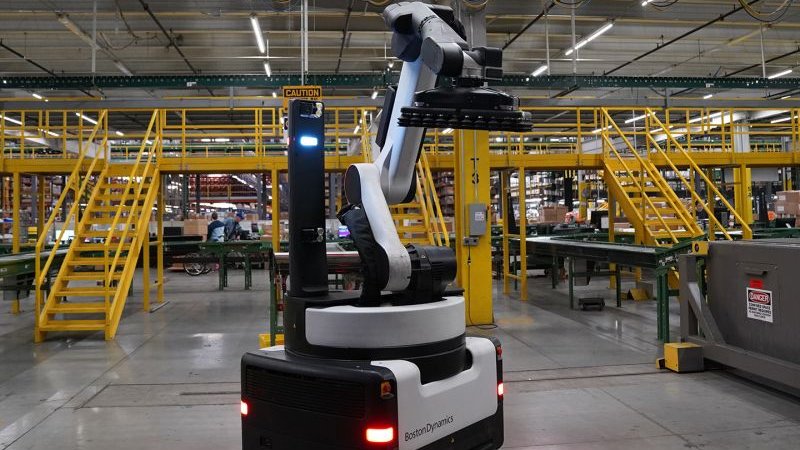





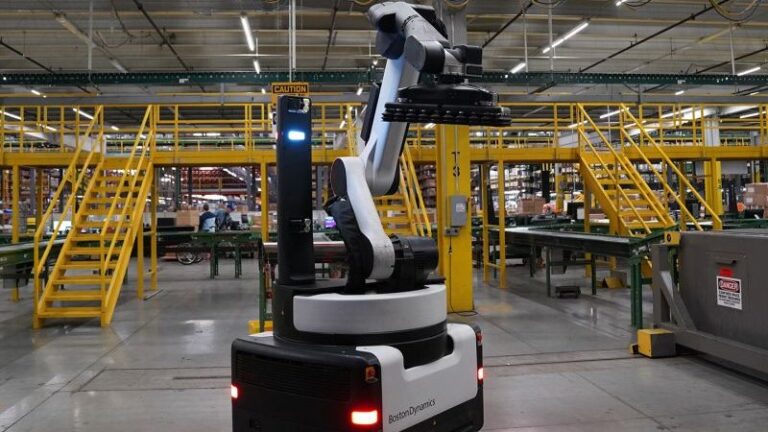
Boston Dynamics removed around 800 metres of cable from inside Stretch when it developed the second generation of its unloading robot, unveiled on 3 November 2026. Internal cabling was cut by 81%, a reduction that Boston Dynamics says boosts productivity and shortens maintenance and repair times. The robot’s job remains the same: picking boxes from trailers and containers and placing them on a conveyor. Stretch is an autonomous mobile manipulator. Its wheeled base carries an arm fitted with a suction gripper, allowing the robot to enter the load compartment and transfer boxes to the conveyor that carries them into the warehouse.
The second generation follows five years of experience with the original. Stretch was unveiled in 2021, and in January 2022 DHL became its first commercial customer with a $15 million investment (around €13 million at the exchange rate at the time). On 31 January the following year, the logistics group announced the first deployment in its warehouses. On 13 May 2025, the two companies signed a memorandum paving the way for more than 1,000 additional units worldwide, with scope to extend their use to full-case picking for order fulfilment. Boston Dynamics says it analysed more than 100,000 hours of operation and data from tens of millions of boxes handled by the Stretch platform. The new model took around two and a half years to develop. The first generation was designed to put a working product into customers’ hands quickly, while the second focuses on simplicity, durability and ease of manufacture and maintenance.
Reducing cable length was the starting point for the redesign. Boston Dynamics identifies wiring and connections as major sources of intermittent electrical faults and wear in the previous generation, as each cable that flexes every time the arm moves is a potential point of failure. The remaining cables are fitted with reinforced automotive-grade connectors with locking mechanisms designed to withstand vibrations from uneven floors and impacts during handling. Hyundai helped Boston Dynamics source a wiring harness through its automotive supply chain. The South Korean group could take full ownership after announcing a deal in July 2026 to buy SoftBank’s remaining stake, subject to the relevant approvals.
The second change concerns Stretch’s arm. Its continuously rotating joints can turn beyond 360 degrees without encountering the mechanical end stops that limited rotation and put stress on components in the first generation. Removing these constraints gives the software more freedom to plan movements along paths that the arm’s physical limits previously ruled out.
For loading dock operators, the most practical change is the new gripper head. Valves and sensors monitor and control each suction cup individually. The system detects which cups have made effective contact with a box and applies suction only to those cups. This has two effects. First, it can speed up unloading. The gripper can lift several boxes in one movement, known as a multipick, and release them individually onto the conveyor. If a substantial part of each cycle is spent moving the arm between the face of the load and the conveyor, carrying more boxes per cycle increases throughput at the same arm speed. The second effect is lower energy consumption, as the vacuum pump no longer draws air through cups that are out of contact with a box.
The second generation also makes servicing quicker. Replacing a complete swerve drive, the module that provides both propulsion and steering for the base, used to take a full day. The new modular design brings that down to around an hour. Standard fasteners mean fewer tool changes, while onboard diagnostics are designed to help customers’ technicians carry out more routine work without waiting for outside support. Boston Dynamics also redesigned the bodywork based on experience at loading docks. The outer panels use more durable materials, and the emergency stop button has been moved lower and recessed. In its previous position, it was more exposed to boxes falling from the face of the load, which could damage the button or stop the robot accidentally.
According to Boston Dynamics, the battery lasts for two shifts and can recharge to 90% in around 75 minutes with the fast charger. Onboard lights allow the robot to work in dark trailers, and a pre-trained vision system recognises most packaging without requiring specific programming at set-up. Boston Dynamics has also updated the electronics. The onboard computing platform has been redesigned to support updates to the detection of boxes, conveyors and container walls, as well as motion planning, gripping strategies and modelling of the surroundings. These updates are released roughly once a month. The latest increased the first-generation fleet’s unloading speed by 24%.
Stretch can unload up to 1,000 boxes an hour, with actual throughput depending heavily on box weight and how neatly the load is stacked. Stretch Gen 2 is already in use at several customer sites and can be deployed in two weeks at a site already using the first generation. DHL first deployed Stretch in North America in 2023 and later extended its use to the UK and elsewhere in Europe. On 9 November 2026, six days after the launch, DHL announced that its Stretch robots had unloaded more than 10 million boxes. The milestone covers the Stretch platform as a whole within DHL Supply Chain’s network, which uses more than 9,000 robots of various types.
P.R.