








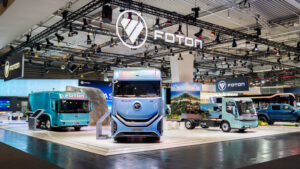
China is at the forefront of electric road haulage, both in the number of vehicles on the road and in the scale and sophistication of its charging network. On 6 November 2026 in Beijing, Foton announced an ultra-fast charging strategy for commercial vehicles that brings together trucks, batteries, charging stations and energy management. CATL, Sunwoda, TELD and Hunan Jingneng are among the members of the industry alliance behind the project. The aim is to build 5,000 stations offering consistent performance.
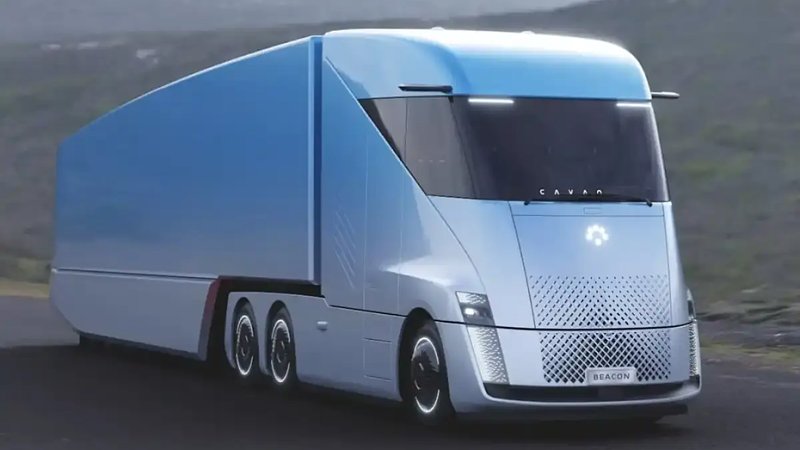
For the Aumark Z electric light commercial vehicle, built on an 800 V platform, Foton quotes peak charging power of 1.05 MW and a maximum charging rate of 8C, taking the battery from 20% to 80% in eight minutes. For the Auman Galaxus and Cavan Beacon medium-duty commercial vehicles, Foton says a 20–80% charge takes 18 minutes, while six minutes of charging can add 100 km of range. The 800 V architecture supports up to 1,000 V and delivers up to 1.5 MW at system level through two 800 A connectors, for a combined current of 1,600 A. Foton puts battery life at more than 6,500 cycles. At IAA Transportation 2026 in Hanover, Foton had already presented a 1.44 MW charging system for the heavy-duty Cavan Beacon, quoting the same figures of 18 minutes for a 20–80% charge and six minutes to add 100 km of range.
The 5,000 stations will provide ultra-fast charging across 368 cities, with priority given to distribution centres, intercity logistics hubs and underserved stretches of major freight routes. The stations will have a 10 kV medium-voltage input and a DC output of up to 1,000 V. They will be able to integrate solar PV, energy storage and load management and can operate as microgrids offering grid services and vehicle-to-grid (V2G) capabilities. The rollout model combines demonstration sites funded and built directly by Foton, joint investment with revenue sharing, and the supply of equipment and solutions to third-party operators that run their own sites. Outside China, Foton aims to have more than 3,000 energy supply units from its own ecosystem installed by 2027 across Asia-Pacific, Latin America, Africa and Europe.
P.R.