







Two significant flight tests took place in China on Saturday 14 November 2026: a turboprop freighter flew with nobody on board, while an electric aircraft carried its pilots for the first time. At Otog Front Banner General Aviation Airport, in the Ordos area of Inner Mongolia, Air White Whale’s W5000 large cargo drone remained airborne for around half an hour, while at Binzhou Dagao Airport in Shandong, Comac’s electric CE-25A carried two pilots and a flight test engineer after nineteen autonomous flights.
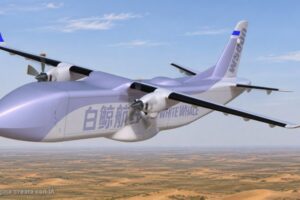
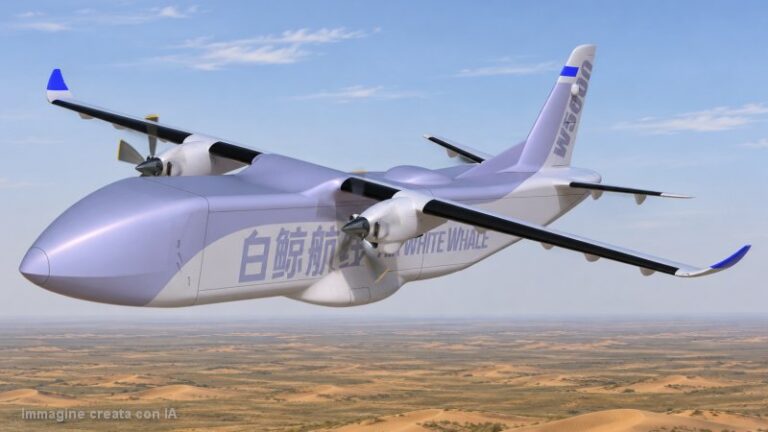
Following a take-off run of around 600 metres, the W5000 climbed to 1,000 metres above airfield elevation at a speed of approximately 220 km/h, before performing level flight, four turns along its programmed flight path, a descent and an approach. The test was intended to verify the aircraft’s controllability and stability, as well as the coordinated operation of its propulsion, flight controls, avionics, telemetry and ground control systems. A quarter-scale experimental model had flown at the same airport in March 2026. The W5000 is a high-wing, twin-engine turboprop with retractable landing gear and a carbon-fibre composite structure, powered by Chinese-developed Aep100 engines. Around 22.9 metres long, with a wingspan of 22.7 metres and a maximum take-off weight of 10.8 tonnes, it offers a cargo hold of more than 65 cubic metres, a five-tonne payload and a range of 2,600 kilometres.
The aircraft operates without an onboard pilot in two modes: autonomous flight and ground supervision. In 2024, the company said a single ground crew could manage up to seven aircraft simultaneously. Founded in 2021, Air White Whale aims to supply the aircraft for regional and interregional freight transport, emergency supplies and, eventually, feeder services linking smaller airports with national and international hubs. Chairman and chief executive Hu Zhendong estimates that its cost per tonne-kilometre will be more than 60% lower than that of a crewed freighter in the same class, thanks to the elimination of the cockpit and lower weight. The target is to begin commercial services by the end of 2027, with planned production of 835 aircraft, each built using 220,000 components, all manufactured in China.
The electric CE-25A’s flight lasted 16 minutes and 38 seconds, covering 60.4 kilometres. Comac is developing the aircraft in partnership with battery supplier Catl and Shanghai Jiao Tong University. Thrust is distributed across ten electric ducted fans positioned above the wing. The aircraft is designed to carry 19 passengers, with a maximum take-off weight of ten tonnes, a cruising speed of 300 km/h at 2,400 metres and a range of 400 kilometres. It is intended for frequent intercity services over distances of 200–400 kilometres. It is not China’s first electric aircraft, however: the AG60E flew in January 2024, while the four-seat RX4E received its type certificate in December that year.
A.M.B.