








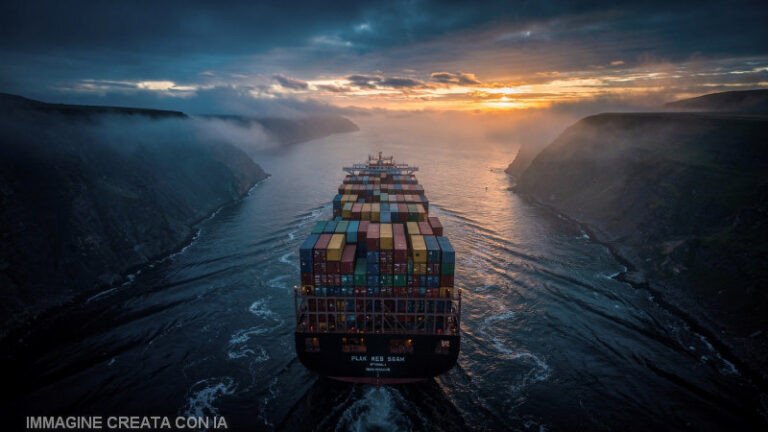
First Israel’s attack on Gaza, followed by the reaction of Yemen’s Houthi forces in the Bab el-Mandeb Strait, and then the joint US-Israeli strike on Iran, which led to the closure of the Strait of Hormuz, have forced shipping lines into structural route changes. In most cases this means a return to the historic Cape of Good Hope route. For now, any hope of bringing container ships back through the Red Sea and the Suez Canal has faded, as the risk of Houthi attacks has not diminished but increased with the third Gulf war. Analysts are now questioning whether this situation is temporary or will lead to medium- to long-term changes, with a growing number favouring the latter.
Drewry’s analysis now clearly refers to a “systemic disruption of container transport”, characterised by bottlenecks, route diversions, rising insurance premiums and freight rates, and broader uncertainty across global supply chains. Sea-Intelligence estimates that a prolonged closure of the Strait of Hormuz could trap more than 200,000 TEU of ocean capacity, triggering cascading congestion at transhipment hubs and gateway ports outside the region.
The reason some analysts do not foresee a rapid return to normal lies in the “accordion” dynamic: Hormuz is not simply open or closed, but subject to brief reopenings followed by renewed tensions. Iran has established danger zones covering the centre of the IMO Traffic Separation Scheme, while the United States has introduced vessel filtering based on ports of origin or destination. This exposes ships to risks that are difficult to insure and makes shipowners and captains extremely reluctant to re-enter the area even during temporary ceasefires. In other words, risk has become permanent and is structurally shaping routing, sourcing and pricing decisions.
It is important to stress that the Hormuz crisis cannot be viewed in isolation. With the Red Sea corridor already compromised by the Houthi threat and military operations along the Bab el-Mandeb–Suez axis, the sector is facing a double bottleneck on the main maritime corridor linking Asia, the Middle East and Europe. What was considered “Suez risk” until 2024 has now become a combined risk that is cutting off entire segments of container flows.
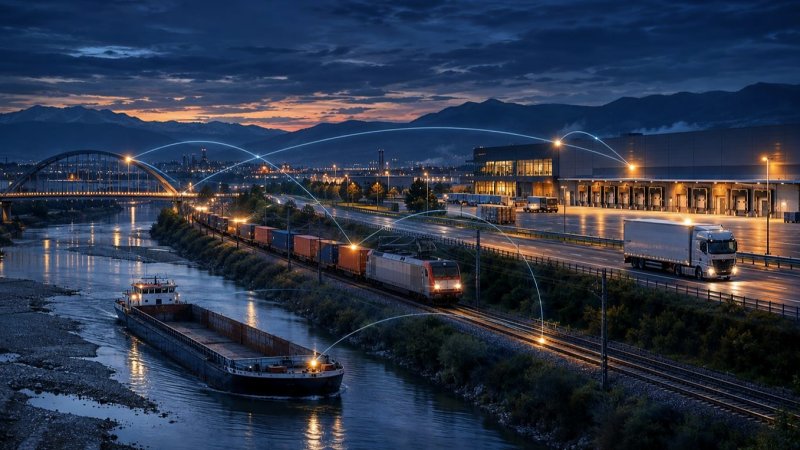
Diversions via the Cape add up to two weeks of sailing time on some routes, reduce effective market capacity and exacerbate imbalances in empty container distribution between ports. At the same time, the industry has begun experimenting with land corridors as partial alternatives: logistics operators have already activated overland connections through Oman, Saudi Arabia and Turkey to reconnect with maritime flows in safer areas. Initially emergency solutions, these routes are gradually becoming standard practice. Logistics companies do not expect a swift return to traditional routes and anticipate continuing to use them even if tensions ease.
A notable example of the ongoing redesign is a new Chinese shipping service linking the port of Qingdao with Egypt and Libya via Port Said, Benghazi and Misurata. According to a presentation by the Julyana Free Zone in Benghazi, this route offers a strategic alternative to Hormuz and reduces sailing time by around ten days compared with previous options, while strengthening trade cooperation between China and North Africa. The decision to develop a dedicated corridor to Libya, outside the traditional Gulf hub system, signals an attempt to redefine Mediterranean gateways for Asian flows, with potential implications for competition among Italian, Greek, Egyptian and North African ports.
The impact on freight rates is already measurable and extends across the entire supply chain. War risk insurance premiums have risen significantly, and these additional costs are passed downstream, increasing landed costs and reducing competitiveness, particularly in price-sensitive sectors. The growing structural volatility of logistics costs is forcing companies to revise price lists, supply contracts and inventory management policies, with knock-on effects on consumer prices and industrial competitiveness. As Drewry notes, this is not simply about “higher” freight rates, but about a new instability that makes transport cost planning unpredictable even over the medium term.
European industries are among the most exposed. Chemicals, metallurgy, automotive, agri-food and large-scale retail are the sectors most affected, all operating with tight supply models or thin margins, where longer lead times and higher costs cannot be absorbed without impacting production or final prices. Diversions lengthen transit times and create port imbalances, particularly damaging supply chains that depend on regular, predictable arrivals. The widespread use of force majeure clauses in contracts may generate long-term effects, including the search for alternative suppliers, renegotiation of terms and persistent misalignments even after maritime traffic returns to normal.
Against this backdrop, current adaptation strategies point towards a deeper restructuring of sourcing models. Many companies are reconsidering inventory levels, moving away from pure just-in-time approaches towards targeted safety stocks for critical products and components. The search for alternative suppliers, including in regions closer to Europe, has become integral to risk management, with some analysts pointing to a partial “regionalisation” of value chains. At the same time, the importance of war risk clauses in logistics contracts is increasing, along with flexibility on discharge ports and demand for carriers capable of operating in crisis scenarios.
The dominant view among analysts is that these changes will persist over several years. Four factors underpin the definition of a “structural change”. The first is the persistence of risk: both straits remain vulnerable, and threats can quickly re-emerge, with no signs of a stable political solution in the medium term. The second is the reconfiguration of maritime geography: the combined Hormuz–Red Sea disruption is driving a lasting shift towards alternative routes, new land corridors and the emergence of different hubs, particularly in the Mediterranean. The third concerns the overhaul of industrial strategies: changes to supply chains, inventory levels, sourcing policies and logistics contracts take years to implement and are rarely fully reversed. The fourth is the new volatility of logistics costs: freight rates and insurance premiums are becoming more sensitive to geopolitical shocks in a market already affected by structural overcapacity.
Michele Latorre