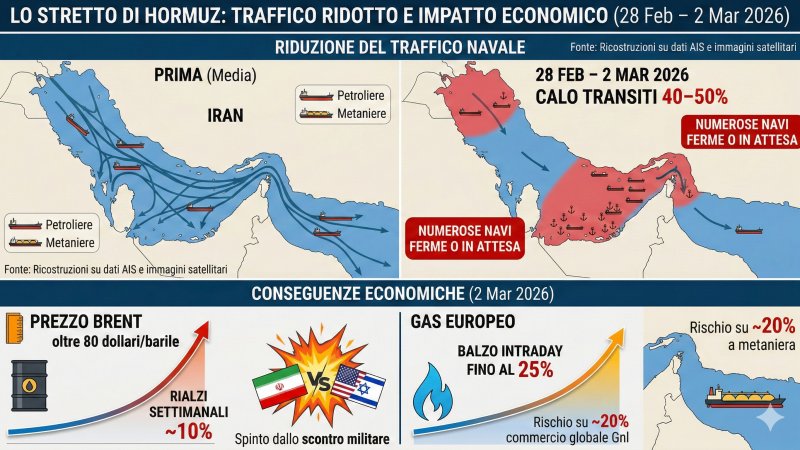





- Between 28 February and 8 March 2026 the British operational centre UKMTO (United Kingdom Maritime Trade Operations) recorded thirteen maritime security incidents in the Strait of Hormuz and the Gulf of Oman, ten of them classified as attacks. Commercial shipping traffic has collapsed to a single transit in the past 24 hours, compared with a normal daily average of 138, despite Trump’s call to resume navigation.
- At least seven seafarers have been killed and several others injured. The International Bargaining Forum has formally designated the area as a warlike operations zone, triggering 100 percent wage bonuses and the right for crews under IBF contracts to refuse assignments.
- More than 600 incidents affecting satellite navigation systems were recorded in the past 24 hours, disrupting hundreds of vessels. War risk insurance cover remains available but only on a voyage-by-voyage basis, with premiums rising sharply after the Joint War Committee expanded high-risk areas. The United States has announced $20 billion in insurance support.
As of 9 March 2029 the Strait of Hormuz remains effectively closed, despite Iranian statements that only US and Israeli vessels would be at risk and President Donald Trump’s invitation to resume navigation. Shipping companies – and above all their insurers – clearly do not trust the assurances from either side and are keeping vessels at anchor in the Persian Gulf. AIS tracking data analysed by the Joint Maritime Information Center (JMIC), a multinational maritime security body established within the US-led Combined Maritime Forces, show that only one confirmed commercial transit has taken place in the past 24 hours. Under normal conditions around 138 ships pass through the strait each day, carrying roughly 20 percent of the world’s oil and a significant share of global liquefied natural gas exports.
Carriers’ caution is confirmed by data from the British operational centre UKMTO, which documented thirteen maritime security incidents between 28 February and 8 March, ten classified as attacks and three as suspicious activity, across an area covering the Persian Gulf, the Strait of Hormuz and the Gulf of Oman. JMIC has raised the threat level to “critical”, warning that the pause in attacks recorded over the past 48 hours should be interpreted as a temporary lull rather than a sign of de-escalation.
The human toll of the crisis is also mounting. At least seven seafarers have lost their lives and several others have been injured, according to Arsenio Dominguez, secretary-general of the Organizzazione Marittima Internazionale IMO (International Maritime Organization), speaking on 9 March at the opening of the subcommittee on ship systems and equipment. Among the victims were four crew members of a tug hit by gunfire around six nautical miles north of Oman while assisting the damaged container ship Safeen Prestige. In a previous incident the tanker Mkd Vyom was struck around 44 nautical miles north-west of Muscat, triggering an explosion and engine room fire that killed one seafarer.
The International Bargaining Forum, the global agreement between maritime unions and shipowners, responded to the crisis by formally designating the Strait of Hormuz, the Gulf of Oman and the Persian Gulf as a warlike operations area. The designation activates several protections for crews under IBF contracts: a wage bonus equal to 100 percent of standard pay, increased compensation in cases of death or disability, and the right to refuse assignment in the conflict zone.
Insurance coverage – the decisive factor in whether ships sail or remain idle – has also tightened. The International Union of Marine Insurance confirmed that war risk policies for voyages in the Persian Gulf remain available, but typically only on a voyage-by-voyage basis and under stricter underwriting conditions, after the Joint War Committee expanded the list of high-risk areas in the Persian Gulf and adjacent waters.
Electronic warfare is adding further complications. JMIC recorded more than 600 incidents affecting GNSS satellite navigation systems in the past 24 hours, including GPS spoofing, AIS anomalies and intermittent signal degradation across the Strait of Hormuz, the Gulf of Oman and the Persian Gulf. Authorities have advised mariners to rely more heavily on radar plotting, visual bearings and cross-checking navigation systems. In practice, however, this significantly complicates operations in a narrow waterway crowded with vessels. Security analysts believe the broader objective of the campaign is to create operational disruption and uncertainty rather than to sink ships.
Some movements in the area are nevertheless taking place, though outside normal tracking visibility. Maritime analytics firm TankerTrackers.com identified six sanction-compliant tankers – two Very Large Crude Carriers, three Suezmax and one Panamax – that had been inactive on AIS for more than 48 hours in waters west of the strait, with declared destinations including China, India and Japan. One of them, the Suezmax Shenlong (IMO: 9379210), later reappeared on AIS in waters approaching Mumbai carrying around one million barrels of Saudi crude, suggesting that some vessels are deliberately limiting AIS transmissions while crossing the high-risk zone.
According to calculations by Lloyd’s List Intelligence, around 44–45 vessels have transited the strait since the start of the month, representing roughly a 90 percent drop in tonnage compared with normal levels. Greek-affiliated vessels appear among the most active in the remaining transits. Bridget Diakun, senior risk and compliance analyst at Lloyd’s List Intelligence, explained that Greek-linked ships currently loaded with oil inside the Gulf are heading towards the strait. If they manage to pass without incident, this could encourage other shipowners and operators to reassess their risk calculations, Diakun said, though much will depend on how the situation evolves.
The crisis is also reverberating through energy markets and global supply chains. India, which imports about 90 percent of its crude oil – nearly half from the Middle East – holds reserves covering only around thirty days due to the short transit times involved. US Treasury Secretary Scott Bessent has announced a waiver allowing New Delhi to purchase Russian crude, with the aim of keeping oil flowing to global markets without, according to US authorities, providing significant financial benefits to the Russian government. South Korea, the main supplier of aviation fuel to the US west coast, held an emergency meeting on Sunday to discuss the possible use of national strategic petroleum reserves to contain domestic petrol prices. Roughly 70 percent of Seoul’s crude imports pass through the Strait of Hormuz.
As noted, US President Donald Trump has urged shipowners not to abandon the route. “These ships must pass through the Strait of Hormuz and show a little courage,” he said in an interview with Fox News. The administration’s position is based on the belief that military operations conducted against Iran have severely weakened Tehran’s maritime capabilities. Shipowners, however, continue to assess the resumption of voyages with caution: missile and drone attacks, explosions of unclear origin and documented sabotage techniques have shown that civilian vessels can quickly become collateral targets in a regional conflict.
M.L.