




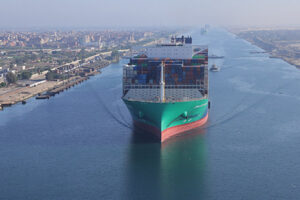

Freight transport faces a sharp rise in costs following the US and Israeli attack on Iran, amid severe restrictions that could amount to the closure of the Strait of Hormuz, a chokepoint through which one fifth of the world’s extracted oil and natural gas transits. On the morning of 1 March 2026, Tehran responded through the Islamic Revolutionary Guard Corps, announcing by radio that passage was dangerous and ordering vessels not to transit. Although the measure has not been formalised as a naval blockade under international law, it has led to an immediate reduction in maritime movements and a rise in the oil risk premium ahead of the reopening of markets.
According to Bloomberg and semi-official Iranian media, the Strait has been described as “effectively closed”, with warnings broadcast to vessels under way. AIS tracking data show container ships and tankers turning back or waiting outside the area, while some units continue to transit under conditions of heightened uncertainty. The area concerned is the corridor between Iran and Oman linking the Persian Gulf to the Gulf of Oman. The annual value of energy flows passing through Hormuz exceeds 500 billion dollars. The strategic importance of this passage leaves the global economy exposed to any disruption, even temporary. Saudi Arabia, the United Arab Emirates, Qatar, Kuwait and Iraq depend almost entirely on Hormuz to export crude, refined products and gas to Asia, Europe and the United States.
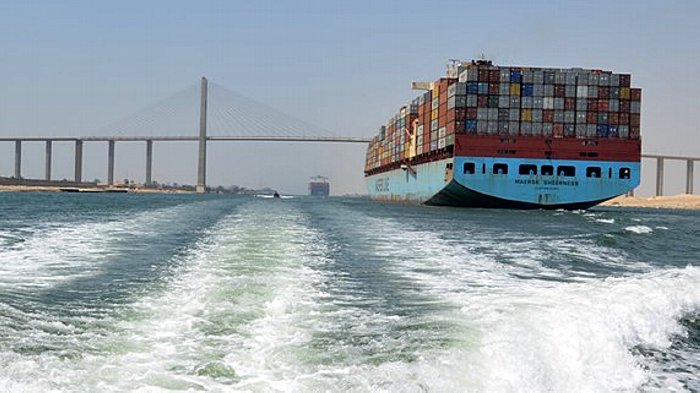
Several shipping companies have suspended transits in the area for security reasons, including container services. Hapag Lloyd announced a halt to sailings through Hormuz following the Iranian communication. ICIS notes that any effective curb on energy flows will drive up insurance premiums for vessels operating in the Persian Gulf and the Gulf of Oman, with immediate effects on freight rates.
The most immediate impact, however, is on energy markets. At the close on Friday 28 February, Brent stood at around 72 to 73 dollars a barrel, already at six to seven month highs due to the war risk premium accumulated in previous weeks. With trading resuming in Asia between the evening of 1 March and the morning of 2 March, crude could rise by 6 to 8 dollars a barrel, quickly moving into the 80 to 85 dollar range if the closure persists or flows are significantly disrupted.
Other scenarios point to prices above 100 to 110 dollars if the blockade were prolonged or resulted in even a 20 to 30 per cent reduction in volumes transiting the Strait. Crude futures, which had already climbed back towards 67 dollars a barrel in previous days, are expected to open sharply higher when US trading resumes, with movements linked to the duration and intensity of the Iranian threat.
Iran produces around 3.3 million barrels per day and, although 2026 is characterised by relatively ample global supply, even a partial removal of Iranian output and compression of transits via Hormuz could push the market into deficit. In this context, Opec+ may be called upon to review production policies, while importing countries assess the use of strategic reserves to cushion the impact on domestic prices.
Price dynamics reflect not only the physical reduction in volumes but also a reassessment of Middle East risk. Bloomberg notes that Tehran may not aim for a total and prolonged closure, which would also damage its own exports, but rather for intermittent management of the threat, keeping the risk premium elevated without fully interrupting flows. This strategy allows pressure to be exerted on the global economy and the United States without assuming the burden of a permanent blockade.
Macroeconomic effects will depend on the duration of the crisis. Oil sustained above 100 dollars could reignite energy inflation and weigh on growth, raising the risk of a shock similar to past supply disruptions. The impact would be particularly severe for low income countries that are net energy importers, with limited foreign exchange reserves and high exposure to increases in electricity, transport and essential goods prices.
As of the morning of 1 March 2026, with Western markets still closed, much of the oil price increase remains embedded in expectations and the risk premium. The full effect will become clear with the opening of Asian markets and, subsequently, European and US trading. The trajectory of prices will depend on the next 24 to 72 hours: the continuity of the blockade, any further military action and the ability of operators to restore at least part of the flows through one of the world’s most strategic maritime passages.
P.R.