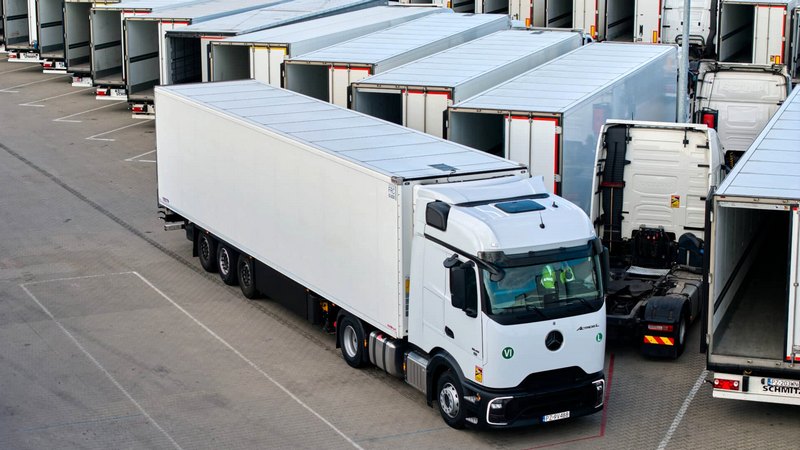



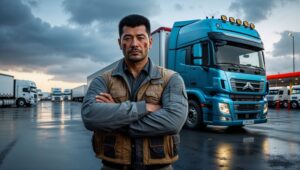
A 35-year-old driver from Tajikistan, employed by a haulage company based in Lithuania, has been parked for around two weeks at a service area along the A1 motorway in the Netherlands. The protest began in early February 2026 and consists of a refusal to continue the journey and deliver the cargo, pending payment of wages that the driver says he has not received.
The lorry driver says he was paid only for the first two months of work, after which payments were drastically reduced or did not arrive at all. For this reason, he is exercising a “right of retention” over the cargo until he receives what he is owed, which according to the Dutch trade union FNV would amount to 60–100 euros per day. In retaliation, the haulage company remotely disabled the truck’s engine, depriving him of heating. The company has also reported him for alleged misappropriation of the vehicle, but the Dutch authorities have not taken action on that basis.
Reports also refer to an attempted assault: several individuals allegedly tried to enter the cab and drag the driver out, presumably to regain control of the vehicle. Three police patrols intervened and the driver is now living permanently in the cab in difficult conditions. He says he feels as if he is in prison and is using a gas stove to keep warm, with obvious safety risks. FNV is providing food and basic necessities and is supporting the case legally, while the Dutch police are monitoring the area to ensure safety and prevent tensions. The union is also informing the haulage company’s clients about the situation in order to increase pressure.
At the centre of the dispute is a demand for a transparent calculation of accrued entitlements: hours worked, travel allowances, bonuses and back pay. The driver reports a lack of clear documentation regarding payslips and the sums due. The refusal to deliver the goods has therefore become a means of exerting pressure on the Lithuanian carrier, formally his employer, but part of a transport chain involving clients in Western Europe.
The case fits into a broader pattern of tensions over the past two years involving drivers from Central Asia recruited by companies in Central and Eastern Europe to operate on a long-term basis in Western Europe. Also in the Netherlands, in Venlo, four Central Asian drivers staged a protest for weeks in a guarded car park in 2025. In another incident, an Uzbek driver employed by a Lithuanian company stopped his truck, again in the Venlo area, over unpaid wages. That case led to parliamentary questions in the Netherlands and a written question to the European Parliament.
Significant is the recognition by the Dutch Labour Inspectorate of at least one case as human trafficking, involving an Uzbek driver. In such cases, FNV explicitly speaks of human rights violations and conditions akin to “modern slavery”, opening a political as well as trade union front. These precedents point to a recurring model: recruitment in non-EU countries, a contract with a carrier registered in Eastern Europe, permanent operations in the Netherlands or Austria, and contested pay and living conditions.
The core issue remains responsibility along the subcontracting chain. The use of companies registered in lower labour cost countries allows Western European clients to contain operating costs, formally shifting wage and social security obligations onto the contractual carrier. Under the European regulatory framework, rules on the posting of workers in transport and the application of the host country’s minimum wage should guarantee minimum protection when activity is carried out on a stable basis in the Netherlands. In practice, however, enforcement depends on the ability of inspection authorities to verify contracts, driving and rest times, wage documentation and the relationship between principal contractor and subcontractor.
Antonio Illariuzzi