




CargoBeamer boosts Domodossola–Liège service
CargoBeamer has doubled the frequency of its intermodal rail service between Domodossola and Liège, increasing operations on the route to six round trips per week. The link, launched in January, was strengthened from the beginning of February, consolidating the operator’s presence along the Alpine–Belgian corridor. The Liège route complements existing services from Domodossola to Kaldenkirchen and Stuttgart, open to all types of semi-trailers. The launch of the Liège line also marks the company’s entry into the Belgian market, expanding its operational footprint in a strategic hub for European logistics flows. The service is also targeting traffic left without alternatives following the suspension last December of the Novara–Freiburg rolling motorway. The new Domodossola–Liège link is intended to absorb part of these volumes, shifting them to unaccompanied intermodal transport.
Trieste–Hungary rail agreement
A new rail agreement between Trieste and Hungary strengthens the development path of Adria Port, the Hungarian terminal currently under construction in the Friuli Venezia Giulia port. Adria Port Zrt has signed a strategic cooperation agreement with Gysev Cargo Zrt to activate a rail connection between the port of Trieste and the Hungarian market, with the aim of establishing a regular rail service between the Northern Adriatic and Hungary. The agreement was signed by Péter Garai for Adria Port and by András Riegler and Péter Tisza for Gysev Cargo. The project includes the construction of a dedicated Hungarian terminal within the port of Trieste, which will serve as a direct maritime gateway for the country’s trade. Last week, Adria Port’s management attended a technical meeting in Budapest with the Maritime Transport Committee of the Magyar Szállítmányozók Szövetsége (Association of Hungarian Freight Forwarders) and with the Association of Hungarian Danube Ports, held at the headquarters of Budapest Freeport Logistics. During the meeting, participants reviewed the progress of the project, the terminal’s development model and potential integration with the Hungarian logistics system. Discussions with freight forwarders and operators focused on rail connections, planned capacity and the integration of Hungarian flows into existing maritime services in Trieste, with the objective of building an integrated logistics chain linking port, rail and the domestic market.
First fully automated container ship berthing in Qingdao
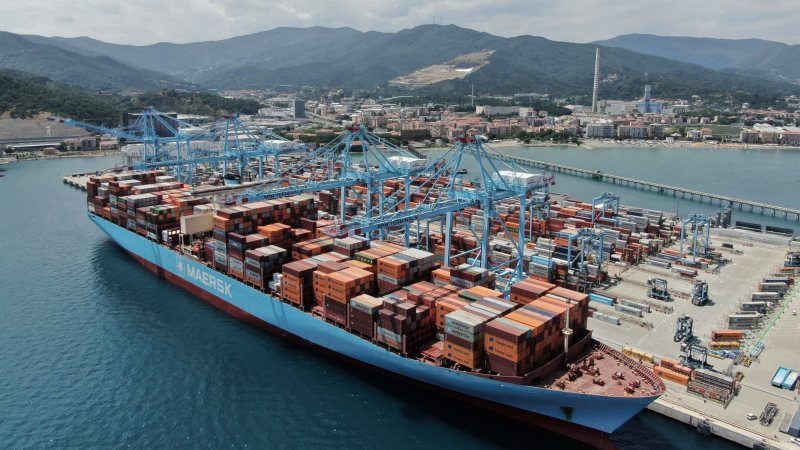
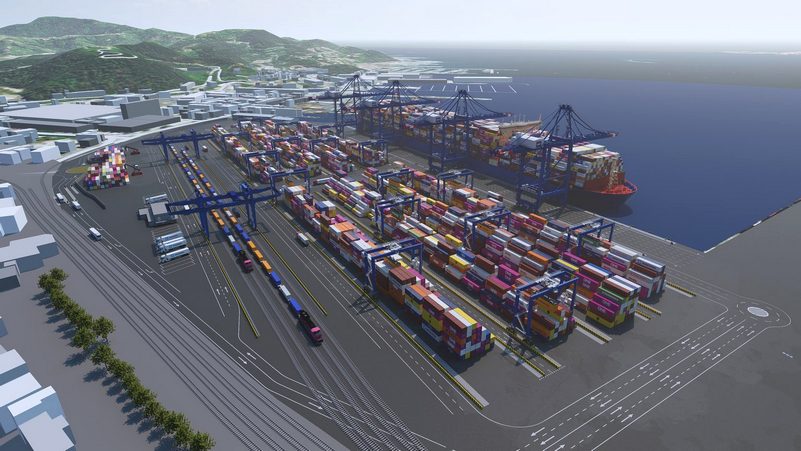
On 21 February, the container ship Zhi Fei berthed at the automated quay of Qingdao port, in Shandong province, completing the entire process in unmanned mode. It marks the first fully automated cycle in the country covering navigation, berthing and port operations for a container vessel. Berthing was carried out with precision through autonomous guidance systems and hull securing using vacuum mooring technology, without manual intervention. The entire mooring operation was completed in less than thirty seconds. After berthing, the automated handling facilities operated in coordination. The terminal’s intelligent control and management system A-Tos and the intelligent equipment control system A-Ecs, both developed in-house, directed the automated quay cranes and automated guided vehicles, enabling container loading and unloading operations. Zhi Fei is the first Chinese merchant vessel with intelligent navigation capability, equipped with a domestically developed system and three operating modes: crewed navigation, remote control and unmanned navigation. The project integrates vessel and terminal into a single digital architecture for the full automation of port operations.
Algeciras digitalises truck access
The Tti terminal at the port of Algeciras is introducing a truck booking system, becoming the first container terminal in Spain to adopt a structured digital solution for managing landside access. The system enables advance planning of flows, with the aim of reducing waiting times and optimising gate and terminal resource capacity. Bookings are managed at vehicle level, linked to licence plates and automatically validated on arrival, with checks on punctuality, no-shows, cancellations and peak time slots through quality indicators. The initiative forms part of a broader digitalisation process launched in recent years, including the introduction of the Vgm weighing service at the gates and system upgrades to improve landside process efficiency. Transport orders remain unchanged, and the system acts as an additional digital layer for haulage companies. Booking slots last thirty minutes and allow multiple orders to be handled in a single visit. The platform is already operational at several Northern European terminals with higher gate volumes than the Andalusian port, providing a benchmark for its implementation in Algeciras. The project was developed in collaboration with Passify, a German technology company specialising in the digital coordination of truck flows at container terminals. The testing and fine-tuning phase also involved the Algeciras Bay Container Transport Association and its member companies, adapting the system to local operational requirements.
Medway invests in French rail
Medway, a subsidiary of the Msc group, is strengthening its presence in the French rail market with an investment of around €45 million for the purchase of eight locomotives and 350 intermodal wagons dedicated to services in France. The new units are expected to be Stadler Euro6000 locomotives, adding to the 16 already ordered in 2021 for Spain and Portugal. The operational launch in France forms part of a broader expansion strategy along the Iberia–France–Central Europe axis. In December 2025, Medway France started its first commercial services between Caffiers and Dunkerque, operating trains of up to 3,600 tonnes of raw materials for the steel industry. The Euro6000 are Co-Co electric locomotives with power output exceeding 6 MW and tractive effort of up to 500 kN, approved for operation in France, Spain and Luxembourg. They can operate at 1.5 kV DC, 3 kV DC and 25 kV AC, ensuring interoperability across different electrified networks. The move is part of Msc’s vertical integration strategy, aimed at direct control of rail assets to connect ports, inland terminals and industrial customers. In France, the core hub is the Paris-Bruyères trimodal terminal, developed by Medlog to integrate rail, inland waterways and road transport. The expansion completes a process already under way with strengthened links between Spain and France and industrial agreements designed to consolidate continuous intermodal flows towards Northern Europe.