






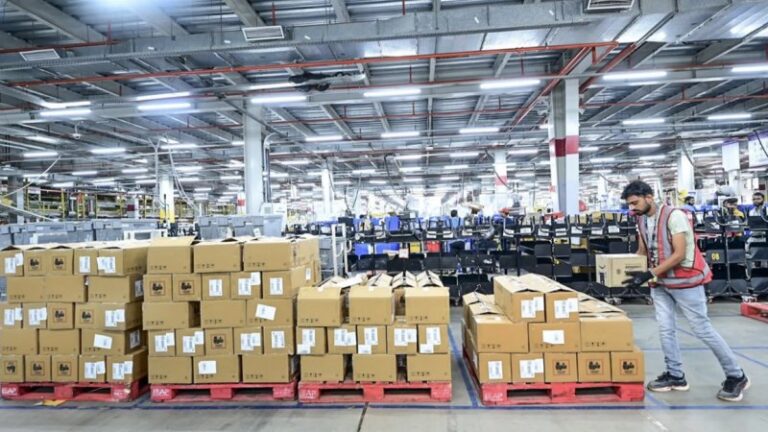
Amazon announced in New Delhi, during the sixth Amazon Smbhav Summit at Bharat Mandapam, an investment plan worth $35bn (around €32bn) in India by 2030. This will be added to approximately $40bn already invested since 2010 (around €37bn), bringing the company’s total stated commitment to $75bn (around €69bn). The programme will be developed along three operational lines with direct implications for logistics: artificial intelligence capabilities, export growth driven by e-commerce, and increased employment across the supply chain.
The timing places Amazon within a closely spaced sequence of Big Tech announcements in India. The most recent came on 9 December 2025, when Microsoft unveiled plans worth $17.5bn (around €16bn) over four years, reinforcing the perception of accelerating competition in cloud, computing and artificial intelligence applications. For logistics, this context is significant because the expansion of e-commerce and rapid delivery services increases demand for warehousing, sorting and last-mile capacity, while the evolution of cloud services drives investment in data centres and connectivity that also act as enabling infrastructure for traceability, planning and optimisation of distribution networks.
The announcement was coordinated by Amit Agarwal, Senior Vice President for Emerging Markets, with a message linking Amazon’s expansion to Indian industrial policy priorities on digitalisation and self-reliance. Samir Kumar, Country Manager of Amazon India, outlined the goal of reaching $80bn in cumulative e-commerce-enabled exports by 2030 (around €74bn). Russell Grandinetti, Senior Vice President International Stores, added that India serves as a laboratory for solutions that can be replicated globally, a point that in logistics terms tends to translate into experimentation with urban warehouse models, automation and new delivery promises.
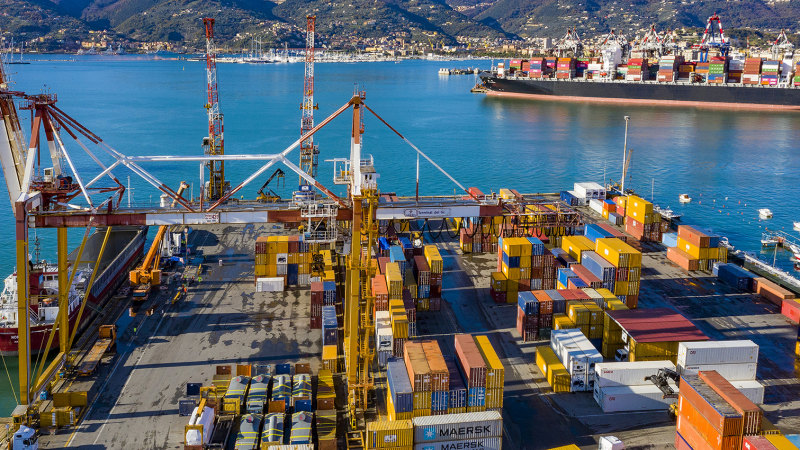
The geographical scope of the investment is nationwide, although some hubs carry greater weight. For transport and logistics, the core of the programme is the expansion of the physical network. Amazon operates in India with more than 100 fulfilment centres across 15 states. In 2025 it launched new facilities in strategic areas including Delhi Ncr, Bengaluru, Kolkata, Nagpur, Thane, Visakhapatnam, Hubballi, Hooghly, Hyderabad, Tiruvallur and Krishnagiri, supporting a network that also includes sortation centres and around 1,950 delivery stations operated directly or in partnership with local players.
Within the same proximity-driven logic, Amazon has developed its ultra-fast delivery channel. The Amazon Now service, rolled out progressively from January 2025, has led to the opening of more than 100 micro fulfilment centres in the pilot cities of Bengaluru, Mumbai and Delhi, with monthly growth in daily orders of 25%. For urban logistics this implies a different network architecture, with distributed inventory, higher replenishment frequencies and a greater reliance on short-haul transport. In this context, a relevant regulatory element has emerged: in January 2026 the Indian Government asked e-commerce platforms to abandon fixed delivery timeframes, a move that could change how customer promises, shifts, picking capacity and last-mile sizing are designed.
Amazon frames its commitment as aligned with national priorities on exports and the digitalisation of micro, small and medium-sized enterprises. According to an Economic Impact Report by Keystone Strategy, between 2010 and 2024 the Amazon ecosystem contributed to the digitalisation of more than 12 million businesses and enabled $20bn in cumulative exports (around €18bn), while supporting 2.8 million jobs in 2024 across direct, indirect, induced and seasonal roles. The stated target for 2030 rises to 3.8 million, according to Investment Monitor, with expected effects on related value chains such as transport, packaging, manufacturing and services. From a logistics perspective, rising export volumes imply both greater consolidation and customs management capacity, and increased pressure on service quality.
Exports are also channelled through supply chain initiatives, with on-the-ground onboarding activities in more than ten manufacturing clusters, including Tirupur, Kanpur and Surat, and collaborations with the Apparel Export Promotion Council Of India and the Directorate General Of Foreign Trade under the Districts As Export Hubs initiative. In this framework, logistics is not an ancillary element: the ability to manage labelling, compliance, packaging, shipping standards and international delivery networks becomes part of the value proposition for manufacturers and sellers.
Market conditions help explain the scale of the plan. Amazon competes directly with Walmart-owned Flipkart and express commerce operators, alongside local groups such as Reliance. Projections cited by Retail Insight Network place the Indian e-commerce market at $211.6bn in 2025 (around €195bn) and up to $1,156.8bn by 2030 (around €1,064bn), with compound annual growth rates above 20%. In parallel, Business Standard points to an internet user base close to 900 million by 2025, expanding the potential market but also making logistics coverage more complex, as growth extends into non-urban areas where infrastructure and delivery density differ from major cities.
A further growth driver is the adoption of artificial intelligence as an operational lever. Even without detailing individual digital products, the impact on logistics and warehousing is expected to focus on forecasting, inventory allocation and orchestration of flows between fulfilment centres, delivery stations and urban micro hubs, with effects on vehicle utilisation, transit times and peak management.
M.L.