







Mercedes-Benz Trucks announced on 3 September 2025 that the five GenH2 Truck units deployed with Air Products, Amazon, Holcim, Ineos Inovyn and Wiedmann & Winz had together passed the significant milestone of 225,000 kilometres. These are electrically driven trucks whose electricity is generated by hydrogen fuel cells, and the German manufacturer entrusted them to the five operators for everyday transport duties. The vehicles have been used in real-world conditions on a variety of routes in Germany, recording average hydrogen consumption between 5.6 and 8 kilograms per 100 kilometres with gross vehicle weights ranging from 16 to 34 tonnes. They completed 285 refuellings at the Woerth am Rhein and Duisburg stations, consuming around 15 tonnes of liquid hydrogen in total. The decision to use liquid hydrogen proved crucial, as its higher energy density delivers ranges in excess of 1,000 kilometres and refuelling times of just ten to fifteen minutes—parameters that make the GenH2 directly comparable to diesel trucks in operational terms.
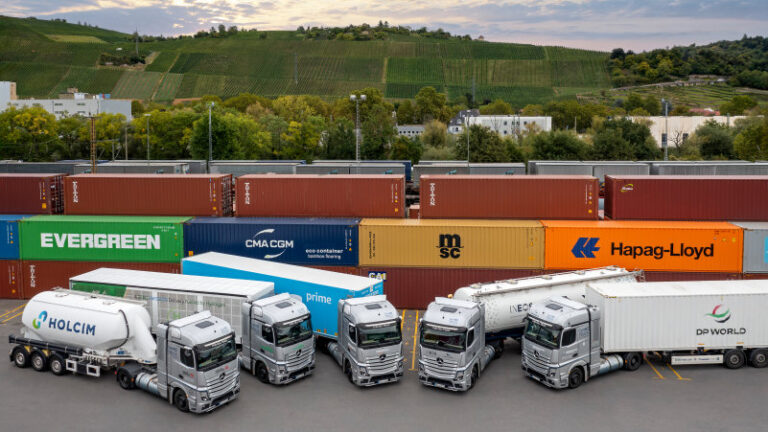
The trials covered a broad spectrum of applications. Amazon deployed the trucks on dedicated routes between its logistics centres, Air Products used them to transport gas in cylinders, Wiedmann & Winz operated them in combined container transport on behalf of DP World, Holcim tested them in cement distribution across Germany and the Netherlands, while Vervaeke, partner to Ineos Inovyn, employed the vehicles for the transport of PVC and vinyl. Mercedes says the hydrogen trucks integrated smoothly into daily operations in all these settings, delivering reliability and flexibility. Drivers praised the quietness, the dynamically delivered power and the driving comfort, attributes that help make the technology immediately familiar compared with conventional vehicles. Michael Scheib, head of vehicle development at Mercedes-Benz Trucks, emphasised the value of the tests, noting that real-world use has demonstrated performance, reliability and efficiency while producing valuable data to refine the technology ahead of series production.
Positive feedback does not, however, remove the remaining challenges. The state of the refuelling infrastructure remains a central issue and is still insufficient to support large-scale roll-out. By 2030 Europe will need at least two thousand hydrogen refuelling stations to enable mass adoption of fuel-cell trucks. Cost is another hurdle: at present the total cost of ownership (TCO) is not competitive with diesel because of the high purchase price of the vehicles, the cost of hydrogen and insurance premiums.
Despite these difficulties, Daimler Truck is looking ahead. A second phase of trials is scheduled from the fourth quarter of 2025 involving five additional customers, and the Woerth plant is already preparing for small-series production: one hundred fuel-cell vehicles will be assembled and put into service from 2026. The company’s overall strategy remains two-pronged, focusing on both battery and hydrogen vehicles. Full industrialisation of fuel-cell trucks is, however, expected only in the early 2030s, by which time infrastructure and costs are projected to support a mature market.