





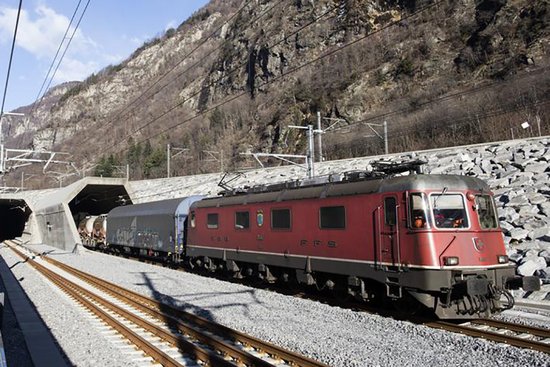
The Gotthard Base Tunnel has marked its first ten years in operation. Inaugurated on 1 June 2016, initially carrying only freight trains during final commissioning, the tunnel beneath the Swiss mountain massif was fully opened to passenger traffic on 11 December that year. The base tunnel immediately became a key element of the transalpine railway project through Switzerland known as AlpTransit. The benefits were immediate, both for high-speed passenger services and freight traffic. Its less steep alignment allows heavier trains to operate without the previous loading-gauge constraints affecting intermodal transport, while also increasing the network’s overall capacity.
Yet despite these clear advantages, the railway’s tenth anniversary has not been greeted with unqualified optimism. Operators and railway undertakings in particular point to both achievements and shortcomings. The new transalpine railway was approved in two popular votes, held in 1992 and 1994, with the aim of shifting traffic from motorway to rail. Despite the progress made in recent years, however, modal shift is now struggling and freight traffic is returning to the road.
According to Pro Gotthard-European Railway, the project remains unfinished because the northern and southern access routes towards Milan are still missing, as are bypasses around Bellinzona and Lugano. In other words, what appear to be genuine bottlenecks remain unresolved. Its future is also clouded by two uncertainties: the financial resources available to the Swiss railway system for new infrastructure remain limited, while national policymakers continue to show little interest in completing the network of connections linked to the AlpTransit project.
In addition to calls from operators, the completion of AlpTransit was supported by the Grand Council, the parliament of Canton Ticino, in a unanimous resolution on 23 May 2023. On 5 May 2026, it also secured the backing of the Southern Alps Alliance, whose members include Lombardy, Piedmont and Liguria. Despite this, the Council of State of Canton Ticino is struggling to agree on the united position needed to press its case effectively. This plays into the hands of the Federal Council, the Swiss government’s executive body, which, pulled by conflicting interests, continues to defer completion of the transalpine railway corridor to the distant future, possibly even towards the end of the century.
Amid all this, rather than providing clarity, the Federal Council’s guidelines for expanding railway infrastructure, known as the Transport ’45 report, leave priorities undefined. The report is based on an analysis by the ETH Zurich, prepared by Professor Ulrich Weidmann. According to the interest group SwissRailvolution, the study merely indicates which proposed projects should be treated as priorities, without assessing their value or their impact on the railway network as a whole. Unless policymakers adopt a long-term service strategy that moves beyond a project-by-project approach, there remains a risk that questionable investments will proceed simply because they have more influential backers.
For freight transport, there is a clear need to identify the most suitable solutions for encouraging a shift to rail. Operators argue that the focus should not be limited to connections along Switzerland’s east-west axis, which has so far received greater attention at federal level. North-south links must also be prioritised as the backbone of rail transport integrated into the wider European network.
Piermario Curti Sacchi