








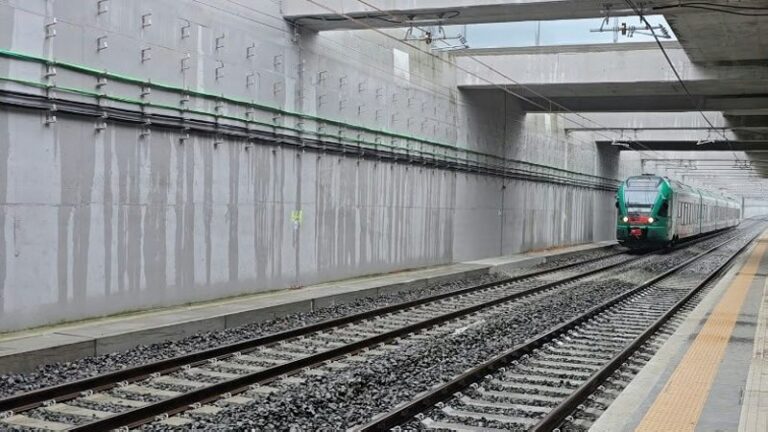
After 27 years of planning, construction starts and suspensions, and seemingly endless works, an 850-metre double-track underground railway tunnel opened to traffic in Ferrara on 10 November 2026, replacing the historic surface route south of the city. The project permanently removes two level crossings that had caused considerable road congestion, while improving rail connections towards Ravenna and Rimini. Alongside the benefits for passenger services, the upgrade to the Ferrara rail junction is significant for future freight traffic between the port of Ravenna and the Brenner corridor. This first phase involved a total investment of almost €70 million, largely funded by the state, with a contribution from the Emilia-Romagna regional government and smaller amounts from Rfi and Ferrara City Council.
The project dates back to June 1999, when an agreement was signed between the Ministry of Transport and Ferrara City Council. Its delivery was marked by a complex planning and administrative process, compounded by the collapse of several contractors. The breakthrough came only in May 2020, when Fer-Ferrovie Emilia-Romagna, acting as the contracting authority and concession holder for one of the lines involved, secured a lasting resumption of construction. Rfi, the national rail infrastructure manager, connected the signalling and control systems for the new underground tracks to Ferrara station’s central control system and decommissioned the former route at the same time. The project involved upgrading traffic management equipment, signalling and safety systems throughout the Ferrara junction.
The project’s significance extends beyond the local area: opening the underground tunnel is a prerequisite for developing rail freight and integrating ports and railways within a wider network, including connections to the rest of Europe. This is the purpose of the second phase of works at the Ferrara junction, where design work on a freight rail link is already under way. The project to complete the upgrade of the entire junction centres on a direct connection between the FS-managed Rimini–Ravenna–Ferrara railway and the Ferrara–Poggio Rusco–Suzzara line, operated under concession by the regionally owned Fer-Ferrovie Emilia-Romagna.
The connection includes a long underground section passing beneath the Bologna–Padua main line without conflicting with its traffic. Freight trains travelling to or from the port of Ravenna along the final section of the Rimini–Ferrara line will be able to use the future direct connection to the line for Poggio Rusco, a station on the Bologna–Verona route and therefore on the Brenner corridor. As well as avoiding crossings with other railway lines, the link will remove the need for freight trains to reverse at Ferrara, for drivers to change ends and for shunting movements to occupy the station’s track layout. The approximately 47-kilometre Ferrara–Poggio Rusco line was modernised in the 1980s through alignment improvements and electrification, effectively turning it into a freight route across the central Po Valley offering an alternative to the busier main lines through Bologna and Padua. By creating a new direct Ravenna–Poggio Rusco route, the Ferrara junction project strengthens the role of the Ravenna hub in freight traffic with Germany and central Europe, particularly ahead of the Brenner corridor upgrade, including the new base tunnel and the first sections to be expanded to four tracks in both Italy and Austria.
Piermario Curti Sacchi