





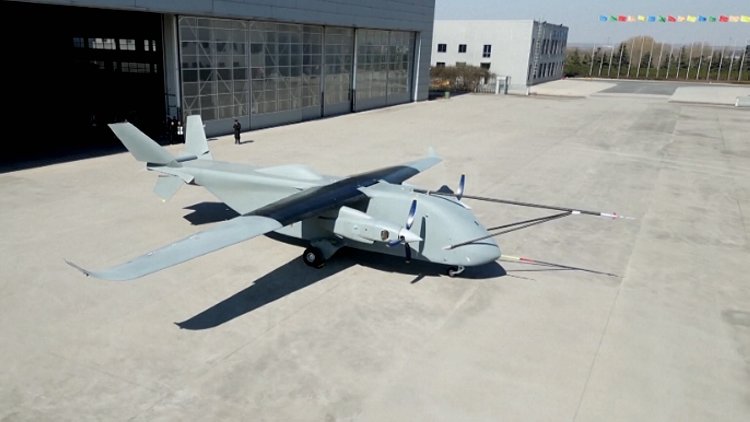
At the end of March 2026, China carried out the inaugural flight of the Changying-8, an unmanned aircraft designed for heavy cargo transport. The test took place at Zhengzhou Shangjie Airport in Henan province. The project has been developed by Beijing Beifang Changying Uav Technology and, according to Xinhua, represents China’s first UAV cargo platform in the 7-tonne class validated through flight testing.
Specifications released by official sources place the aircraft at the upper end of the unmanned transport segment. The Changying-8 has a maximum take-off weight of 7 tonnes, a payload capacity of up to 3.5 tonnes and a cargo hold volume of 18 cubic metres. Its declared range exceeds 3,000 kilometres, although, as noted in the same communications, this should be regarded as a design performance rather than a fully validated operational figure. The aircraft can take off in around 280 metres, suggesting potential use at secondary or less developed airport infrastructure.
The Changying-8 is designed to cover a broad range of logistics missions. Sources indicate medium- and long-range freight transport, delivery of emergency supplies, resupply of remote or border areas, and operations in environments characterised by complex terrain. It is also intended for cold chain logistics and the transport of perishable goods, a segment where speed and continuity in the supply chain are critical factors.
The programme launch forms part of the broader development of the so-called low-altitude economy, a strategic direction in Chinese planning aimed at leveraging lower airspace for logistics, industrial and service applications. The Changying-8 is conceived as a platform capable of supporting both commercial logistics and emergency operations, contributing to the creation of a transport network that is alternative or complementary to traditional systems.
Within this narrative sits the claim that the Changying-8 is “the largest cargo drone in the world to have carried out a maiden flight”. However, this definition leaves room for ambiguity. Sources do not clarify whether the reference relates to maximum take-off weight, payload capacity or other technical parameters. In some English-language versions, the wording is softened to “world’s heaviest cargo drone of its class”, implicitly limiting the distinction to the 7-tonne category. It should also be noted that the lack of systematic comparison with other drone programmes, whether civilian or military, makes independent verification of this global claim difficult. In the aeronautical sector, many high-end projects feature incomplete or non-public data, complicating efforts to establish objective rankings.